Featured

Week 1: Module 1: Geometry Chapter 1: Euclid’s Story

EUCLID of Ancient Greece

Introduction to Mathematical Logic

What is Planar Geometry?

Euclid’s Axiomatic System

The notorious parallel postulate

Revisiting High School Geometry

It is the glory of geometry that from so few principles, fetched from without, it is able to accomplish so much

— Sir Isaac Newton

This is the first post on my new blog

What are Mathematics and Physics?

Mathematics and Physics are tools to explain the world around us. They provide a condensation of diverse natural phenomena into a few set of basic principles called as laws/postulates/axioms from which all other phenomena can be explained based on just applying logic to the postulates.

Basically if you know the axioms of math and the laws of physics, you will find nature to be just the consequences of application of those laws. Physics is an attempt to condense the description of nature to as few statements as possible and using them to explain everything else by applying logic.

Geometry
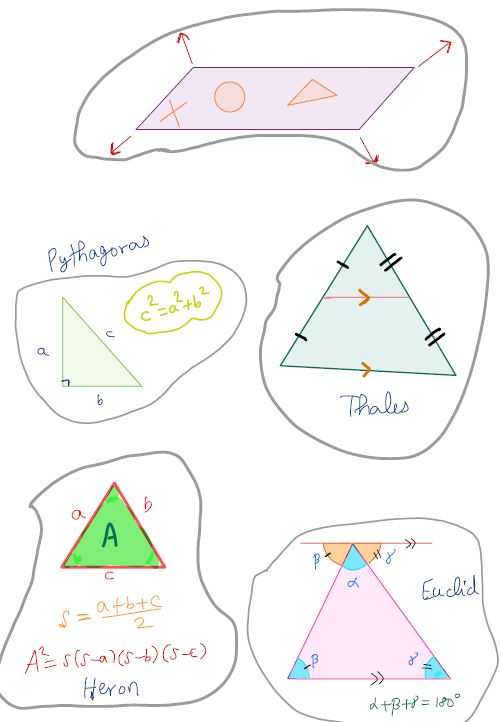
One of the most fundamental branches of mathematics is geometry, which is roughly the study of shapes. It is important to physics as well as the stage of mechanics is geometry as we will see.

In mathematics, as with any language, we need to build upon a preliminary set of vocabulary to begin with that captures the basic things around us. The preliminary vocabulary should be easy and obvious enough that everyone understands it in an unambiguous way. All other concepts will have to be defined in terms of this vocabulary only. In geometry, we need to come up with some basic concepts so that everyone else can easily understand it in the same way. What do you think is the basic ingredients for geometry? Let us first study the simplest of all geometries. Geometry in a plane. (Shapes that can be drawn in a notebook roughly).

Word 1: Infinite PLANE (Plane)
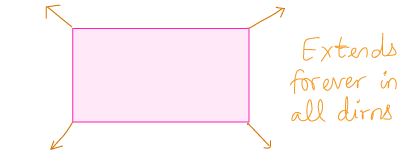
Infinite Plane

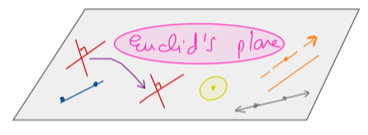
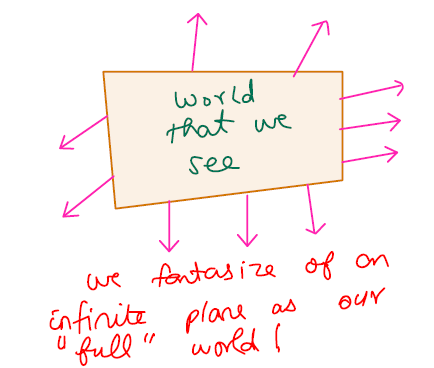
When we say infinite plane, we do not mean the rectangular sheet of paper or rectangular blackboard. We consider the indefinite extensions of the blackboard/paper in all possible directions.Even though we cannot draw an infinite plane or exhibit it physically, we can think of it unambiguously. That is the beautiful part about human thinking and communication in the sense that humans are the only species that can think, communicate and reason with things that do not physically exist but that which exists only on their heads. So this infinite plane is something that we can not physically show but we all can think about it unambiguously. We think of the infinite plane because we can never run out of space to draw as many shapes as we want and of as much size as we please without running out of space. (For example, in a rectangular sheet of dimensions 5x5mm, I cannot have a triangle with sides of length 3000mm). So we think about an infinite plane because alteast theoretically, we do not want to be constrained by the amount of space that exists in a finite sheet which restricts the size of objects that have to be considered. From now on, we will just call the infinite plane, just as the PLANE

So our stage in geometry shall be this plane and hence the geometry that we study will be called planar geometry. What do you now think are the fundamental concepts in plane geometry? What is the smallest and most basic constituent of plane?

Word 2: POINT

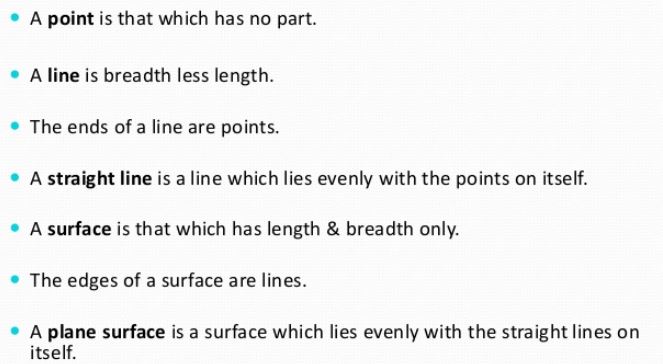
A point is something that is the smallest and most basic, indivisible element of planar geometry. Again, if I ask you to draw a point, you will probably draw something like this below.

You cannot draw an ideal point!

But this is not perfectly a point that we imagined in our head because if we zoom into this blot of ink that we had shown as a point, it would be a thick blob and consist of many many points. So in reality, if I indeed mark a point in the plane, you cannot see it at all for it is so tiny! (It has no size). So you see that the concept of a point is also a figment of our human imagination but just that all of us have the same fantasy of a point in our minds as the basic constituent of plane geometry.

This abstraction of a point is needed as it is the simplest of all constituents in a plane.

What do you think is the next most fundamental concept in plane geometry?

Word 3 – LINE SEGMENT

Again this is a very fundamental shape in all of the possible other complicated shapes that we can think of in the plane. Now again if I ask you to draw a line, you will probably draw something like this below:

An ideal line segment too is something that is only in our imagination!

Again, if you zoom enough, you will see that it has some thickness and other imperfections and so on….

So, again we all have this idealization of a line segment even though we cannot show one perfectly.

!!!!

Word 4 – LINE / INFINITE LINE / EXTENDED LINE

Physically we can never draw a line as we need an infinite plane to accomodate the extended line.

And so is the notion of an extended line…..

Like this below, we define several new words which can be taken as the base language of geometry and which are understood to be unambiguous and obvious.

Word 5 – LENGTH

Word 6 – ANGLE

Word 7 – NUMBERS ( and their associated arithmetic like +,-,x,/)

Word 8 – EQUAL/UNEQUAL (for numbers)

Word 9 – SAME/DISTINCT (for geometric objects)

Word 10 – TRANSLATION and ROTATION

Again, one can provide several illustrations to these concepts but the fact remains is that they are all obvious to us and we all think of the same thing when somebody says any of these words to us.

Now that we have defined these basic words, let us see if we can define other notions in terms of these notions. We will go back and cherish our high school geometry memories without resentment however.

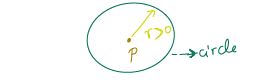
Def 1: CIRCLE

Given a point P in the plane and a positive number called radius r>0, a circle of radius r centred at P is the collection of all points with length from the given centre P equal to r

Again, we can think of a circle as something like this below
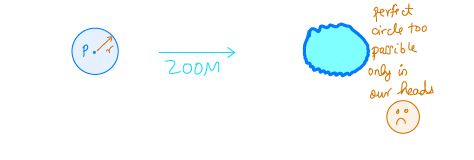
Circle too!!!

but again the fact is that we can never draw a perfect circle in practice

Def 2: PARALLEL LINES

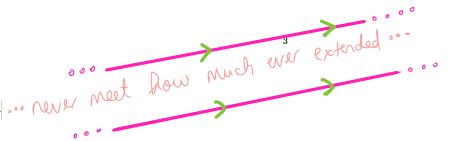
Two lines are said to be parallel either if they are the same, or they do not meet all no matter how much extended. Again, we have a strong belief regarding the existence of parallel lines but again physically we can never draw two distinct parallel lines as we have to be sure that they don’t intersect in the entire infinite plane how much ever they are extended. Again this notion should be natural to all.
Def 3: INTERSECTING LINES

Two lines are said to intersect if there exists a point P on the (infinite) plane such that P is in both of the lines.
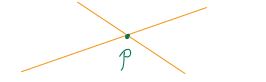
Intersecting Lines

Def 4: RIGHT ANGLE/ PERPENDICULARITY

When a line set up on another line makes adjacent angles equal on both sides, then both the angles are said to be right angles and the two lines are said to be perpendicular to each other.
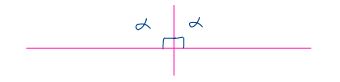
Perpendicular Lines

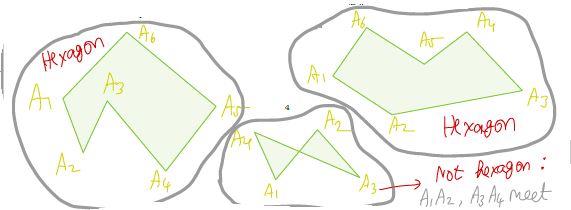
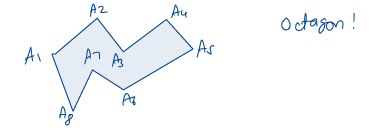
Def 5: POLYGON OF n SIDES (n GON)

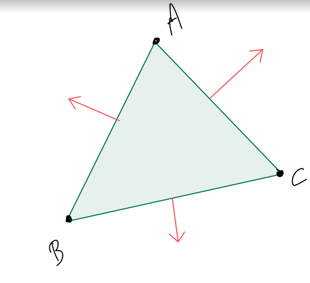
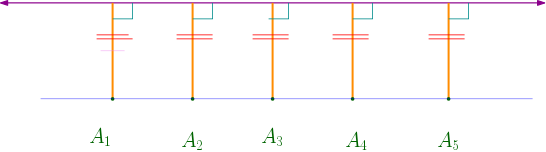
A n-gon or polygon of $n$ sides is a sequence of distinct points A_1,A_2,..A_n such that the line segments containing the point pairs (A_1A_2),(A_2A_3),..(A_nA_1) do not contain any point in common other than adjacent pairs (A_iA_{i+1}),(A_{i+1}A_{i+2}) having the point A_{i+1} in common. Common names for polygons :

n=3 : Triangle

n=4: Quadrilateral

n=5: Pentagon ….

This definition might seem like a mouthful but a little careful look will establish that this is indeed the familiar polygons that we intuitively think of.
Axiomatic Systems

Let us stop with these definitions for now and define more as we need them on the flow. Now that we have a fairly rich set of vocabulary, what shall we do next? Ultimately we want to understand the properties of lines, triangles and stuff in the real world. We need to know what is true about lines, angles, triangles in the plane and what is not true.

For that we need to start with a certain set of “facts” that we believe are true from our experience. These facts are called axioms.

Axioms are taken as unquestioned truths and we use these axioms to answer any other questions that are asked outside these set of axioms. We need axioms to do any mathematics or physics. In physics we call them laws. We have to start with some axioms. If we choose to not believe in the truth of anything, then we won’t get anywhere. Without assuming anything, we cannot expect to prove stuff like Pythagoras Theorem or Thale’s theorem. So in this sense, mathematics is also like a religion. It rests on some statements that are taken as unquestioned truths. There is no point in arguing whether they (axioms)are actually true or not. All we can say is that, if we choose to believe in them, we get so and so facts also coming to be true or false.

There are only two things in framing an axiomatic system. The first thing is that there should be as few statements assumed to be true in an axiomatic system. This is because we do not want to blindly accept too many things to be true for granted. An axiomatic system that has very few statements will not produce much consequences and an axiomatic system that has many statements assumed to be true will have a richer set of consequential statements. The intelligence lies in picking the optimal set of statements such that with as few statements assumed to be true, we get as many results as possible. We have only two requirements for an axiomatic system. They are:

Non-Redundancy (and) Consistency

Let us formally define a non-redundant, consistent axiomatic system:

Def 6:

Given a vocabulary (a set of undefined concepts), a non-redundant and consistent axiomatic system (hereby called just an axiomatic system) is a set of truths involving the vocabulary in the form of statements S_1,S_2,..S_n such that they satisfy two conditions:

Consistency: All the statements have to be consistent. Using some statements, I should not be able to prove that the other statements in the same axiomatic system to be false. For example, I cannot take S1 as the statement “I am thin” and S2 as the statement “I am not thin”. i.e. The statements present in the axiomatic system do not contradict each other!

Non-redundancy: The system should not contain any statement that can be logically proved from the other statements (the concept of a logical proof is given below). i.e. There should not be indirect repetition of the same statement in another form as another statement. i.e. S1: I am tall and handsome, S2: I am tall. The set \{S_1,S_2\} is a redundant axiomatic system as assuming S1 to be true automatically implies S2 to be true by logic. There is no need to have assumed S2 separately. S2 is a redundant system.

Having said what is an axiomatic system, we have to establish whether a given statement is true within the framework of an axiomatic system. For that , we introduce the notion of a proof of a statement in a given axiomatic system.

Def 7:

Given a statement S built up from a vocabulary, a proof of the truth of a statement S in a given axiomatic system involving the same vocabulary, is a finite sequence of statements S_1,S_2,....S_n such that S_1=A, S_n=S (A is any of the statements in the axiomatic system assumed to be true) and such that for each statement S_j in the proof, we logically have that S_1,S_2,...S_{j-1}\Longrightarrow S_j.

n is called the number of steps in the proof

More informally, we start with an axiomatic statement, deduce from it through logical implications only, finally establish the given statement S at the end. So if the axiomatic statements are assumed to be true, then the given statement S also has to be true.
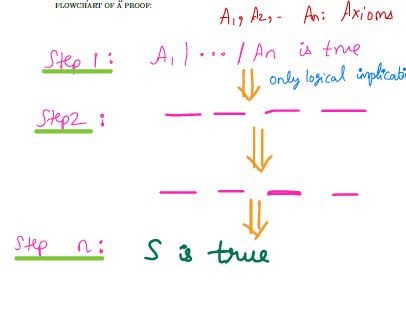
Flowchart of a Proof

NOTE: The proof of a statement, if exists need not be unique. There can be several proofs to the same statement with one being in 5 steps and the other being 500 steps. It is the ingenuity of the reader to find out the shortest proof(s) of a statement if it is true.

There may be several questions plaguing us formally now for the over curious reader!

Question 1: How do we know if a given axiomatic system is consistent? In principle, we have to consider all possible logical implications of all subsets of the statements and check that they do not contradict any of the statements that are not in the subset. Seems like a Herculean task!!

Question 2: How do we know if a given axiomatic system is non-redundant? We have to check if each statement can be proved from logical consequences of the remaining set of statements. Again sounds a tough job!! We will encounter these questions in geometry too!

Finally, Question 3:

If a statement S in a given axiomatic system is true from the logical implications of the axiomatic statements, is it always true that there exists a proof of that statement from the axiomatic system?!!!

The last question might seem peculiar as we believe that every statement that is true from the axioms got to be provable from it but the surprising answer is a resounding no in even many simple cases:

Theorem 1 (Godel’s incompleteness Theorem ) – stated without proof

Any axiomatic system that contains and captures the arithmetic of natural numbers contains a statement that is true but cannot be proved!

Note that this is shocking as natural numbers and their arithmetic are very basic to all of mathematics and our geometry vocabulary does indeed contain in New Term 7, not only natural numbers but all kinds of numbers!!

Note that Godel proved this theorem in 1930 using the axioms of set theory but the proof is very complicated and goes into the deep abyss of mathematical logic and hence will take us far too apart from where we want to go. But all the statements that we normally encounter in geometry can be proved or disproved and hence we shall not be worried about Godel type statements popping up. But the question of redundancy and consistency even though difficult, will be important in geometry as we shall see.

Now, having said that our vocabulary is consisting of new terms 1-10 and the derived vocabulary from definitions 1-5, what shall we take as the axioms of planar geometry? There are several axiomatic systems possible that are the same.

Def 8: EQUIVALENCE OF TWO AXIOMATIC SYSTEMS

Two axiomatic systems are said to be the same or equivalent if each axiom in each system can be proved from the axioms of the other system

i.e. The statements that are true/false in one axiomatic system are also true/false in the other axiomatic system and vice versa.

Axiomatic System for Planar Geometry

There are several possible axiomatic systems in plane geometry but the most widely and most accepted axiomatic system that is still in use today was framed by a Greek mathematician Euclid of ancient Greece around 300 to 200 B.C. Euclid’s axiomatic system consists of some 5 statements regarding geometric objects and 5 statements regarding numbers and their arithmetic. The first five statements are called “postulates” and the second five are called “common notions”. As we shall see, all the postulates of Euclid (except one) are very obvious that we ourselves might have developed them. We now state them as Euclid did.

EUCLID’s AXIOMATIC SYSTEM:

Postulates:

(P1) Given a line segment, it can be extended uniquely to an infinite line segment that contains the original line segment
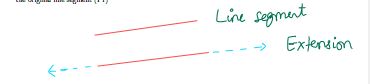
P1

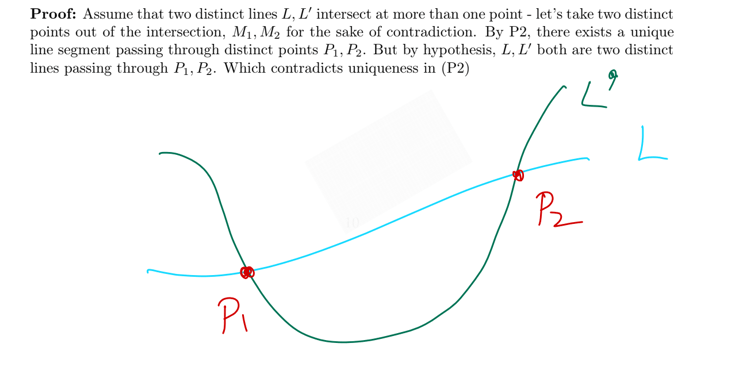
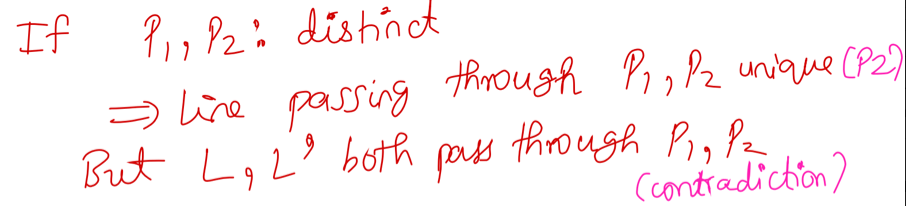
(P2) Given two distinct points, there exists a unique line segment (and hence by postulate 1, a unique line) that contains the given two points
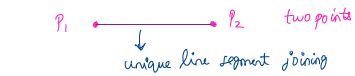
P2

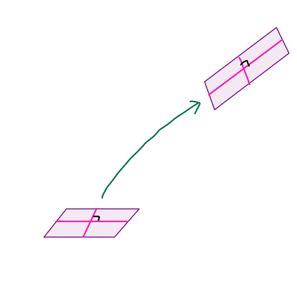
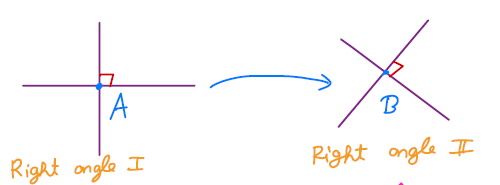
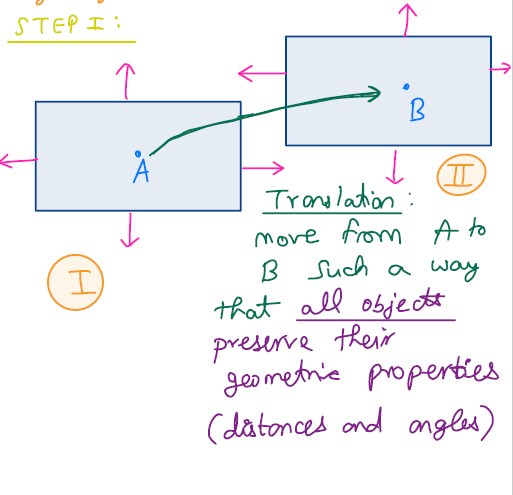
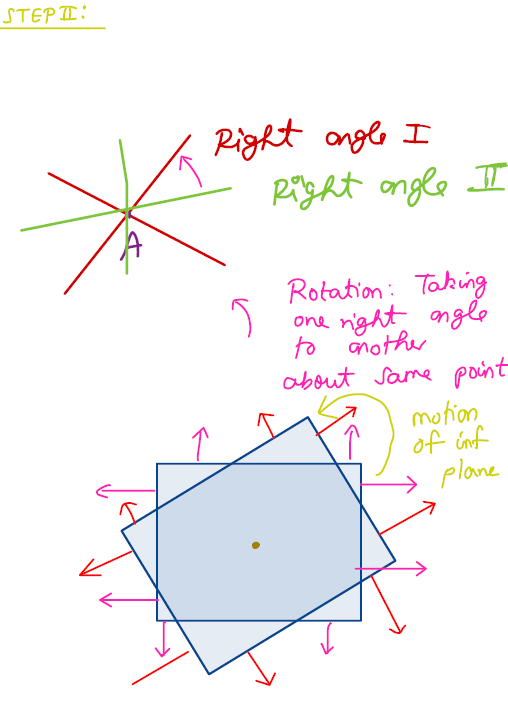
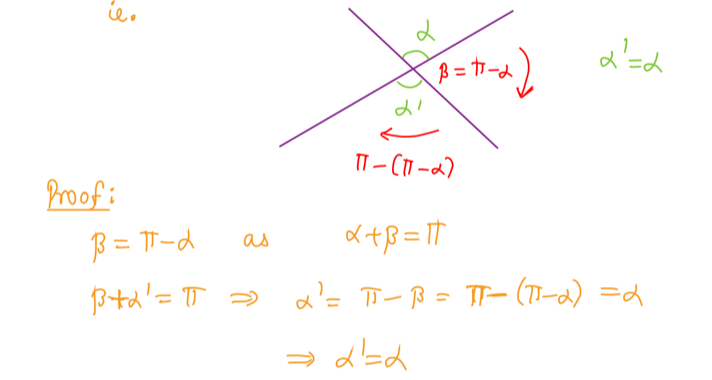
(P3) All right angles are equal. They can be obtained by translation and rotation of any given right angle.
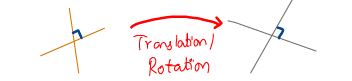
P3

(P4) Given any point P in the plane and given any positive number radius r>0, there exists a circle whose centre is P and radius r

P4

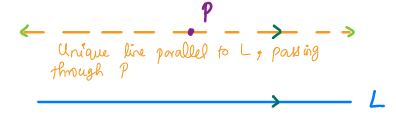
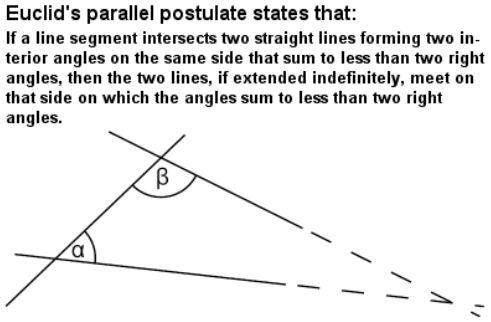
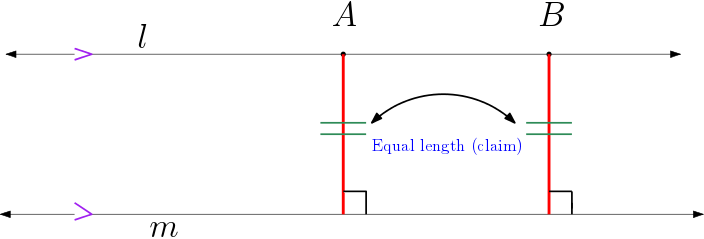
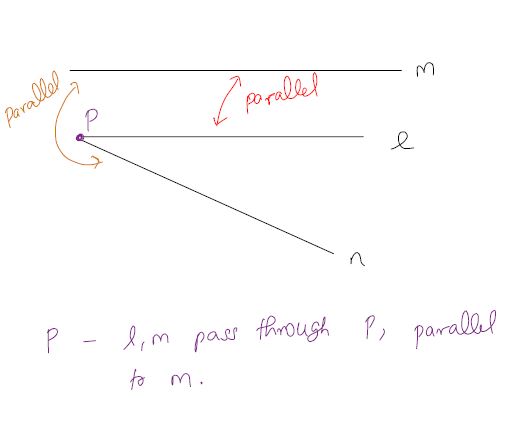
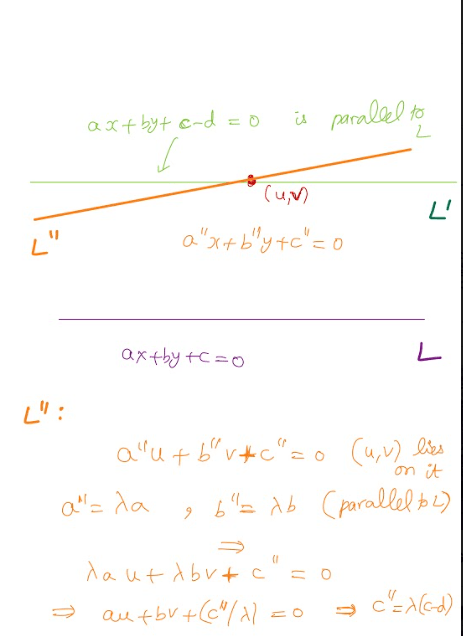
(P5) Parallel Postulate: Given a line L and a point P not lying on the line, there exists a unique line L' passing through P and parallel to L

P5

Common notions:

(P6) If a=b and c=b, then a=c

(P7)If a=b, then a+c=a+b

(P8) If a=b, then a-c=a-b

(P9) The whole is greater than the part

(P10) Things which coincide with one another (through translation/rotation) are equal to one another (also called as congruent to one another)

One more postulate was added more recently that was used implicitly used by Euclid but was not stated because it was far too obvious

(P11) There exists three points in the plane such that they all do not lie on a same line

We see that these postulates are so self evident (except P5 which we will return later).

But now we have to ask: Is this axiomatic system consistent and non-redundant?

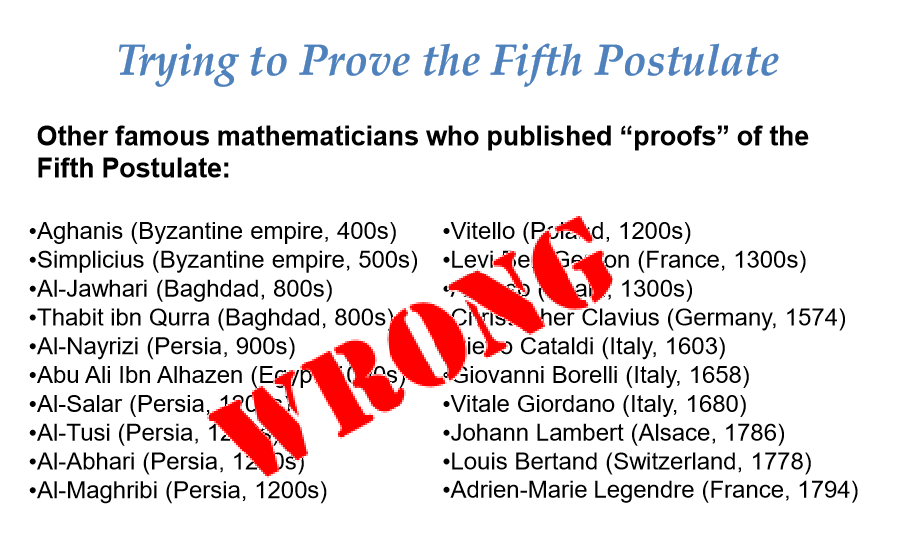
One can prove using rigorous logic that Euclidean axioms are indeed consistent (we shall not do it now) . ie. no statement of Euclid contradicts any of his other statements. But the question of redundancy was a delicate issue. The parallel postulate caused a problem. Since the parallel postulate P5 was not as obvious as the remaining ones, many including Euclid himself hoped that P5 could be logically proved from the remaining postulates. Many people (starting from Euclid himself) tried to remove the parallel postulate from the axiomatic system by proving it as a logical consequence of other 4 postulates but they were unsuccessful. There were some who claimed to succeeding in proving the parallel postulate but a careful examination of their proof showed that in proving so, they had assumed some other statement to be true implicitly and that statement (even though looking more obvious than the parallel postulate) when combined with the remaining postulates turned out to be logically equivalent to the Euclidean axiomatic system with the parallel postulate itself, thus replacing the parallel postulate with some other equivalent postulate within the framework of the remaining axioms.

But Euclid needed the parallel postulate to prove several important results like the sum of interior angles of a triangle being equal to two right angles, Pythagoras theorem and many other important geometric facts. In fact, Euclid wrote a 13 volume book series titled Elements that contained proofs to hundreds of theorems about various geometric shapes, all just using the five postulates and five common notions as axiomatic system!!! So these five statements can explain 13 volumes book worth of facts!! But if the parallel postulate were removed ,then only first 28 theorems could be proved by Euclid which were very trivial. Thus, without the parallel postulate, the work was few pages but with the parallel postulate, it was 13 volumes!! So the parallel postulate was indeed very important to planar geometry.

Now we know that the parallel postulate cannot be proved from the remaining four postulates and hence it is independent logically from the other four postulates (which also we shall not prove)

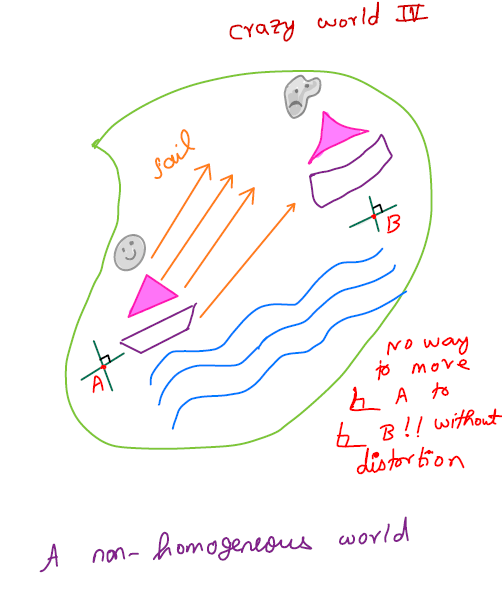
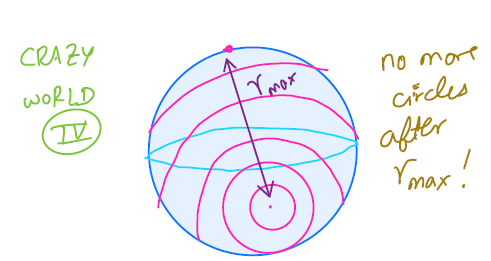
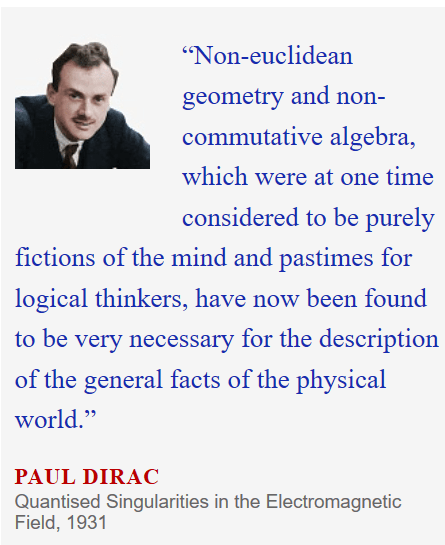
NOTE: The question as to what happens when we modify the parallel postulate is the subject of non Euclidean geometry and will lead to curvature! (in future weeks!)

NOTE: Note that several of Euclid’s axioms contains the phrase ‘there exists a unique‘ and this has to be taken carefully with a pinch of salt. It not only says the proposed entity exists but it is unique. i.e. There cannot be more than two distinct proposed entities that exist. It is a highly powerful statement. Existence and uniqueness are independent. Somethings may exist but not unique and some other things are unique if exists but need not exist.

Euclid’s Elements continues to be the standard of modern high school geometry and is printed more than the Bible!

Now this Euclidean geometry is very important as an axiomatic system as geometric mechanics seeks to generalize Euclid’s axiomatic system. Before discussing deeper issues on the axiomatic system of Euclid, let us prove some well known geometric results from Euclid’s axioms.

These should take you back to the proofs of high school geometry. Now we are doing all these because all of it has a deep connection with the general theory of relativity. It might not be evident but General Relativity evolved from Euclid to Descartes to Galileo to Newton to Gauss to Riemann to Einstein!!

Let us now prove some results from the axioms as given in Euclid’s Elements. I am doing this because I want to replace the Parallel Postulate in Euclid’s axiomatic system to the following two equivalent statements:

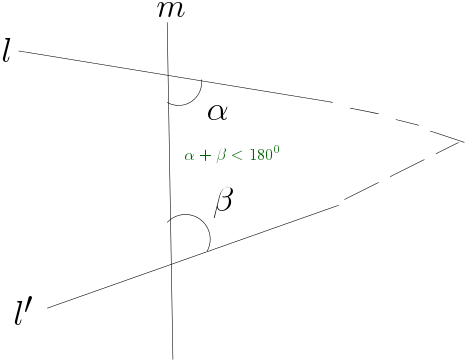
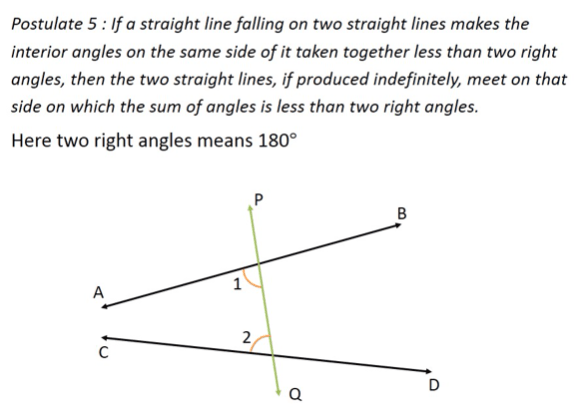
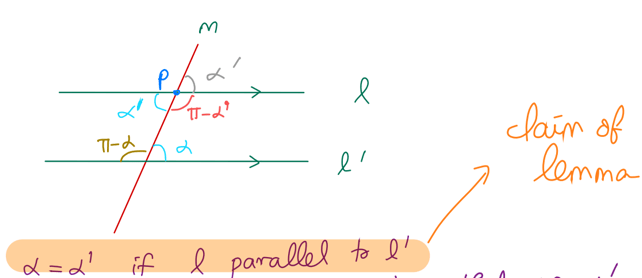
Statement 1: If a straight line m falling on two other straight lines l,l' make the sum of angles (\alpha+\beta) less than two right angles on one side, then the two straight lines will meet when extended on that side.

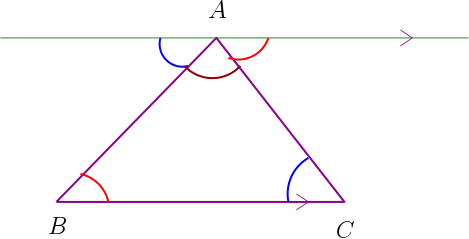
Statement 2: The sum of the three interior angles of a triangle is 180^0 i.e. \alpha+\beta+\gamma=180^0

What is meant by this is that the axiomatic system of Euclid (P1-P11) is same as (P1-P4+Statement 1 + P6-P11) AND (P1-P4 + Statement 2 + P6-P11). In the presence of remaining postulates, the parallel postulate can be shown to prove and to be proved from any of the two statements above.

NOTE: Euclid originally stated Statement 1 only and the parallel postulate that we use is called Playfair’s Axiom. Anyways once we prove the logical equivalence of the three statements, what we started off with is immaterial.

Why are we bothered about these other forms of the parallel postulate? Statement 2 has a deep connection with Einstein’s Relativity. We will begin to explore that in the next post of the blog!! But we will just start the flow of the importance now. Let us put the equivalent statements again below:

Statement 1: If a straight line m falling on two other straight lines l,l' make the sum of angles (\alpha+\beta) less than two right angles on one side, then the two straight lines will meet when extended on that side.

Parallel Postulate: Given a line L and a point P not lying on the line, there exists a unique line L' passing through P and parallel to L

Statement 2: The sum of the three interior angles of a triangle is 180^0

Statements 1 and Parallel Postulate involve indefinite extensions of lines. In statement 1, it just says that the two lines when extended, meet somewhere in the plane. We are not guaranteed that they will meet within this region or sorts. Similarly, in parallel postulate, to check if two lines are parallel, we have to extend the lines indefinitely and ensure that they do not meet how much ever we extend. Again, they involve the entire infinite plane as they talk about extended lines, parallelism and meeting somewhere. But the statement that the sum of three angles of a triangle is 180^0 is something that is local. A triangle is a local entity and confined to a finite region of the plane and its interior angles can be checked by staying in the region bounded by the triangle itself without flying off anywhere. So, later in this course, we want to study about “local” geometric properties, which means properties of geometric figures confined to a given local region. In this case, the interior angle sum formulation is useful as we can talk about sum of interior angles of triangles that are confined to a given local region alone whereas in the other version, they involve the entire plane and not use local objects.

If you are interested in how the two statements are logically equivalent to the parallel postulate, you may consult this PDF below. It is not difficult!! (just requires some investment of your precious time)

Link to the PDF: (will be posted soon)

Week 7: Beginnings of Relativity – 2: Uniform motion in absolute space does not need a cause!

STORY SO FAR:

So last time, we saw that Newton and Galileo believed in the notion and existence of an absolute space (independent of any object) which when witnessing different instants of time, create the stage for every event in this universe to happen. (So every event has a unique location in absolute space independent of any other concept and a time of occurrence). Also Newton postulated that this space was three dimensional and Euclidean which meant that it obeyed Euclidean axioms of spatial geometry which implied:

1. Such a space is homogeneous and isotropic everywhere. There is no preferred point in space and a preferred direction in space geometrically, without any prejudice to any other external object or event.

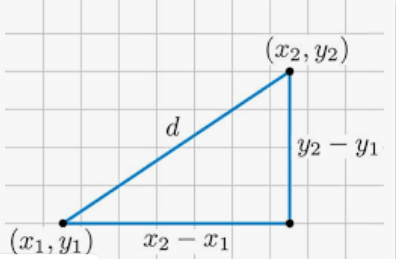
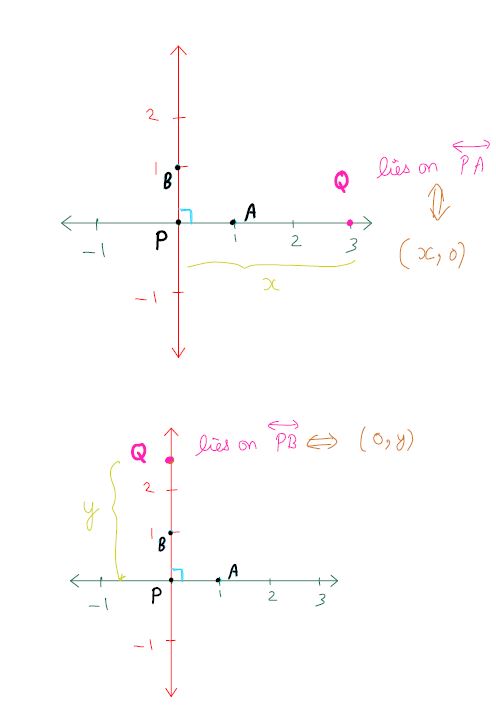
2. It can be put in one to one correspondence with \mathbb{R}^3 which is set of all triplets of real numbers (x,y,z) such that distance between two points (x_1,y_1,z_1),(x_2,y_2,z_2) is \sqrt{(x_2-x_1)^2+(y_2-y_1)^2+(z_2-z_1)^2}

A small technical note: (CAN BE SKIPPED AND REFERRED TO WHEN USED LATER)

Before we proceed to this week’s formal contents, let us prove a small mathematical result so that it will provide us with the right insight when the time comes. Let (x,t) be two variables and let x'=f(x,t) be another variable that is a function of x,t. Now, the result that we need to prove is:

Let f(x,t) satisfy the following properties:

1. Let (x_1,t_1), (x_2,t_2) and (x_1',t_1'),(x_2',t_2')satisfy x_1-x_2=x_1'-x_2' and t_1-t_2=t_1'-t_2'. Then, f[(x_1,t_1)]-f[(x_2,t_2)]=f[(x_1',t_1')]-f[(x_2',t_2')]

2. For a given t, f([x,t])-f([x',t])=x-x'

What do you think f(x,t) can be if it has to satisfy these properties? Think yourself before looking at the answer discussed below:

The second property says that for a given t, x-x'=f(x,t)-f(x',t). So, f(x,t) preserves differences between the x coordinates at a given time. So for a given t, f(x,t)=a+x where a is some constant. But as time progresses, a can change, and hence the second property constrains f(x,t) to be of the form f(x,t)=a(t)+x

Now applying the second condition, it says that identically separated (x,t) pairs 12, 1’2′, goes to identically separated values in f. If we put this assuming x_1=x_1'=x_2=x_2'=0, we get that f(0,t_1)-f(0,t_2)=f(0,t_1')-f(0,t_2')if t_1-t_2=t_1'-t_2'. So since f(0,t)=a(t), we have that a(t_1)-a(t_2)=a(t_1')-a(t_2') if t_1-t_2=t_1'-t_2'. Or \frac{a(t_1)-a(t_2)}{t_1-t_2}=\frac{a(t_1')-a(t_2')}{t_1'-t_2'}

So, we have a(t)=x_0-vt as only a linear function of t can satisfy this as this condition says that the slope of the function a(t) remains constant. So ,we have

f(x,t)=x_0+(x-vt)

COMING BACK TO OUR MATTER:

So last time we saw that how Galileo and Newton postulated the existence of an “absolute Euclidean space” – which when witnessing the passage of time, generates the set of all possible events. Since that absolute space is homogeneous and isotropic (as all Euclidean spaces are)[looks same everywhere and in every direction], it is impossible to detect where we are in a purely geometric basis without reference to any external objects. In the dark space where there is nothing, but plain space without any objects, one cannot determine if an object is moving through that absolute space – as even when it is moving and it traverses different points at different instants of time, we cannot deduce it as every point in that dark space looks the same.

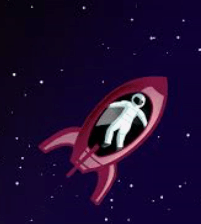
In other words, let us say if you are put in a rocket that is in deep empty space without any visible star or planet or any object but just sheer darkness outside. The rocket is now at rest in absolute space. When you fall asleep, the rocket switched on its engine and moved to some other place in that dark empty space. What I claim is that after you wake up, you cannot determine if the rocket had moved or stayed at the same place. Because the point you were before you slept and the point you are at now, look the same in dark absolute space without reference to any other objects. So you never know if you have moved. So, absolute motion is undetectable without reference to any external objects. Similarly, absolute time is undetectable. Without an external event, it is impossible to tell how much time you have slept. Only time intervals are detectable – absolute time is undetectable. You have to have two events to talk about time. Every instant of time is same (time flows uniformly). In the rocket, without a clock or someone watching, it will be impossible to determine how much time you have slept!!

Absolute Motion (without reference to external objects) through absolute space and absolute time is undetectable!

In other words, the so called absolute motion through absolute space cannot be detected and only relative motion w.r.t another object can be detected. We summarise our last week’s findings below:

This homogeneity of space, when combined with the homogeneity of time, results in space-time homogeneity where in

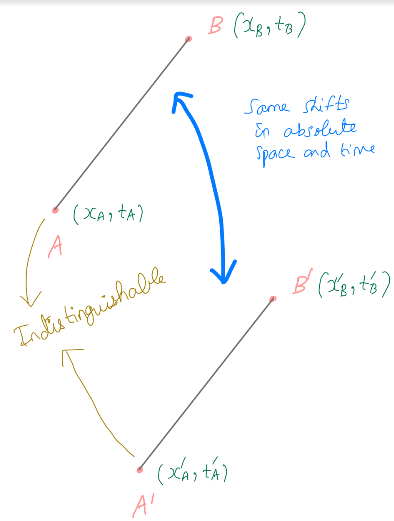
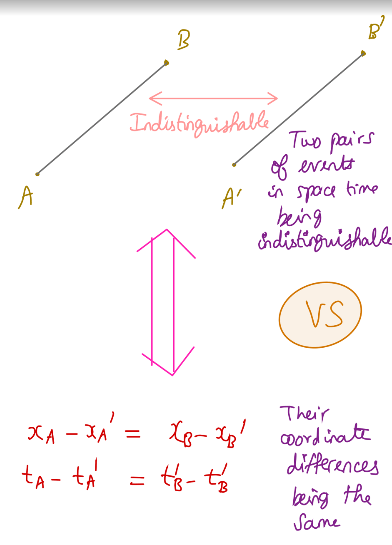
Two pairs of events having same spatial and time separation are indistinguishable from each other without any reference to external objects and events

FRAME OF ABSOLUTE REST:

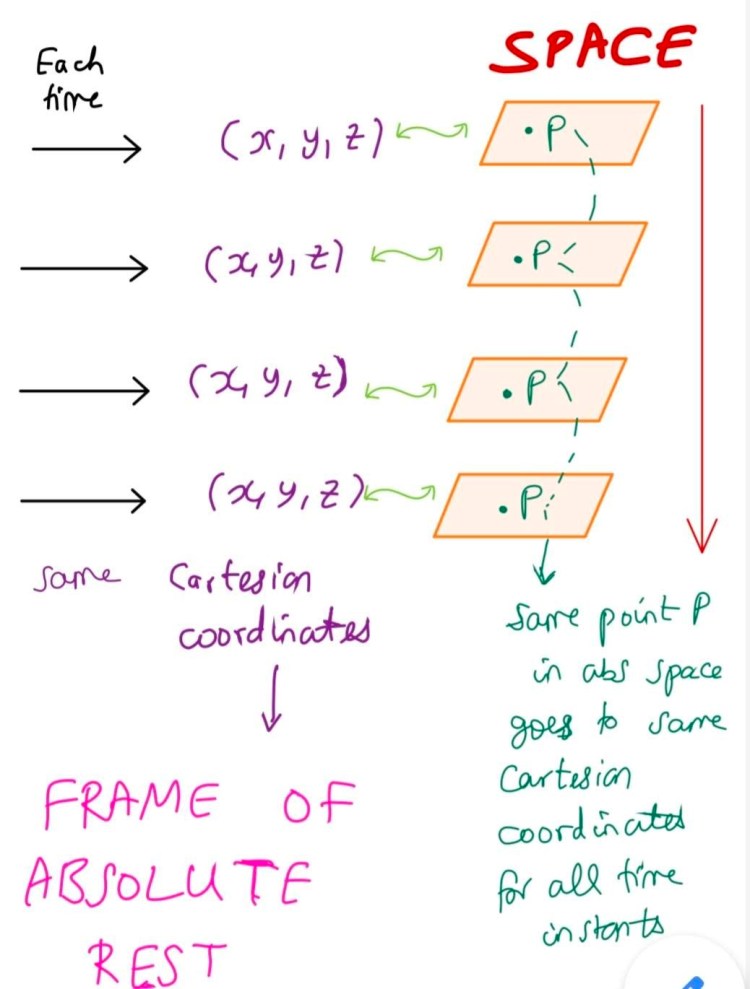
Note that last time we talked about a natural frame of absolute rest, where in, with reference to an event, the coordinates of an arbitrary point P in space-time are (x,y,z,t) where (x,y,z) are its coordinates in absolute space with respect to the reference event as origin, and (t) is the time elapsed from the reference event. It is a natural coordinate system as the same point in absolute space always goes to the same spatial coordinates. It is very natural as it respects the absolute space concept of space-time.

In this frame, the spatial separation between two events P_1 and P_2 in absolute space with coordinates (x_1,y_1,z_1,t_1) and (x_2,y_2,z_2,t_2) is given by (x_2-x_1,y_2-y_1,z_2-z_1) and the time separation between the two events is t_2-t_1 as the first 3 coordinates of the event are the coordinates of the point of the event in absolute space. But if we do not believe in the idea of an absolute space, it does not makes sense as two non-simultaneous events cannot be compared spatially as it does not make sense to retain the spatial identity of a point as time progresses.

The coordinates of absolute rest frame $latex (x,y,z,t) satisfy the following properties:

1. t is the time interval measured from a reference event

2. The distance between two simultaneous events (x_1,y_1,z_1,t) and (x_2,y_2,z_2,t) is given by \sqrt{(x_2-x_1)^2+(y_2-y_1)^2+(z_2-z_1)^2} (Note that it makes sense to talk about two points at same time as the set of all simultaneous events forms a 3 dimensional Euclidean space)

3. Two pairs of events have (x_1,y_1,z_1,t_1), (x_2,y_2,z_2,t_2) and (x_1',y_1',z_1',t_1'),(x_2',y_2',z_2',t_2') are separated identically in space and time, if and only if x_1-x_1'=x_2-x_2', y_1-y_1'=y_2-y_2', z_1-z_1'=z_2-z_2' and t_1-t_1'=t_2-t_2' (Eqn *)

The third statement is quite profound. It says that two identically separated pairs of events (which are indistinguishable in homogeneous spacetime: as they have same spatial separation in absolute space and same separation in time) also have same coordinate differences and vice versa in the rest frame. i.e. If a pair of events 1,2 is identical to another pair 1’2′, the event 1′ should be shifted from 1 exactly the same amount in which 2 has shifted from 2′ in space-time. So, their coordinate differences should match. (Word description of the contents of Eqn *)

In other words, space time homogeneity is reflected as coordinate differences in the absolute rest frame. Two pairs of events in space-time are indistinguishable if and only if their coordinate differences are the same.

Now let us ask: What other coordinate systems satisfy these properties? Is it only the rest frame coordinate system that satisfies these three properties? For now, let us assume that space is only one- dimensional so that we need only one coordinate (x) to capture. So, the coordinates for our space time is (x,t). Now let (x',t') be some other coordinates for space time.

To preserve the fact (1) even in the new coordinates, which is “t is the time interval measured from a reference event”, we need that t'=t

To preserve the fact (2),in the new coordinates, which is “The distance between two simultaneous events (x_1,t) and (x_2,t) is given by |x_2-x_1|(Note that it makes sense to talk about two points at same time as the set of all simultaneous events forms a 1 dimensional Euclidean space -we have assume our space to be one-dimensional) “, we must have that |x_2'-x_1'|=|x_2-x_1| where (x_1,t),(x_2,t) are two simultaneous events. Hence, we must have x'=a(t)+x by taking the same line of arguments done in proving the second part of the technical result in the beginning! If you look back, it is the exactly same problem here.

Now we want the fact (3) to be true of (x',t') as well, which in one dimensions, is “Two pairs of events have (x_1,t_1), (x_2,t_2) and (x_1',,t_1'),(x_2',t_2') are separated identically in space and time, if and only if x_1-x_1'=x_2-x_2', and t_1-t_1'=t_2-t_2' (Eqn *)

So, we want this equation Eqn * to be true in both the coordinates and denoting the new coordinates x’ as x'=f(x,t), then we have the same problem in the first part of the technical result and hence we must have x'=x_0+x-vt

So, if (x,t) are the rest frames, we have that any coordinate system (x',t') of the form

x'=x_0-vt

t'=t

Set of all coordinate systems (x’,t’) in which homogeneity of events in absolute space-time is preserved

Now, these are very special. The thing is that anyways it is impossible to detect absolute motion in homogeneous space as I was saying before. All we can do is measure distances between two simultaneous events and measure times. For that any function a(t) of the form

x'=a(t)+x

t'=t

will work.

But the event pairs that the rest pair observer decides as indistinguishable by considering his spatial separation and time separation (in his absolute rest frame) need not be indistinguishable as observed in the other frame for random a(t) by considering his spatial coordinate and time differences. For example, consider a(t)=t^2, and consider the event pairs: (x,t):(0,0),(1,1) and (x,t):(100,300),(101,301). The above two pairs are indistinguishable in absolute rest frame as their spatial and time separations are identical. But it is not true in the new frame related as x'=x+t^2, t'=t

So, even though absolute rest frame has the sacredness of being special, its homogeneity and indistinguishability is carried to other frames satisfying the equations

x'=x_0+x-vt

t'=t

So, this frame is as good as absolute rest frame as I can decide if two pairs of events are indistinguishable by just observing their coordinate differences. (spatial and time differences). The value of those differences may not be the same as in absolute space but indeed that does not matter as anyways we cannot detect motion through absolute space and we cannot talk about spatial separation at different times purely geometrically.

So, all these frames must be of equal importance if the laws of physics respect the fact that there is no absolute motion and there is only this space-time homogeneity.

So, here we have the Galilean principle of relativity:

GALILEAN PRINCIPLE OF RELATIVITY:

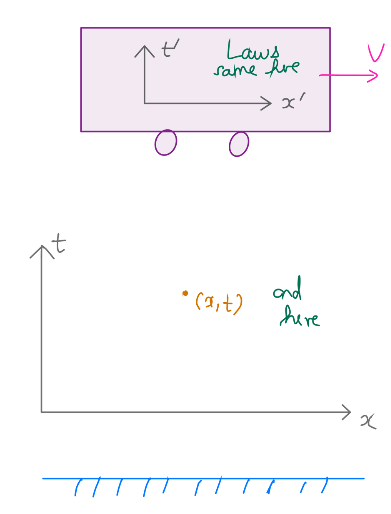
I do not know the laws of physics, but whatever they are, if they are true in the frame of absolute rest with coordinates (x,t), then it should be true and have the same form in any other frame $latex (x’,t’) satisfying the condition below:

x'=x_0+x-vt

t'=t

Physically, when x(t)=vt, then it means that I am moving at a uniform motion through absolute space with constant velocity v. But putting x=vt, gives x'=x_0=constant, which means that (x',t') is the frame used by an observer, let us say in a ship, that is moving at velocity v through absolute space.

So, another equivalent statement of Galilean principle of relativity is:

I do not know the laws of physics, but whatever they are, if it is true in the frame of absolute rest, then they should take the same form in a ship moving in absolute space with some constant velocity v.

OR

Uniform motion with a constant velocity ‘v’ in absolute space time should not be inferable from the laws of physics. i.e The laws of physics must look the same in all frames moving with uniform velocity relative to the rest frame (Hereafter lets call such frames as inertial frames)

So, a short restatement of Galileo:
THE LAWS OF PHYSICS ARE SAME IN ALL INERTIAL FRAMES!

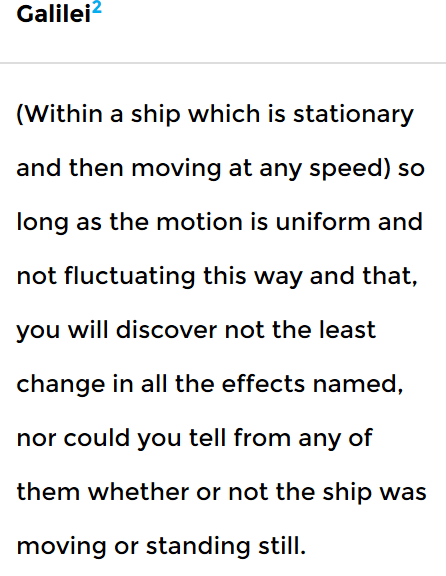
In original words of Galileo and Newton

Newton’s statement
Galileo’s statement


A consequence: Uniform velocity motion in absolute space should not have a cause. The laws of motion should not involve velocities as velocities change when going from one inertial frame to another.

This was in contrast with Aristotle who postulated that rest in absolute space is the natural state of motion of any body. Any body naturally comes to rest. To make it move, it needs a cause. But this is not true in any other inertial frame. For example, if a body is at rest with respect to me, for a person moving in car with uniform velocity, it will appear that the body (that according to Aristotle is at is “state of natural rest” from the point of view of the person on the ground), is moving now as seen from the car, say at 30 kmph So, he will conclude that in his frame of the car, “motion with uniform speed of 30 kmph is the natural state of motion for any body. To make it deviate from that uniform velocity of 30kmph, we need a cause”. So, this is not a frame invariant statement. In my frame rest is the natural rest and Aristotle is right whereas in the other frame Aristotle is wrong. So Aristotle’s statement as the law of mechanics is not correct as it is not possible to be true in all inertial frames. 🙂 🙂

Newton realized that only the derivative of velocity, which is acceleration can have a cause according to Galileo’s principle.

Because if x'=x-vt, then \frac{dx'}{dt}=\frac{dx}{dt}-v (velocity changes from one inertial frame to another), but differentiating once more, we get

a'(t)=\frac{d}{dt}(\frac{dx'}{dt})=\frac{d^2x'}{dt^2}=\frac{d}{dt}(\frac{dx}{dt})=\frac{d^2x}{dt^2}=a(t)

(acceleration is defined as the instantaneous rate of change of velocity – derivative of velocity)

So we see that any two inertial observers always agree on their accelerations. So, acceleration can have a cause. So, Newton said that in his first law

Newton’s first law:

Any body far away from other bodies (under no influence from anything) will move at a constant velocity in absolute space. (The acceleration of a free body is zero)

So according to Newton, a body does not need any exeternal agent to maintain a state of uniform velocity. So motion with a uniform velocity (whatever the value may be) is the natural state of motion for every body. This is a frame invariant statement as if the body is moving with uniform velocity in one inertial frame – it is also doing so in another inertial frame (although the value of the uniform velocity may differ). Or if acceleration is zero in one inertial frame, it is zero in another inertial frame as well (coz acceleration is same in all inertial frames as we have established)

Now to make it accelerate, and hence change its state of uniform velocity, we need a cause. The simplest relation between cause and an effect is a proportional relationship. So, Newton says

Newton’s second law:

For a body to accelerate or deviate from the state of uniform motion, needs a cause called the force (F) and that cause is proportional to its effect (acceleration a)

So, F=ma

where the proportionality constant is called “mass” of the body and it determines the resistance of the body to accelerate.

So, we see that Newton’s first two laws are the simplest laws that respect Galilieo’s principle of relativity.

Week 6: Beginnings of Relativity – 1: Time and Absolute Space: Newton-Galileo vs Leibnitz-Mach

Mathematics is the language in which God has written the universe

Galileo Galilei

Many people think it was Einstein who invented relativity. They could never be more wrong. Relativity is a 400 year old tale. It was there since the beginnings of physics. What Einstein did was merely to modify the pre existing model of relativity. The modification that Einstein made was so drastic on the existing theory (that was very natural and obvious) and hence people think that Einstein invented the concept of relativity. But here we will explore the old theory of relativity that was invented long back and prevailing physics till the beginnings of the last century. The man who started it was Galileo Galilei

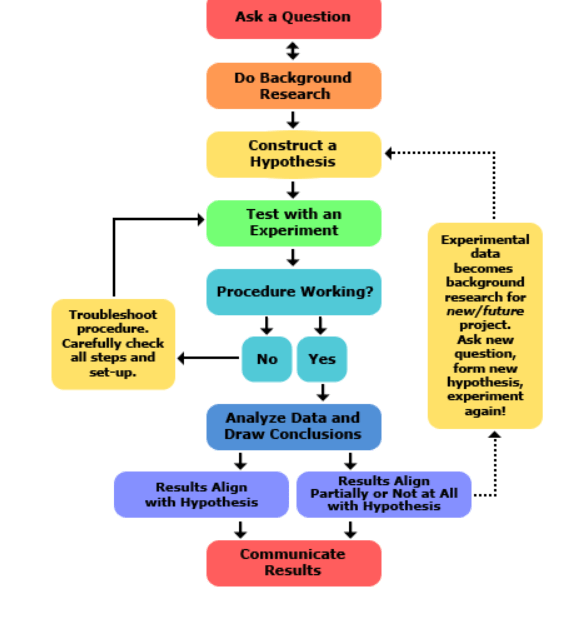
I admire this man too much. For many reasons. First is, he established this concept of scientific method – making hypothesis and testing them against reality to verify them as a foundation of reasoning and it was in staunch opposition to the Biblical concept of belief based on authority due to which he was subjected to immense difficulties and eventual death.

The scientific method

Next is that he laid the very foundations of mechanics without which no worthwhile invention would have been made today. Galileo came nearly closed (or converged – to say in Zeno’s language :P) to the laws of mechanics that Newton invented – in fact the laws that Newton invented were the only simplest ones that were plausible which were compatible with Galileo’s principle of relativity that he hypothesized. Galileo Galilei is also the first person who started the trend that if a simpler model could explain phenomena, then it ought to be accepted with grace. The prevalent model of the solar system then was that the earth was center and stars and the sun moving around them in circular orbits and planets moving around them in even more complicated orbits. But Galileo proved that placing the sun at the center and at rest with the other stars and the planets including Earth moving around the Sun in circular orbit constitutes a more simpler explanation of natural phenomena in sky that was first hypothesized by Copernicus. We know what Galileo had to undergo for sticking to this view point.

Events, space-time and geometry:

Having mastered geometry, it is time to come to physics now. Geometry studies some collection of fundamental objects called as ”points”. But in physics, we intend to study how things move and why things move. So, some notion of timing is also important. So, the fundamental objects are no longer points. Some notion of timing associated to each point is important. At first we shall be vague about the concepts ”point” and ”time”. Later we will develop a proper axiomatic system out of them. The fundamental objects of interest in mechanics no longer are points because we need to take time also into consideration. It makes sense to distinguish between ”this point P at 12:00” and ”the point P at 1:00”. Because mechanics is the study of how things move with respect to time, the additional detail of ”when at this point” is also important.

Having said this, let us now come back to square one. The fundamental object of mechanics is said to be an ”EVENT”. Again, I am going to assume that we all have the intuitive and unambiguous understanding of what is meant by the word EVENT and as I said it talks about a point but with a label of timing. The set of all events is denoted by E, and is called space-time! Mechanics is nothing but the study of events associated to moving objects.

Galileo wanted to study motion. How do objects move? Why do they move the way they move? This is a natural and first curiosity in nature and hence mechanics was the first branch of physics to be discovered. As usual we have to start with a bunch of axioms. (In physics they are called postulates or laws)

In Euclid’s geometry, the fundamental object of study was the infinite plane and the fundamental constituent of the plane were points. Galileo realized that to study movement, the fundamental constituent or object is “event”!

The fundamental vocabulary, according to Galileo were:

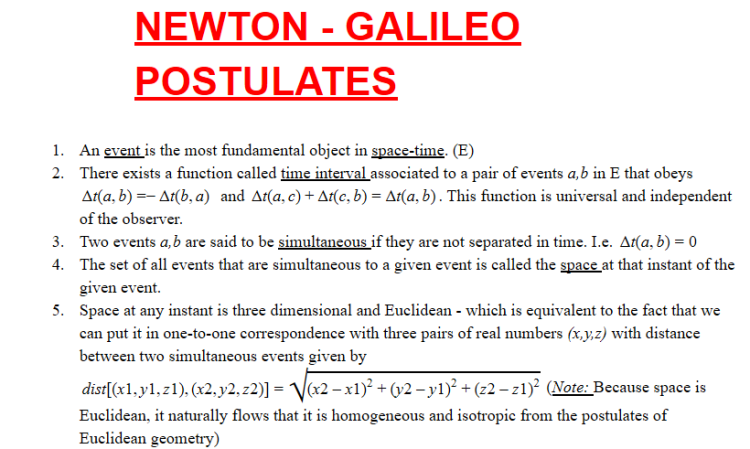
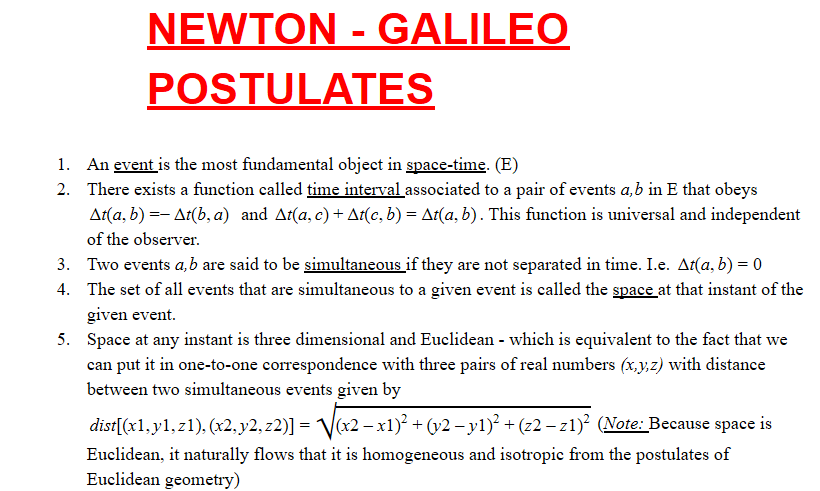
1. Event: An event is the most fundamental object in physics. Physics is the study of events associated to objects. Motion is the set of events associated with a particular object. Chemistry is the study of events associated with combination and splitting of molecules. Biology is the study of events associated with living beings. History is the study of events related to mass human behavior.

2. Space-time: The set of all events is called space-time. Although Galileo didn’t call it so, let us use this name as Einstein used it. Space-time is the word for the set of all events that happens in the universe. It is denoted by E.

3. The notion of a universal Time interval/clock : Galileo postulated (although not in this exact words): There exists a function called “time interval” associated to any two events A and B in space time

i.e. \Delta t: E \times E \rightarrow \mathbb{R}

(Forget it if you cant understand it)

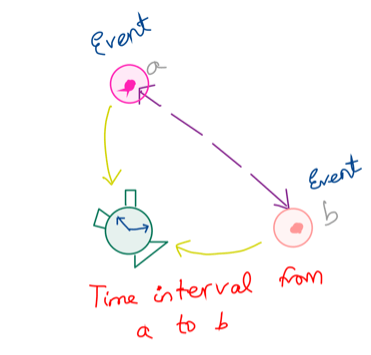
What he says is that, given any two events a,b, there exists a number called the TIME INTERVAL between events a,b such that

(i) \Delta t(a,b)=-\Delta t(b,a) (says that if event ‘a’ happened 3 second before event b, then event ‘b’ happened -3 seconds before event ‘a’ or that ‘b’ happened 3 seconds after ‘a’

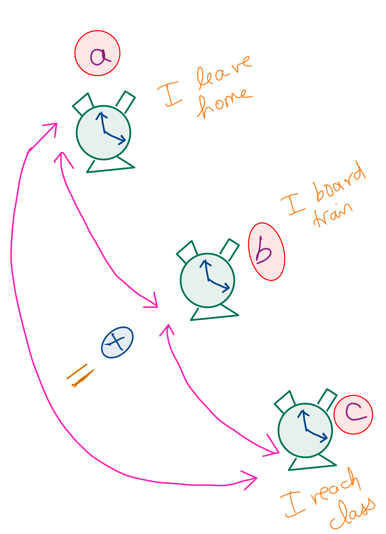
(ii) \Delta t (a,b) + \Delta t(b,c)=\Delta t(a,c) for any three events a,b,c

(The time interval between ‘a’ and ‘c’ is the sum of time intervals between a,b and b,c: One can always calculate time intervals between a pair of events ‘a,b’ with reference to any third intermediate event ‘c’)

Consider the following:

Event a: Clock at home reading 8:00 am when I leave

Event b: Clock at metro station showing 8:10 am when I board the train

Event c: Clock at my classroom showing 9:30 when I reach my college

It better be that time interval between ‘a’ and ‘c’ is 10 min (a,b) + 1 hr 20 min (b,c) = 1.5 hours

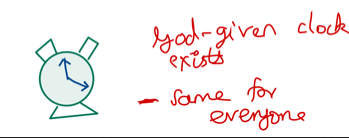
Galileo says that this function “time interval” is universal. There is a universal clock ticking that enlightens one about the time interval between two events. Any observer in whatever state, will measure the same time interval between two events! Thus, the Galilean concept of time is universal. It is same for everyone no matter whatever they are doing. This is a very obvious and intuitive assumption but nevertheless needs to be explicitly stated.

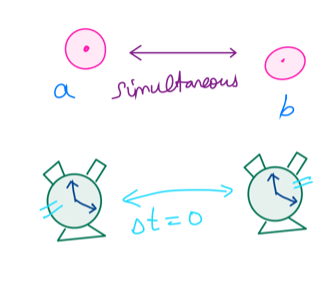
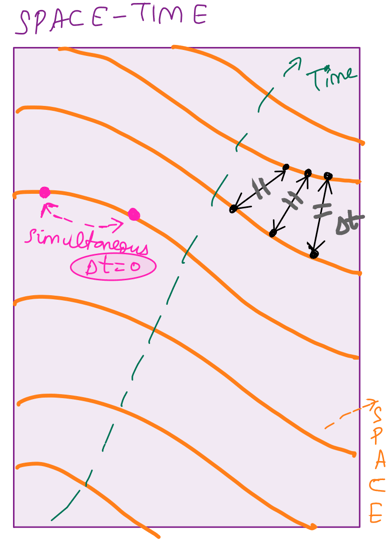
4. The notion of simultaneous events: Two events ‘a’ and ‘b’ are called simultaneous if \Delta t(a,b)=\Delta t(b,a)=0. This is a very natural definition. Since time interval is a universal concept, independent of the observer, the notion of simultaneity is also absolute and universal. If one observer observes two events to be simultaneous, another observer also observes it to be simultaneous.

Theorem 1: Two events ‘a’ and ‘b’ that are both simultaneous to another event ‘c’, are also simultaneous to one another!

Proof: If \Delta t(a,c)=0, and \Delta t(b,c)=0, then by additivity of intervals, \Delta t(a,b)=\Delta t(a,c)+\Delta t(c,b)=0+0=0. So, ‘a’ and ‘b’ are simultaneous as well.

Theorem 2: An event is simultaneous to itself. i.e. \Delta t(a,a)=0

Proof: \Delta t(a,a)=-\Delta t(a,a) (exchanging the two slots) and hence $\Delta t(a,a)=0$

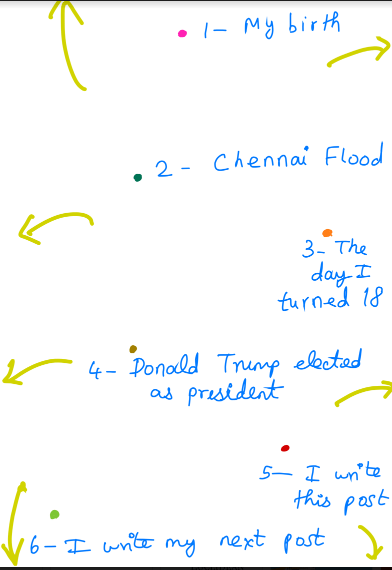
5. The notion of space: The collection of all events simultaneous to a given event is called the “SPACE”. SPACE in space-time is the set of all events simultaneous to a given event. So when I say space, when I am typing this blog, this means that the set of all events simultaneous to the event of me typing this blog. The collection of all such events is called space at the instant when I am typing this blog. But the space associated to another event not simultaneous with my event can be different. For example, the space associated with the event “my birth”, is different from the space associated to the event “I am typing this blog”. Galileo believed in the existence of space and events, independent of the existence of any other material object.

NOTE: Even though we refer to events by giving a certain phenomenon happening related to some objects, the entity which is referred to – the event corresponding to “I am typing this blog” – that dot in space and time is absolute – and whose existence is independent of my existence and me typing here. It is like this. Just because I may refer a piece of land by referring to its current owner, the existence of land is independent of the owner and the owner may change in future and it may not have been owned at all in the past. The notion of that piece of land is independent of who owns it, who does what with it, who mines on it, who grazes on it, who shits on it, or who walks on it even though I may use them for referring to it or identifying it. Similarly, the event referred to as “me typing this blog” is absolute and has an ethereal existence of its own even though I use my activity to refer to it. I may not have been born at all in this world, and still at this event, someone else would have been doing something at this event I am referring to, and still that also is a valid pointer to the event. So the concept of an event is part concrete and part imagination. But then the only difference is that all of mankind can have this same fantasy of an “event”, “space” and “time”. For that sake, even the concept of numbers are like that. Even though we use symbols and objects to learn and refer to them, their existence is independent of all such objects and persistent and consistent in all of our heads. (just like the fantast of a “point” in geometry)

Similarly, the notion of a space, which is the dark naked empty space at a given time, independent of objects was imagined by Galileo!

6.Space is three-dimensional and Euclidean:

As we have seen that Euclid’s infinite plane can be put in one-to-one correspondence with two sets of real numbers \mathbb{R}^2, with distance between two points dist[(x_1,y_1),(x_2,y_2)]=\sqrt{(x_2-x_1)^2+(y_2-y_1)^2}, it looks like our space is not Euclidean plane! Just a single plane of Euclid is not seemingly enough to cover all of space.

As an exercise: I leave it to you to come up with what all notions are required to capture the full space around us and extending Euclid’s postulates to this extended space. There are many ways to do this and these go under the name of Hilbert’s axioms, Tarski’s axioms and these are all ways to extend this Euclidean system to the space that seems to be insufficient to be covered by a plane.

Fundamental vocabulary and definitions: Almost same as Euclidean plane with few extra notions in bold letters – point, infinite space, distance, angle, translation, rotation, point, line segment, infinite line, congruence, containment, plane, infinite plane, parallel lines in a plane (notion of parallelism of lines is defined only in a plane – two lines are parallel if they lie in the same plane and they do not intersect how much ever extended) , parallelism of planes (two planes are defined to be parallel if they do not intersect, no matter how much ever extended)

You can look up Hilbert’s / Tarski’s axioms but more or less the flavor of axioms will look something like:

Given two distinct points in entire space, there exists a unique straight line joining them

Euclid’s postulates hold in any plane

Given three points, not all of them lying in the same line, there exists a unique plane containing all of them (and any plane can be extended uniquely into an infinite plane)

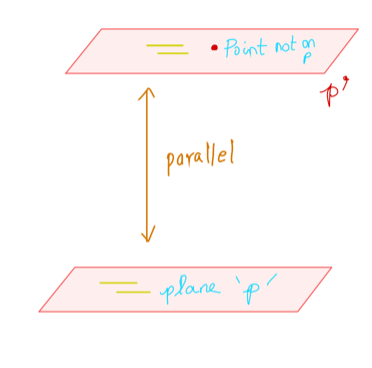
Given a point P not on a given plane p, there exists a unique plane p’ passing through P and parallel to P.

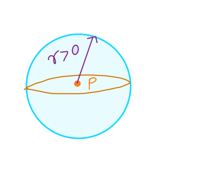
Construction of spheres of any centre and positive radius or some equivalent of them

Some form of homogeneity and isotropy like “All right angles are equal”. Some notion of congruence between any two points and any two directions (just to say that space looks the same everywhere and in every direction – homogeneity and isotropy!)

And some other formal notions and common notions regarding numbers….

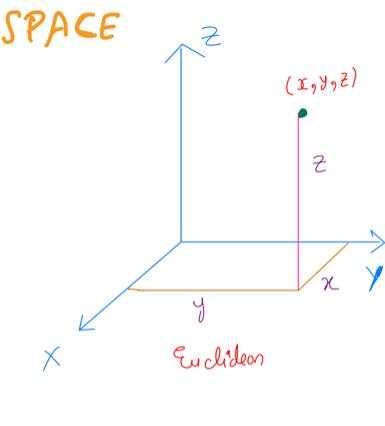
So with all this, we can prove that the “Euclidean space” can be put in one-to-one correspondence now with \mathbb{R}^3 , a set of three numbers (x,y,z) with the distance formula dist[(x_1,y_1,z_1),(x_2,y_2,z_2)]=\sqrt{(x_2-x_1)^2+(y_2-y_1)^2+(z_2-z_1)^2}

This is something again that has got drilled into you right from high school.

So what Galileo says is that

The set of events simultaneous to a given event, called “space” at an instant, is a Euclidean space and can be put in one-to-one correspondence with \mathbb{R}^3 with the distance formula dist[(x_1,y_1,z_1),(x_2,y_2,z_2)]=\sqrt{(x_2-x_1)^2+(y_2-y_1)^2+(z_2-z_1)^2}

Again, as I have warned already, what we observe is a tiny portion of space-time and postulating that the entirety of space is Euclidean seems so far fetched but it works and it is the most natural thing as pointed out already in Week 4.

So what we have done so far is summarized below:

So, if we take all the events simultaneous to a given event, called as space at that instant, then it is natural that it is 3 dimensional and Euclidean as it is indeed so according to our experience.

THE IDEA OF AN ABSOLUTE SPACE:

The notion of an absolute space!!??!!??!!?? – Intense philosophical debates

Now starts one of the intense debates in physics. But this debate can never be settled as it can be proved to be impossible to regard one claim as correct. The issue is as follows:

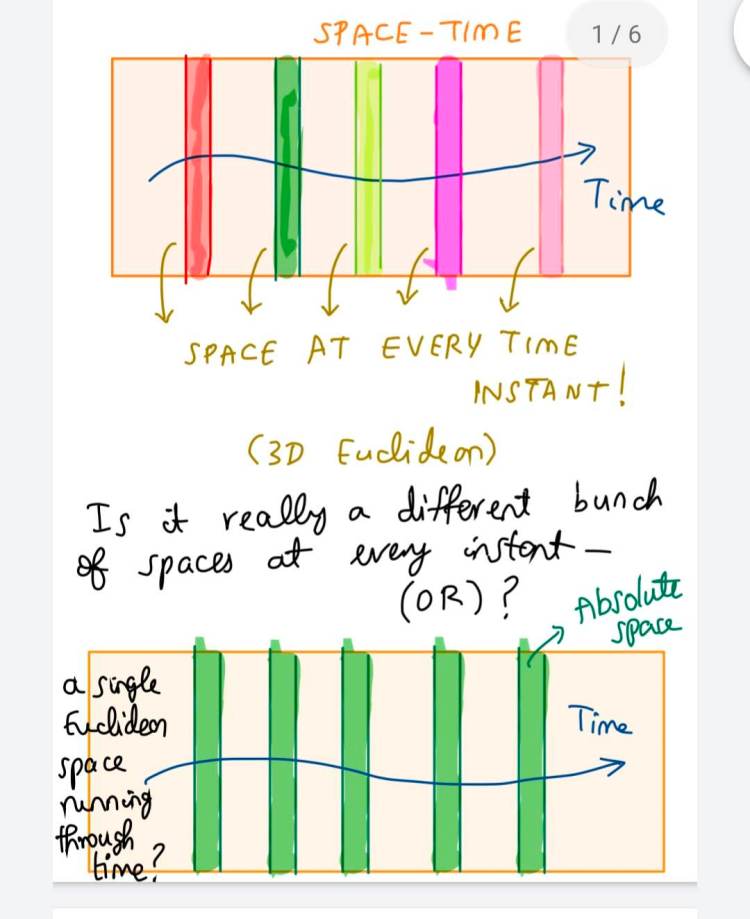
The issue is as follows: At each fresh instant of time, we are blessed with a three-dimensional Euclidean space (which is homogeneous and istropic). At a given instant, we can compare points and we can distinguish between points – say right now – the point where the close icon X of your laptop or desktop is the point P and the point where your index finger tip is Q. But at the very next instant, we start afresh. We are now given another fresh set of points that forms a three dimensional Euclidean space and we can now label these set of points as well. Now the question is as follows:
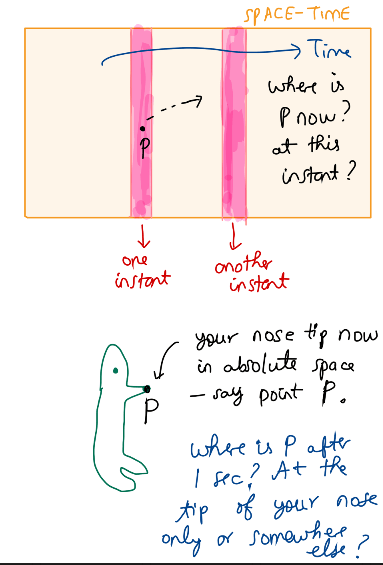
Is there something – a single 3D Euclidean space – called the absolute space – whose points when labelled with time, constitutes the set of all possible events? To rephrase it, if an event at a particular time is labelled as point P in space, then, at later time, does it make sense to ask where is that point P? Is space-time really a single absolute still space that is running through time, or is it really a bunch of fresh Euclidean spaces, each arising at different instants of time?


This is very deep. Note that we are talking about only properties of events. As I said, even though I may use external objects and phenomena to refer to events, the notion of event still makes sense and has an independent existence. So, let us strip our entire universe of any external objects and stare at only the dark naked and empty universe – we are asking about that. Is it really a fresh bunch of Euclidean spaces at each instant of time – or is it just a single Euclidean space labelled by time? All we know for sure is that at each instant, the collection of all events at that instant (called space) is three dimensional and Euclidean. Most of us would prefer to say that the answer is latter. i.e Space-time is a single space running through time.

Is space time a single absolute space running through time or different fresh euclidean spaces at every instant?

If yes, let us ask this question. Let us say the point corresponding to your nose tip, is labelled P at this instant. Since space-time is just a single space running through time, I ask you where is the point P after say 1 seconds? You might say, it is ridiculous. After 1 seconds, the point P is the same tip of my nose, as it was before.
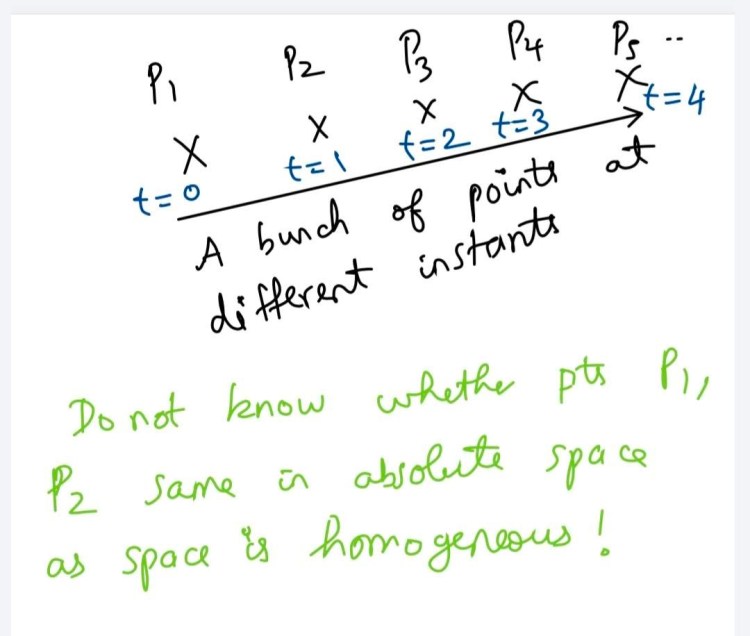
But is it true really? How do you know that the tip of your nose stays at the same point of absolute space, as time progresses? After all, you are sitting on earth which is rotating and revolving around the sun. So the point where your nose tip was 1 seconds ago, would now be lagging behind the tip of your nose now, as your nose is moving with the earth and I asked you for the point P. Will you be satisfied if you are now at the sun 😛 and I ask you the same question? Say, you are now standing on the SUN and let point P now correspond to the tip of your nose. Where is it after 1 seconds? Is it still the tip of your nose? No! THe sun is moving with respect to the Milky Way Galaxy and who knows – the point P that was in your nose tip 1 seconds before might have moved with the Sun and hence the point that was your nose tip 1 second before is no longer your nose tip now! You see what is happening!! We can never know if a collection of points, running through time, is the same collection of points, or moving with respect to absolute space. The root cause of this is the homogeneity of absolute space. Since all points in absolute space look the same, we never know, if any collection of points running through time, (say my nose tip running through time) is indeed the same collection of points indeed. We never know that whether we are moving with respect to absolute space (in a purely geometric way – independent of reference to external objects and phenomena). Because a transport of us to a different point in absolute space would be
undetectable. If you are now at a point in the dark absolute space without any objects or external phenomena, ad while you are sleeping and someone suddenly transports you to some other point while asleep, then after waking up, you would never notice whether you are transported or not without reference to external objects as every point in absolute space is the same geometrically. So even if an absolute space exists, which when labelled by time, corresponds to all events of space-time, it is impossible for us to talk of or label individual points in a geometric way. So, while the existence of absolute space may be true, in practice it is not a useful construct as a purely geometric object as we can never keep track of points in the absolute space, through different time instants, as every point in that absolute space looks the same (homogeneity of Euclidean space).

While Galileo and Newton believed in the concept of absolute space, Leibnitz, Mach and others who were his arch enemies (both mathematically and personally) did not believe so and said that motion makes sense only when relative to external objects.

Newton on Absolute Time
Newton on Absolute Space (From his book “Principia”)

HOMOGENEITY OF SPACE-TIME AND FRAMES OF REFERENCES:

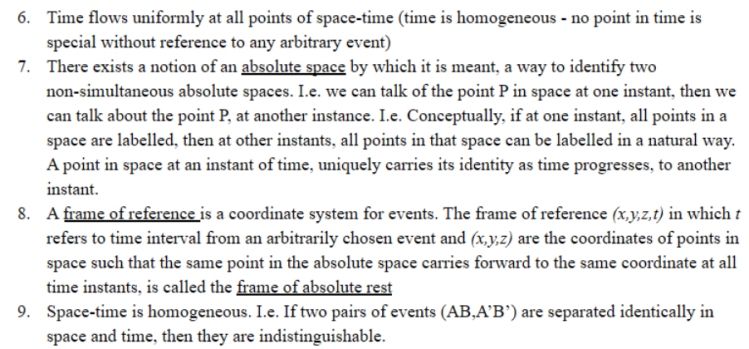
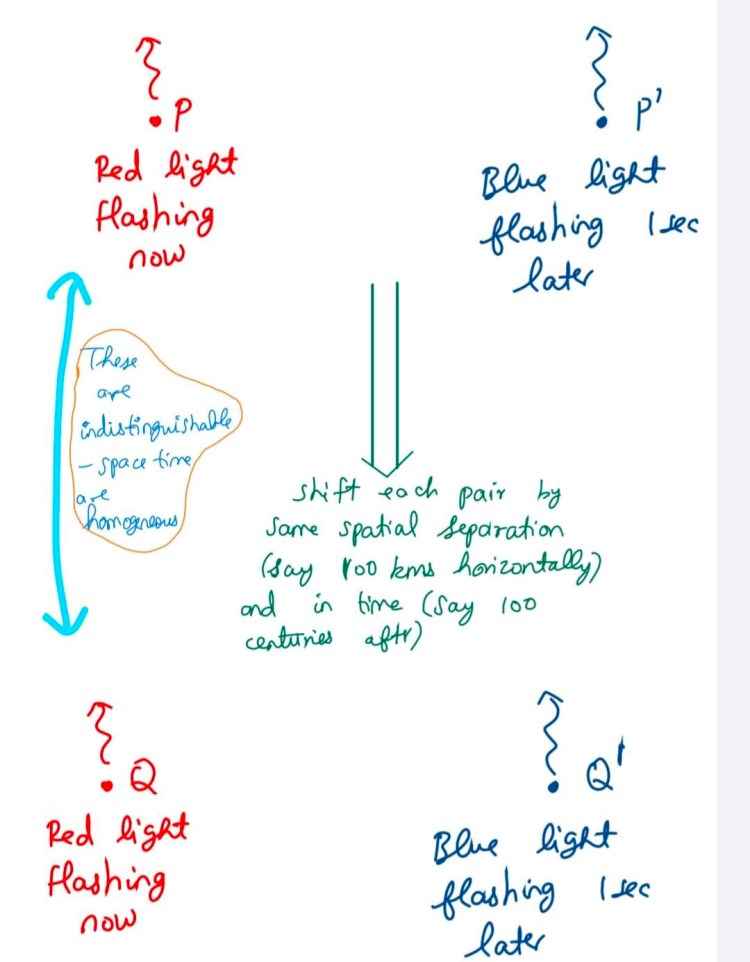
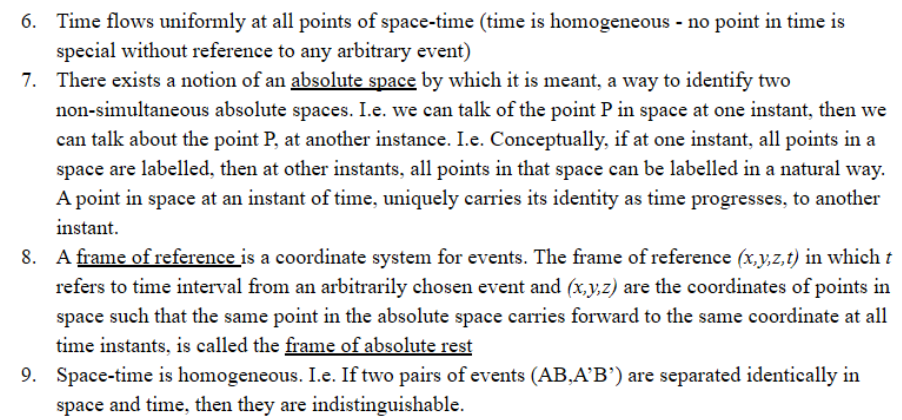
We know that as all right angles are equal, space at an insant or absolute space (if it exists) is homogeneous. Which means every point in the space and hence absolute space (if you believe in it!) is the same geometrically. Any distinction between two points in absolute space comes only with reference to some external object or phenomena while the existence of space-time is assumed to be independent of all such external stuff. And also every instant in time is same. Every moment in time is same. Time flows uniformly everywhere. It is impossible to know how much time you have slept without any reference to external objects like clocks or stuff. Galileo combined homogeneity of absolute space and time and came up with a homogeneity of space time as follows: There is no privileged event in the universe. Every event in the absolute space-time universe is the same. If there are two pairs of events (P,P’) and (Q,Q’) such that the time separation and space separation is the same for the pairs (P,P’) and (Q,Q’), then according to Galileo, you can never distinguish between the two pairs. Let P: a red light is flashed now and here and P’: Blue light flashed 1 second later and 1 metres to the right. Now, let Q: red light flashed 100 centuries later and 100 kilometres to the right from here and Q’: Blue light flashed 1 second after Q and 1 metres to the right of the point corresponding to Q. Then according to Galileo, without reference to anything external, we can never distinguish between the pairs. The absolute point in space-time does not matter and cannot be inferred by just the geometric measurement of distances and angles in absolute space and time interval measurement in space-time. As everything we can measure is only separation of points and time intervals between events, it is impossible to determine without anything external, the absolute location in space-time of a pair of events.


Frame of reference:
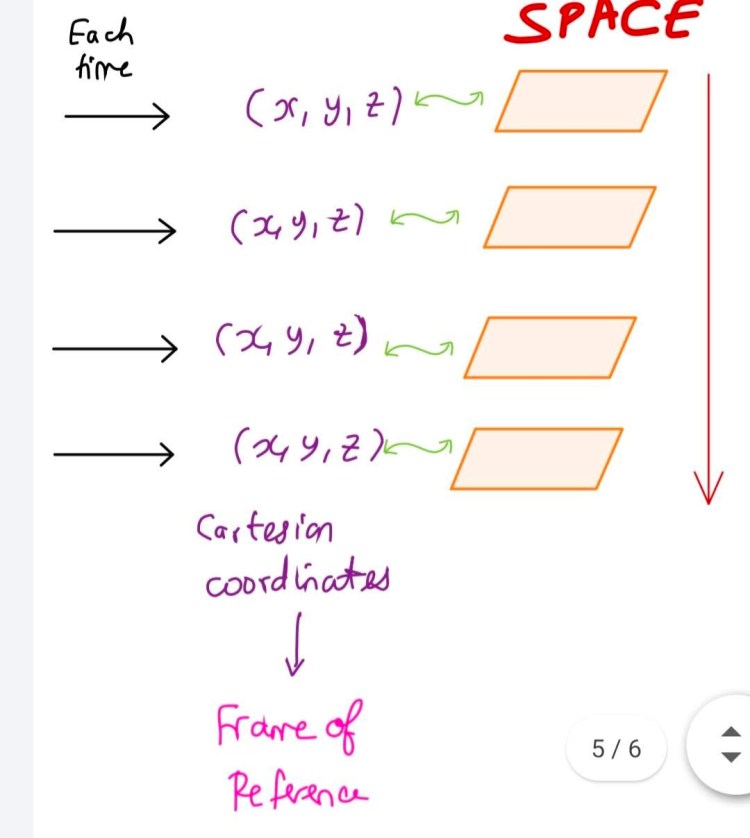
As we could do Cartesian coordinates for geometry, frame of reference is the generalization of assigning numbers to space-time. A most obvious way to assign coordinates to space-time is as follows: We can assign 3 numbers (x,y,z) called Cartesian coordinates for space at a given time instant. All we need to do is to choose an origin in space at that instant and three set of perpendicular right handed directions. With this, we have exhausted labelling space – i.e. events at a given instant of time. But now we have to do this process yet again at another instant. We have to assign fresh coordinates to space at some other time. So, to exhaust all possible events, we have to assign Cartesian coordinates space at each instant. Such a process of assigning a set of Cartesian coordinates to space at all times is called FRAME OF REFERENCE. A frame of reference is a choice of a Cartesian coordinate system to space at every instant of time. So the labels (x,y,z,t) where ’t’ is the time interval from a reference event and (x,y,z) is the set of Cartesian coordinates to space at that instant ’t’ is called a frame of reference. A frame of reference is nothing but a choice of Cartesian coordinate system to space at each instant of time which is then used to parametrise space-time.

Note that there are many choices. At each instant I can make an arbitrary choice of coordinates. There is no natural frame of reference in space-time. But this is where the notion of absolute space helps, if we believe in it. If we believe in absolute space, then a natural way to assign frame exists. We can choose frame of reference such that the same point in absolute space goes to same coordinates (x,y,z) at all instants. Since space-time is really one single absolute space running through time, if we assign Cartesian coordinates at a single instant of time, then we can
extend it to other instants by making the same point in absolute space go to the same coordinates that it was assigned at the reference instant. Such a frame of reference is called the FRAME OF ABSOLUTE REST or ABSOLUTE REST FRAME. Note that this is only when we believe in the idea of absolute space. Note that the ABSOLUTE REST FRAME is a theoretical construct. As we saw before, it exists theoretically, but since space time is homogeneous, we can never know if
our frame is absolute rest!

We are now done with the vocabulary for Galilean relativity in space-time.

We shall summarize what we learnt so far below that contains the definitions and postulates of space-time from Newton-Galileo point of view.

Note that this is not the end. We shall explore some consequences of these postulates in the next week.

Week 5: Zeno of Elea: The crazy world of infinities, infinitesimals and limits – Birth of Calculus

Some infinities are bigger than other infinites

John Green

This week we take a detour from geometry. I was telling you the other kind of geometry that is non-Euclidean and has the feature that given a line and a point not in it, there are many lines passing through the point and parallel to the given line. But that geometry is not quite natural to develop as was the geometry of a sphere. It will require some tools and some familiarity with coordinates and numbers and some calculus. As calculus is an unavoidable toolkit in a physicist’s toolbox, it is better confronted sooner than later. Also historically, the new geometry was invented after the invention of calculus. So this week shall be purely about numbers and functions.

Once again the story starts in ancient Greece! This time it is not with Euclid but another philosopher called Zeno. He put forth several paradoxes (not really paradoxes) which can be explained only when one has familiarity with the infinite.

Zeno of Elea

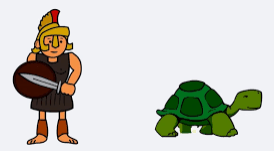
First paradox of Zeno – Achilles and the tortoise:

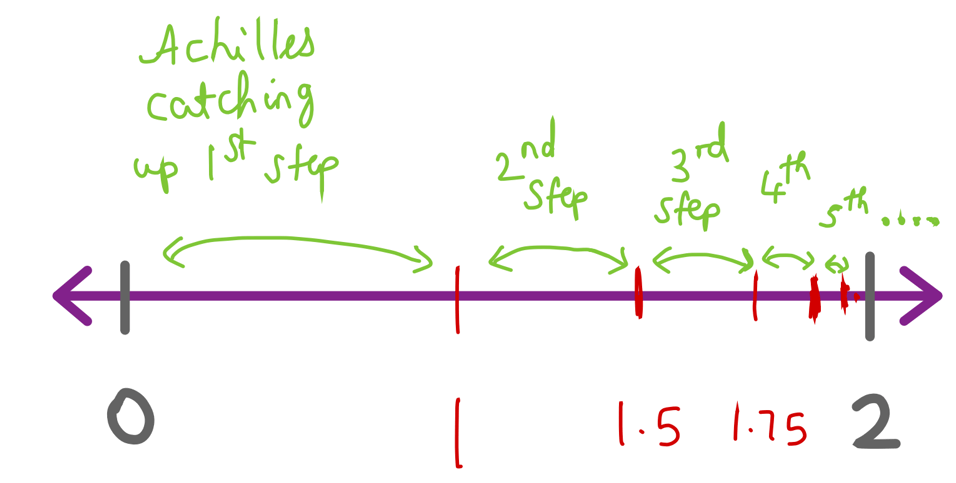
The number line

The first paradox concerns this: Imagine that Achilles is initially at x=0 of the number line shown below and travels at a uniform speed of 1 metres every 1 second. The tortoise on the other hand is initially at x=1 in the number line (it gets a headstart) but has a speed of only half a metres every one second. Now any child will know that even though the tortoise gets a headstart, since it is running slower than Achilles, Achilles eventually will overtake the tortoise in some time

Let A(t) denote the position of Achilles at time ‘t’. Since Achilles travels at 1 metres every 1 second, we have \frac{A(t)-A(0)}{t-0}=1. But since Achilles starts at 0 initially, A(0)=0. So Achilles motion is given by a(t)=t. On the other hand, let the tortoise position be given by T(t). Tortoise speed is half and initially starts at 1. So we have \frac{T(t)-T(0)}{t-0}=\frac{1}{2} and putting T(0)=1, we have T(t)=1+0.5t. Now, we see clearly that for t<2,

t<2 \Longleftrightarrow 0.5t<1 \Longleftrightarrow t - 0.5 t < 1 \Longleftrightarrow t < 1 + 0.5t \Longleftrightarrow  A(t) < T(t)

And similarly,

t>2 \Longleftrightarrow 0.5t>1 \Longleftrightarrow t - 0.5 t > 1 \Longleftrightarrow t > 1 + 0.5t \Longleftrightarrow A(t) > T(t)

So, we have that for the first two seconds (t<2), Achilles is behind the tortoise (A(t)<T(t)), and after two seconds, Achilles beats the tortoise and keeps moving ahead. i.e. A(t)>T(t). This is common sense. A fast person will eventually beat a slow person even if the slow person has an initial headstart. It is only a matter of two seconds or whatever depending on the exact speeds and the initial headstart.

But Zeno argues that this will not happen and it is called the Zeno’s paradox.

He argues as follows:

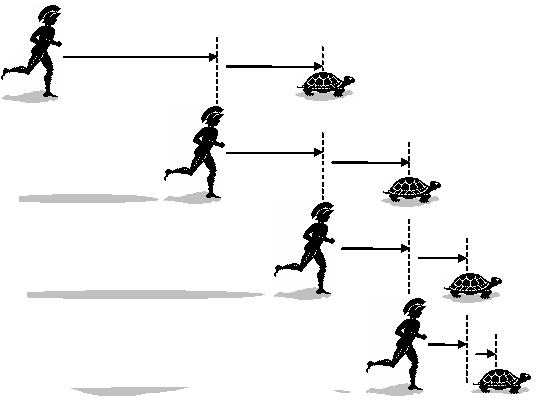
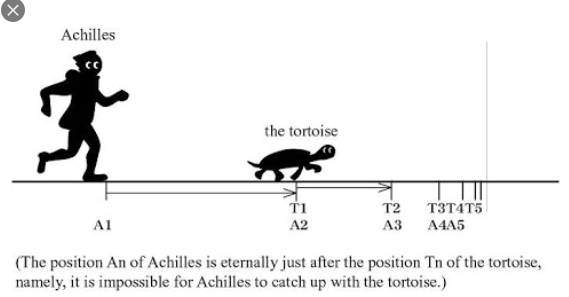
1. Initially, the tortoise is farther – T(0)=1, A(0)=1. So it will take some time t_1 for Achilles to reach where the tortoise was initially.

2. But in this time t_1, the tortoise even though however slow, would have moved ahead by some distance apart, to some other point – T(t_1).

3. Achilles now should has to reach T(t_1) now from the old position, T(0). This will take some time t_2.

4. But again in this time t_2, the tortoise would have moved some smaller distance no matter however slow, to a new position T(t_1+t_2).

5. Now Achilles has to start afresh. From the current position T(t_1) he has to reach this new position T(t_1+t_2) and this will take him some non-zero time t_3 no matter however low.

6. And so on…….

This continues forever

So Zeno argues that Achilles can never reach the tortoise as he has to keep on chasing the tortoise “infinite” times where the tortoise is going. Achilles will take t_1+t_2+t_3+t_4+..... seconds to reach the tortoise and each of the t_i are positive and nonzero, however small. So Zeno argues that it is not possible that Achilles can catch up with the tortoise in two seconds, because Achilles will have to keep following the tortoise. So, he argues that logically, the possibility of Achilles overtaking the tortoise is impossible.

But we know there is something fishy in Zeno’s argument as we intuitively know and also from the equation of motion for A(t) and T(t) that within two seconds, Achilles should overtake the tortoise. It looks like if Achilles has to think about covering the distance that the tortoise traverses, it looks like it will take forever as he has to keep on covering the tortoise’s old positions again and again. But looks like if he does not care about it, things are normal.

Second paradox of Zeno – motion is impossible logically and is an illusion!

According to Zeno, by similar arguments, he argues that motion is impossible logically and it is hence an illusion. He argues that it is impossible to move from a point A to another point B in a line (say).

1. Then first I have to reach the point that is halfway between A and B, say A1. It will take time t1. (non zero time – as I cannot be in two different places at once)

2. Having reached A1, I now have to cross the point halfway between A1 and B – say A2. Again I will take some non zero time t2 to reach from A1 to A2.

3. Having reached A2, I now have to reach the point that is half way between A2 and B and I will take some time t3 to reach that.

4. And on and on. So I have to keep chasing infinite number of half way points A1,A2,… in times t1,t2,…. and hence I can never reach from A to B.

If you continue traveling half the distance that is left, you’ll never get to point B because you can always slice the remaining distance in half again

So according to Zeno, motion is an illusion and I can never reach from any point A to any other point B.

But everyday experience shows that I can reach from A to B in finite time. If B is 1 metres to the right of A, then travelling at a constant speed of 1 metres every one second, I can reach B in 1 second.

What is wrong in these flow of arguments by Zeno although they seem logically solid!

This is where the delicate issue of limits come into picture. Normally, the concept of limits is introduced only in high school that too in a highly unmotivated manner but with these examples, we can introduce it to even small children who would be more curious about these things.

Let us now prove deeper into this. First let us take the first problem. Achilles and the tortoise. The first logic that involved calculating A(t) and T(t) (where we did not think about Achilles covering the tortoise’s old way points), it was found that Achilles would beat the tortoise in exactly two seconds.

Let us now calculate the explicit time involved:

Initially, Achilles is at 0 and tortoise at 1. Since Achilles is moving 1 units of distance every 1 second, it will take 1 second for Achilles to cover from x=0 to x=1

So, t1=1

Now, in this this 1 second, the tortoise, moving at 0.5 units per second, would have covered a distance 0.5. So it will be at T(1)=1+0.5 (1: initial point, 0.5: additional distance covered from there)

Now, Achilles has to move from his present position (x=1) to tortoise’s new position (x=1.5)

So, he has to cover 0.5 units. Since he travels at unit speed, it would take 0.5 sec.

So, t2=0.5

Now in this 0.5 seconds, the tortoise would have covered 0.25 metres as it is going half metres every second.

Now to cover this 0.25 metres , Achilles would take t3=0.25

Repeating this, we get t_n=(\frac{1}{2})^{n-1}

Achilles, to cover n waypoints of the tortoise, will take time t_1+t_2+....+t_n seconds which is

1+\frac{1}{2}+\frac{1}{4}+\frac{1}{8}+...(\frac{1}{2})^{n-1} seconds

I think if you had studied high school, you might have seen this somewhere! It is called the geometric series.

If you struggle with it, a little bit, you can evaluate this sum 1+\frac{1}{2}+\frac{1}{4}+\frac{1}{8}+...(\frac{1}{2})^{n-1}.

Let S_n= 1+\frac{1}{2}+\frac{1}{4}+\frac{1}{8}+...(\frac{1}{2})^{n-1}. Then

\frac{1}{2}S_n=(1-\frac{1}{2})S_n=S_n-\frac{1}{2}S_n=(1+0.5+0.25+...+\frac{1}{2}^{n-1})

-(0.5+0.25+0.125+...+\frac{1}{2}(\frac{1}{2})^{n-2}+\frac{1}{2}(\frac{1}{2})^{n-1})

We now see that the terms cancel nicely and we are left with

\frac{1}{2}S_n=1-(\frac{1}{2})^n

So, S_n=2(1-[\frac{1}{2}]^n))=2-(\frac{1}{2}^{n-1})

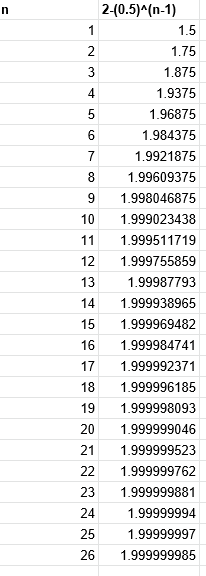
So, it will take 2-(0.5)^{n-1} seconds for Achilless to overtake the tortoise n times. Now let us put a table of how this varies with n.

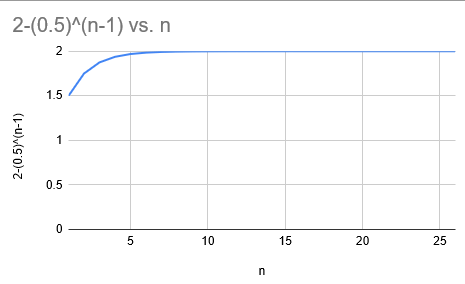
Plot:

Now here comes the cool part:

Although Achilles has to chase the tortoise infinite times, looks like he will cove rall these infinite steps in just two seconds (see the graph or data above)

As n becomes very large, S_n becomes closer and closer to 2. Although it never does become 2, we observe that it keeps getting closer and closer to 2.

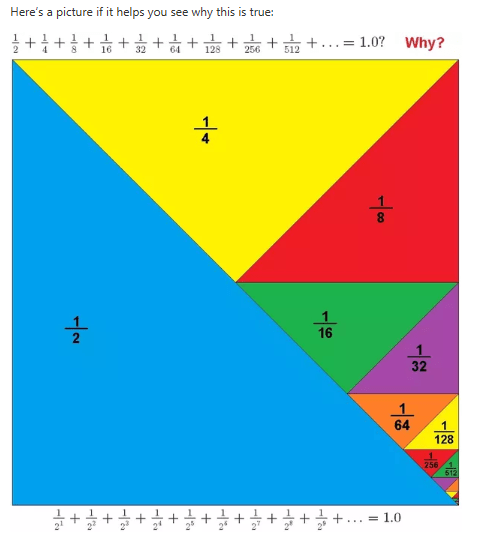
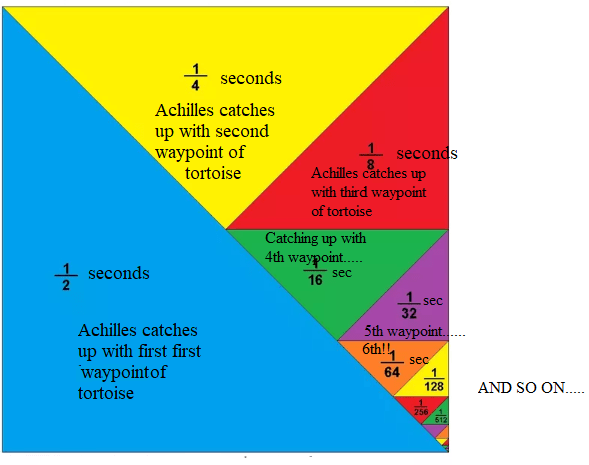
Another way to convince yourself that the “infinite sum” 1+\frac{1}{2}+\frac{1}{4}+\frac{1}{8}+...=2, I give a diagrammatic proof below:

Geometric Proof

We can see that we can divide a unit square into infinitely many pieces, each of area \frac{1}{2},\frac{1}{4},\frac{1}{8},... and we realize that although we can never reach the full unit square by pasting any finite number of those pieces all together, we can get how much ever closer we want to 1 because the residual area \frac{1}{2}^{n} goes arbitrarily small as n goes arbitrarily large.

We see that although we are pasting together infinite number of triangles, the area resulting in it can still be finite.

What Zeno has done is divide the 2 seconds gap where Achilles beats the tortoise into infinitely many gaps where in, at each gap, he chases the previous position of the tortoise.

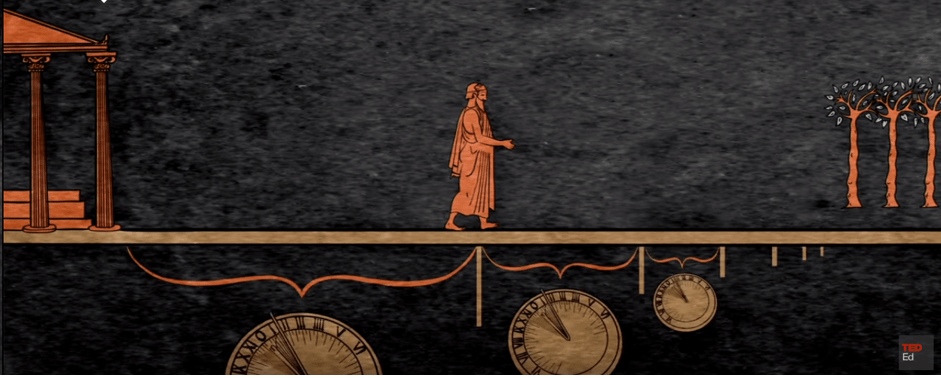
Dividing Achilles’ 2 seconds into infinite segments of journeys

SO a resolution of Zeno’s paradox lies in the fact that a finite part of length/time/real number can be broken into infinite pieces of segments and eventhough we do not get the original piece back by merging how much ever finitely large number of pieces back, we somehow get the original segment back when we merge all the infinite pieces!!

Dividing two seconds of Achilles’ beating time into infinite segments of way points

The resolution of Zeno‘s second paradox is also exactly similar. We have divided the segment of the journey between A and B into infinite number of way points by continuous halving of the segments. So we cannot expect to get the original segment back by merging/adding finite number of steps. Following this we are tempted to believe that “we can add infinitely many numbers” .

But it is at this stage, we must be careful. We can repeat the same paradox with Achilles running slower than the tortoise and this time, truly, Achilles cannot catch up with him. So when we add the infinite segments together, we cannot expect to get a finite answer.

Example: If t_1+t_2+t_3+t_4+...t_n+...=1+2+4+8+16+....2^{n-1}+... then, we keep getting ever larger and larger numbers as we keep adding more and more terms (this is what happens when the tortoise is twice as fast as Achilles) and hence in this case adding infinite sums won’t make sense and is not expected to make sense as in this time, Achilles can never catch up with tortoise in any finite time.

Now, based on this, we give the following definition:

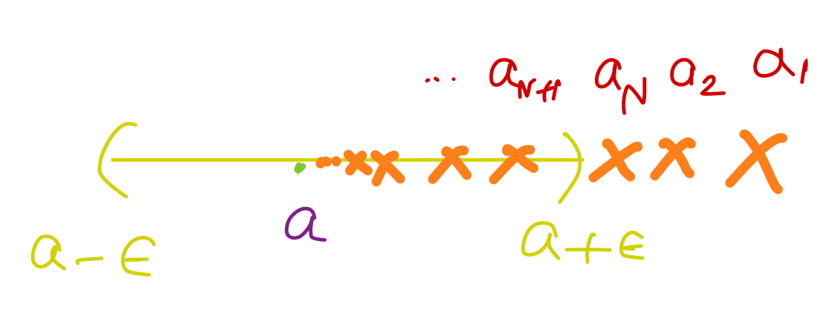
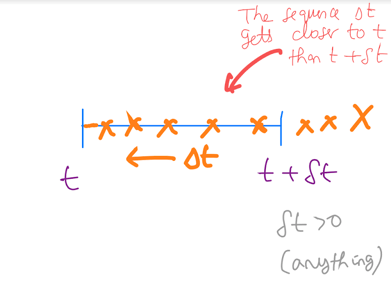
Definition 1: A sequence of real numbers a_1,a_2,...a_n,.... is said to converge to a number “a”, if given any tolerance \epsilon>0, there exists a large enough number N such that for all n\geq N, we have that a_n \in (a-\epsilon,a+\epsilon)

where a_n \in (a-\epsilon,a+\epsilon) means that a-\epsilon<a_n<a+\epsilon

Given any degree of closeness \epsilon to a, after a certain stage, the sequence gets that close to a

It captures intuitively that even though the sequence may not become the number a after any large number of steps, we have that, after a large enough number of steps, the elements of the sequence comes very close to the number a, and given any degree of closeness we demand from the function, by choosing \epsilon>0 very small, it is just a matter of large enough N after which the elements of the sequence all come and fall into that \epsilon neighbourhood of a.

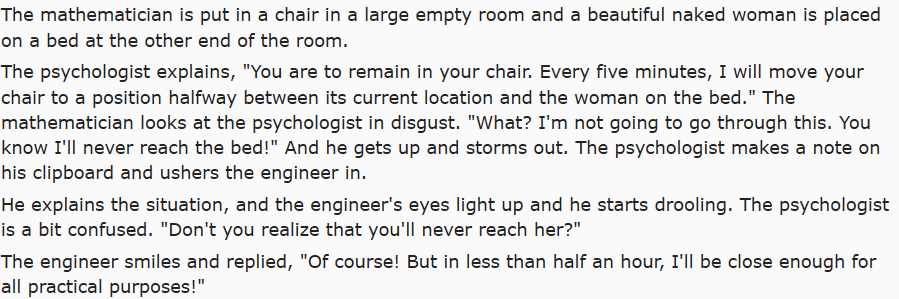
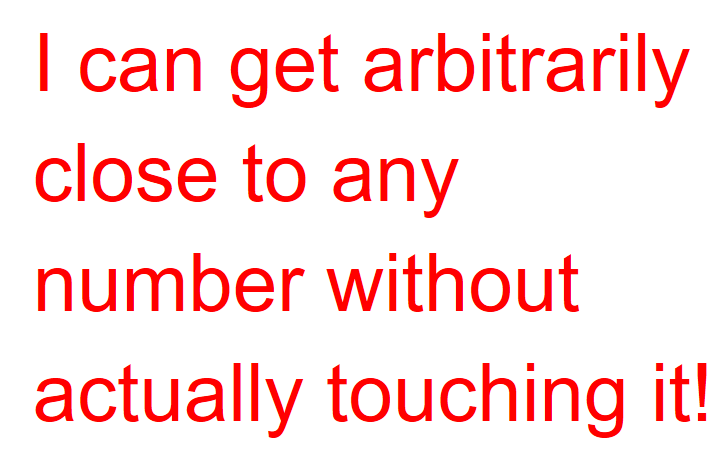
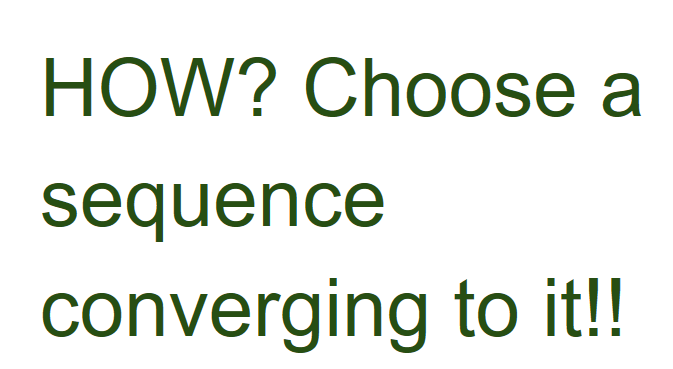
So, we have that the sequence t_1+t_2+.....t_n converges to 2 seconds. When a sequence of sums a_1+a_2+...+a_n converges to a number a, we say that the infinite sum of a_1,a_2,... is a. The fact that a sequence converges to a is also stated as: The limit of the sequence is a Using this concept of limits, we can get how much ever close to a number a we want, by using a sequence that converges to a, without actually getting to a. A joke to lighten the mood below!

The mathematician might be called as Zeno who thinks that nothing is gonna ever happen between him and the girl!

So the moral so far is:

THE BIRTH OF CALCULUS:

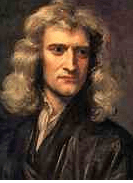
Sir Isaac Newton
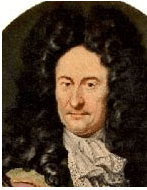
Gottfried Wilhelm Leibniz

PIC: Founding fathers of calculus – Newton and Leibniz

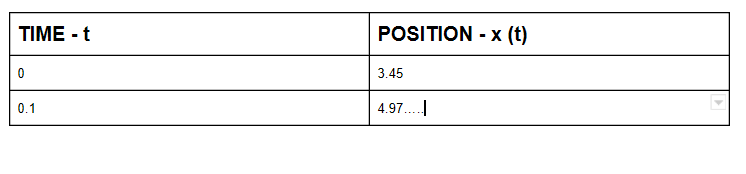
This spirit of limits is what gave birth to calculus. Newton was watching the motion of a cart in a road and he observed the behavior of the position of the cart at each instant of time. Assuming the road to be a line and making it into a numbered line, we can capture its movement by having a table of position vs time as follows:

In other words, motion in a line can be specified by a function from a number “time” to another number “position”, denoted by x(t)

In other words, for every time t, we need to keep track of $x$, that depends on t and hence the notation x(t)

Now, Newton asked, what is the speed of an object moving arbitrarily in a line as x(t). Of course if it were moving with a constant velocity such that it covers equal intervals of length in equal intervals of time, then we define speed as a single number \frac{x(t_2)-x(t_1)}{t_2-t_1} and this number will be independent of t_1,t_2 chosen (as long as t_1\neq t_2) since we are given that it always covers equal intervals of distance in equal intervals of time.

Now Newton asked, what if the object is moving in a completely arbitrary way such that the speed is not constant in any segment of the journey? Lets say the object travels in a line according to the relation x(t)=t^2. Definitely, the speed depends on t_1,t_2 chosen. So one is tempted to then say in this case that “the speed varies from point to point“. But what is meant by the word “speed at a point – or speed at an instant – say speed at time t=3sec?

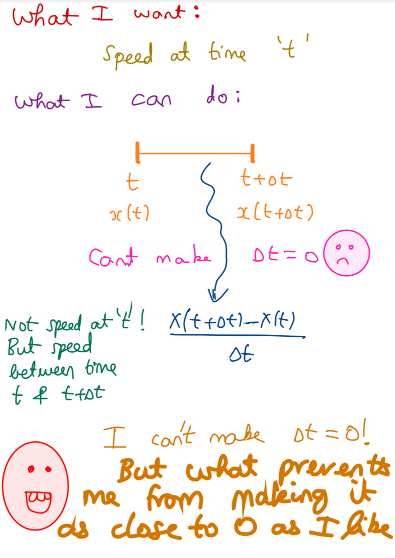
To define speed at say time ‘t’, we run into a paradox. To define speed, we need two distinct instants of time (t_1\neq t_2) to calculate change in position with respect to change in time.

But we have only one instant given to us, which is time t.

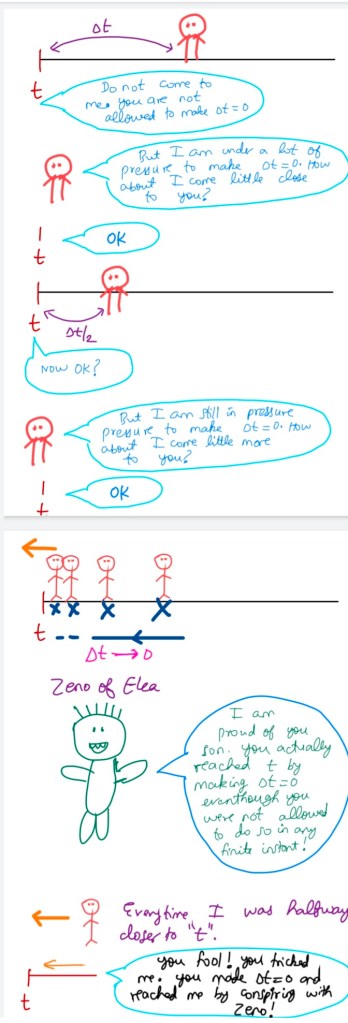
We can take one of the instants (say t_1) as t. But the other instant has to be different from t. t_2 has to be t_2=t+\Delta t where \Delta t \neq 0

So, we run into a conundrum. We want to make \Delta t=0 so that we do not use any other instant to calculate speed. But we cannot make \Delta t=0.

But if we take t_2=t+\Delta t for any non zero \Delta t, Newton objects by saying that you are not calculating speed at time “t” but the average speed between t, t+\Delta t

Now the below cartoon signifies the thought process that led to the birth of calculus – or notion of speed at an instant of time , even though we need two instants of time to talk about speed!

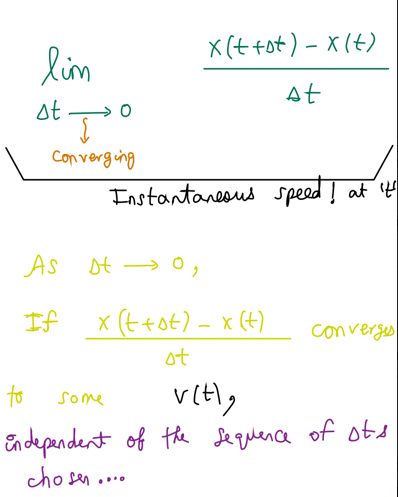
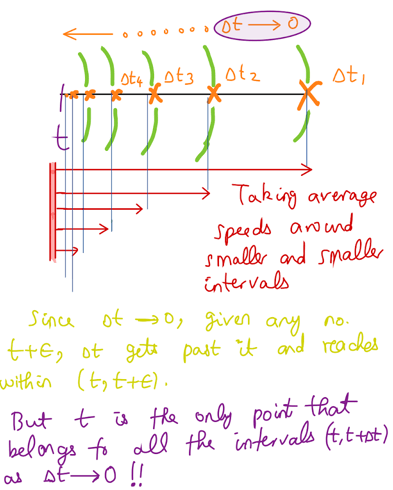
\Delta t can never be made to 0 but can be made to converge to 0!!

Now the cunning mind of Newton thought: I cant make \Delta t zero but I can make it as close to 0 a I want by choosing a sequence converging to 0.

Now as we choose a sequence of \Delta ts that converges to 0, the corresponding speeds calculated, if they converge to some number, independent of the sequence chosen, then that limit is very important.

Such a limit if exists, is called instantaneous speed at time ‘t’.

Instantaneous speed is defined as:

The limit of the sequence of the average speeds around t as they become smaller and smaller…. (if exists) is called the instantaneous speed v(t)

The limiting speed that is calculated, called the instantaneous speed at time t is not the speed between time t and any other instant. Because for every imaginable separation \delta t from t, the sequence \Delta t continued from then on and got closer to t than \delta t.

The sequence gets closer to ‘t’ than any other point that we choose, eventually and hence is actually a state of affairs at ‘t’ indeed – not between t and t+t+\delta t for any \delta t

Such a limit, if exists, independent of the particular sequence of \Delta t chosen, is called the instantaneous speed v(t) of the particle at t. Note that it is the speed at t as we have that it goes to zero in the limit, even though it actually does not go to zero!

It is not the speed between t and any other point as we eventually will make t+\Delta t closer to t than any given point. Eventually, it is just a matter of time.

Another perspective to convince you that it is the speed at an instant really, what we have essentially done is this:

I found the speed \frac{x(t+\Delta t) -x(t)}{\Delta t}. But some one complained that it is not the speed at “t” but an average state of affairs between “t, t+\Delta t“. So let’s say I halve the time interval. I now calculate this average speed between t and 0.5\Delta t. But again someone else complained that it also isn’t the instantaneous speed. But an average state of affairs between “t, t+0.5\Delta t“. So I was sad. To satisfy that person I again halved my interval into 0.25\Delta t. But even then someone else complained. So I calculated for0.125\Delta t. I kept on doing this. I realized that I was just wasting my time satisfying the whims and fancies of every person. I realized that how much ever I reduced my interval \Delta t, someone else is gonna ask me to reduce even further. So I realised that at no stage I can satisfy anybody. But I prayed to Zeno and he made me realize that even though at no finite stage can I satisfy anyone, if I keep on evaluating the speeds for lower and lower \Delta ts, then if these approach a limiting value, then in that limit I satisfied anyone. Because that limiting value of 0.5\Delta t is zero. I realized that by reaching out halfway to zero everytime, even though I never reached zero actually, I reached zero in the limit. So the instantaneous speed is indeed evaluated by putting 0.5\Delta t=0 but as I was not allowed to make it exactly zero in finitely many iterations, I followed Zeno and reached 0 in the limit by going halfway to zero everytime or by choosing any sequence that converges to zero!

Let us evaluate this for the function x(t)=t^2

x(t+\Delta t) - x(t)=(t+\Delta t)^2-t^2=2t\Delta t+ \Delta t^2

Hence \frac{x(t+\Delta t)-x(t)}{\Delta t}= 2t + \Delta t

Now, since \Delta t \rightarrow 0, putting \Delta t=0 above, we get

v(t)=2t

This says that the instantaneous speed increases linearly with time. Another notation for v(t) is \frac{dx}{dt}!

So, we have proved that \frac{d(t^2)}{dt}=2t, the good old formula for differentiation in high school!

Exercise: Prove that \frac{d(t^n)}{dt}=nt^{n-1}, \frac{d}{dt}(u(t).v(t))=\frac{du}{dt}v(t)+\frac{dv}{dt}u(t)

So we have learnt two things so far:

1. A finite number can be divided into infinite number of pieces – which when all of them put together will give the original number – but if only finitely many of the pieces are put together, will get arbitrarily close to the number!

2. I can get close enough to 0 arbitrarily without becoming zero by choosing a sequence converging to zero and this enables me to talk of an instantaneous speed at time t even though I need another nearby instant t+\Delta t to talk about speed. (I am making that nearby instant come arbitrarily close to the given instant, as close as I like ,closer than anyone can ever come to, so that I can talk of a limiting speed at \Delta t=0 by choosing a sequence converging to 0. That is called the instantaneous speed.

We will return to geometry next time. See you 🙂

Week 4: Earth is a sphere, where Euclid’s postulates not so dear, and other curiosities…

So last time we saw how Euclid’s fifth postulate was deeply influencing many properties of his plane like the ability to scale objects, the equidistance of parallel lines, the sum of interior angles of a triangle being two right angles, the possibility of translating a straight line to another straight line and the existence of rectangles (due to Saccheri). Also the Pythagoras theorem was found to be equivalent to the parallel postulate assuming the remaining four postulates of Euclid.

Let us now get deeper into how we formulated this Euclidean geometry. We had this notion of an “infinite plane” as our building block. We said that we cannot actually visualize it and it is just a figment of our collective imagination. We introduced this just so that we never ran out of space. We imagined this as the building block and the stage of all of our geometric objects and that which is supposed to explain the shapes and geometry of the real world. We imagined that this “infinite plane with Euclidean postulates” was the world that we live in!

How do we know that the world globally is flat? In fact we would call someone today dumb if they believed Earth was flat!
A doughnut shaped planet could theoretically exist according to astronomers! Such a planet also would locally appear flat

NOTE: When I say “world”, it means the surface of the planet we currently live in. Imagine that you are an ancient Greek who did not have access to any form of flight like spaceships, and all and all that you could do was explore the land. So now we want to know if Euclid’s five postulates hold in the surface of the planet in its entirety although I can at a time access only a small portion of it!

We know only a small portion of the Earth at a time!

Let us see the second postulate: We believe that it does. We believe that the postulates of Euclid hold good in the real material world. Take two points. We can always draw one and only one straight line between them. Seems legit. But what about the first postulate? A straight line can be extended indefinitely? What makes us think that we can keep on expanding our straight line forever? We know that we can do it in our fantasy world of the infinite plane but the material world can be crazy! What excludes the possibility that if we keep on extending, we may hit a barrier and we cannot go further than that? What makes us think that our fantasizing abstraction of the “infinite plane” is indeed the world we live in when all we know is only a small portion of it?

Although the possibility that the real world we live in is such a way that it has a boundary beyond which nothing can be extended sounds unnatural, it is not a logical impossibility!!

Postulate 2 of Euclid says that given any two distinct points, there exists a unique straight line segment joining them. Sounds legit as we said for the points that we can see. But if the real world were crazy and had exotic points, we can never be sure that this postulate 2 is true for all the points in the world. Keeping my ass in Chennai, and just because I find that given any two points in Chennai, there is a unique line segment joining the two points, it seems so proposterous and ignorant (although very natural) to suppose that it holds for all pairs of points in the entire world.

Next postulate 3: All right angles are equal. This needs a deeper explanation. It is in fact the strongest of all the assumptions that Euclid made although it does not seem so. What did Euclid mean when he said that all right angles are equal?

I told in Week 1 that it means the following: Any two right angles anywhere in the plane can be obtained from each other by “translation” and “rotation”. But what is a translation or rotation? We see that on the deepest level, they are correspondences between points in the plane that preserve distances and angles. Such a transformation between points in the world that preserve distances and angles are called technically as “isometries“. So what this postulate says is that given a right angle at point A, and another right angle at point B, there is an isometry taking A to B and that which also takes the right angle from A also to the right angles of B. That part of the isometry that moves between points is called “translation”. And that which takes one right angle to another at the same point is called “rotation”. This actually is very deep. It says that the world is “homogeneous” and “isotropic” on the geometric level at least. That is, the world looks the same around every point looks the same and in every direction. Certainly counterintuitive because it is hot at Chennai and freezing cold at Russia. Also next to my left, I see my genius eccentric friend busily typing in his desk whereas to my front, I see a lifeless piece of wall. The world seems different from point to point and from direction to direction. But what Euclid is trying to say is that it is same geometrically. The notions of hot and cold, living and non living, are not geometric notions. What Euclid is saying is that using measurement of distances and angles, one cannot distinguish between two points. Chennai may be hot and Russia may be cold but I can not see sum of angles of a triangle in Chennai adding to 180^0 in Chennai and sum of angles of a triangle in Russia, adding to 190^0 in Russia. The reason is that if I see something holding true for my geometric object here in Chennai, I can translate it and rotate it to Russia and since they have preserved all distances and angles, they preserve all the geometric properties of the triangle (as it is carried away to Russia by translation and rotation) as everything in geometry is defined in terms of distances and angles.

Transation!
Rotation:

But what if we lived in a world where it were not so? How would it look like if we were given a triangle here, and when we try to move it, it becomes distorted no matter in whatever manner we try to move all its points. i.e. We can never find a distance and angle preserving correspondence between all pairs of points. What if I take a triangle and keep it in my boat and sail all points on the boat in the same direction, only to find that after I reach Russia, the sides and angles of the triangle in the boat is distorted? It sounds like a crazy world to live in but it is a logical possibility if we assume the violation of Euclid’s third postulate!! Of course the sanctity of geometry would be lost but nevertheless we have to accept it as a logical possibility if we rule out the third postulate!

Now comes the fourth postulate: Given any point and any radius, I can draw a circle whose centre is the given point and whose radius is the given radius. In other words, I can keep finding points that are arbitrarily far away from any given point. Again. How? Why in the real world? We will soon see that it is not obviously true given that we live in the Earth which is the surface of a sphere.

We may think that I can draw a circle of radius 100 miles and 1000 miles about Chennai. But what Euclid claims is more. Given any real number how large, whether million or trillion or a zillion miles or beyond any imaginable limit, we should be able to draw a circle of that corresponding radius. Again we underestimated the power of the statement “given any positive radius” . It is not enough if you check for upto 1000 miles or 10000 miles or 100000 miles. No finite number however large is ever enough. We can never verify this postulate in practice even if it holds as our human memory can do only finite number of steps. So again this is a very non trivial postulate.

Practically impossible to verify this postulate if it holds true! All we can do is hypothesize!

Next comes the fifth postulate whom everyone was not having a contention with. Out of all the postulates, somehow for 2000 years, only the fifth postulate seemed unnatural. That too it was not unnatural because Euclid assumed it to be true. It was unnatural as an axiom rather than a theorem. Still people wanted to prove it. They thought only the fifth postulate was least natural whereas as we saw that on a deeper level, all of Euclid’s postulates are very powerful, non-trivial and involve several unjustifiable or even unverifiable assumptions about the world .

Now, in this course, for the sake of relativity, we would have to abandon all these assumptions as these are all too powerful. But people did not realize that while Euclidean geometry seemed natural, the very world they lived in was a sphere and it did not obey Euclidean geometry. People took that long to realize that while Euclidean geometry reigned supreme, there was a non Euclidean geometry right under their nose and sitting right in front of them.

EARTH IS A SPHERE—-

The ancient Greeks realized that the surface of the earth was a sphere rather than a plane. The standard story is that if the Earth were flat, then a ship sailing into the horizon would disappear uniformly but the actual fact is that the mast disappeared in different time than the hull.

Now that Earth is a sphere, this is our plane now. Certainly not the infinite plane but this sphere shall be the object of our new geometry. Points on the surface of the sphere seems conceivable. But what are lines on spheres? What is a straight line on the sphere?

Take two points A and B on the sphere. Forget the sphere. If not for the sphere, the straight line in the space should be the straight line joining A and B. But alas, that straight line in space joining A and B has points that are not on the sphere and hence it cannot be a “straight line on the sphere“. Neverthless we can make that straight line as a guide to forming the straight line on the sphere

The characteristic feature defining a point on the sphere is that its distance from the centre point should be fixed, say R. But our line segment AB in space is not so. So the simplest job would be to make all such points on the line satisfy this condition by pulling them to the R distance along the line joining them to their origins!!

Such a curve is called a GREAT CIRCLE on sphere and should be regarded the straight lines in sphere since that is the closest we could get to a straight line on the sphere!! We also realize that the great circle arises when we intersect the plane passing through OAB with the sphere! So great circles are the intersections of the sphere with planes in space passing through the centre of the sphere.

So now do we have Euclid’s first postulate true? Yes. We can keep on extending the great circle to complete the full circle in the OAB plane and keep going. A straight line can be extended uniquely into an indefinite segment no doubt but it is peculiar that after a while, when we extend, we come back to where we started!

By definition, the extension is unique as there is only one circle lying in the plane OAB that extends the circular arc AB. The arc AB is circular as they are all same distance from O.

Let us try second postulate. Always there exists a straight line between points A and B as there is always a plane that contains OAB and intersects with the sphere. But is the plane containing O,A,B always unique always? Think?

If OAB are collinear, there are many planes (infinitely many) that contain OAB. This happens when A and B on sphere are diametrically opposite. Then we have infinitely many great circles joining A and B as shown below. So certainly in this case it is not unique.

So the second postulate of Euclid already screws up with!

Certainly the third postulate holds as sphere appears to be a symmetric object. Note that when we rotate about any axis passing through the origin in space, points that are on the sphere remain on the sphere.

So translations on sphere = rotations in space about an axis passing through origin

Rotation about the point A on sphere = rotation about the axis OA (as axis is fixed, A is fixed)

As there is rotation taking any line to any other line in the space, (our experience) there is a translation that takes any point to any other point on the sphere. Similarly, as we can rotate from any orientation to any orientation about the same point in the ambient space, we have that we can rotate from any orientation to any other in the sphere also. (Note that angle between lines is defined as the angle between the tangents)

So Euclid’s third postulate definitely holds!!

How to move one right angle to another without distorting distances and angles – Postulate 3

Now comes the fourth postulate! Given any centre and any radius r>0, we can draw a circle centred around that point of any radius r>0. This again does not hold true in sphere. Since the sphere is bounded, there is a maximum distance between two points which happen when they are diametrically opposite. When points A,B are diametrically opposite, any great circle connecting them has length that is half of its circumference and hence the distance between A,B is \pi R. We measure distances as we did in Euclidean plane. We assign lengths to lines. Then distance between two points is the length of the line segment joining them. Here instead of line segments, we have the great circles and the full segment of the great circle is 2 \pi R and since half of it connects diametrically opposite points, we have that distance between them is \pi R. Note that in the space, they are actually 2R units apart whereas in the sphere they are \pi R distance apart. Also this is the maximum possible distance between any two points as any other non-diametric-opposite points are connected by great circle segments less than half of the full segment.

Next obviously fifth postulate does not hold because there do not exists parallel lines at all in this geometry!

If we go by Euclid’s definition that parallel lines are those which do not intersect how much ever extended, here we find that any two great circles intersect at two points!!

Let arc OAB and arc OCD be two great circle segments connecting points A,B and C,D. Then the planes OAB,OCD intersect in a line passing through the origin. Then any line passing through the origin cuts the sphere in two diametrically opposite points. So, we have that there are always two common points on any two of the great circles!!

So given a great circle and a point not on the great circle, vacuously, since there are no parallel lines, there will be no parallel line passing through the point as well. So the fifth postulate is violated as it states that there exists a unique parallel passing through the point:

NOTE: We are using Playfair’s version of the fifth postulate. We showed that only under the validity of the first four postulates, is the fifth postulate equivalent to the Playfair’s version. But since here the first four postulates also do not hold, we cannot claim the equivalency of all the versions of the fifth postulate!

So, for example, the original version of Euclid’s fifth postulate will trivially hold as any two lines meet no matter whatever the sum of two angles subtended with another line are. So here the original version of Euclid’s fifth postulate holds but Playfair’s version does not hold.

Having commented about the validity of the postulates let us derive what this peculiar geometry has to offer!!

We can define triangles in the same way as the Euclidean case and triangles are the most fundamental and the most extensively studied objects in Euclidean geometry and any polygon can be decomposed into triangles. One central result in Euclidean geometry is that the sum of three interior angles of a triangle is 180^0. What is it in the sphere? Let us explore some triangles on the sphere called geodesic triangles (OR) spherical triangles.
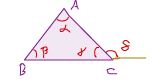
First of all we note that the sum of angles of a triangle is not 180^0 always. Consider the most simplest triangle on the sphere:

This triangle if you observe has all angles as right angles and hence has angle sum as 270 degrees!! So triangles in a sphere have more angle sum than in Euclidean plane. It turns out that the angle excess over 180 degrees is larger for bigger triangle and it is proportional to the area. There is this remarkable theorem that for a sphere of radius 1, the angle excess of any triangle over 180 degrees is exactly the area of its interior!! So, the angle excess is proportional to the area enclosed by the triangle!

Girard’s Theorem: The angle excess of a spherical triangle in a unit sphere is equal to its area! i.e.A+B+C-\pi=Ar(\Delta ABC) (note that in theorem, angles are in radians and hence the expected sum is \pi instead of 180)

Proof:

Before that, let us prove an intermediate result that calculates the area of the region between the great circles:

Def: A spherical lune is the region formed by intersection of two great circles. Their angle of intersection is called the lune angle theta.

Lemma: A lune of angle \theta subtends an area of 4 \theta (including its antipodal mirror image)

Visual proof of Lemma:

Now, we have that the portion of angle in the sphere subtended by the two lunes together is \frac{2 \theta}{2\pi} . (including the antipodal area)

So the fraction of area of the sphere is also the same \frac{\theta}{\pi}. So the area subtended by the lunes is \frac{\theta}{\pi}4 \pi ( as area of unit sphere is 4\pi) and hence equals 4 \theta

Proof of Girard’s theorem:

Look at the diagram in the theorem statement and carefully observe the lune pairs formed by angles A,B,C respectively. Then if we take all the lune pairs, they cover the sphere but the spherical triangle and its antipode area alone is covered 3 times which is 2 times each more than needed to cover the sphere which is 4 times the area of triangle ABC. So, we have

4A + 4B + 4C= sum of area of lunes= area of sphere + 4 Ar(\Delta ABC)=4\pi+ 4 Ar(\Delta ABC)

Therefore,

A+B+C-\pi=Ar(\Delta ABC), the celebrated Girard’s theorem

Now, for a sphere of radius R, you can verify that

A+B+C-\pi=\frac{Ar(\Delta ABC)}{R^2}

So we see that this angle defect is pronounced only when the area of the triangle is large. Which is why we don’t see it for triangles drawn on our city or on the site of our house because such figures occupy a ridiculously small area compared to the square of the earth’s radius.

CONSEQUENCES OF GIRARD’S THEOREM:

1. There is no perfect map of any small region of the earth!!

If a small part of the earth were mapped to the small part of the plane (which is what maps do) exists, then distances and angles are preserved (which maps are supposed to). Then straight lines on sphere (great circles) get mapped to straight lines on the plane (as geometry should be preserved in a perfect map).Then triangles go to triangles. And as the angles are preserved, then the interior angles are same also. But this is a contradiction as sum of interior angles of a triangle is 180 in plane whereas it is more than 180 in a sphere, no matter how small it is. It is 180 only approximately when area is small. So no map is perfect! To illustrate this, consider the map below:

The shortest path from New York to Istanbul is not the straight line in the map but a curve as distances get distorted in any map!

Any map has to distort distance/angle. In normal maps, a Mercator projection is employed that preserves angles but distorts distances. We have to compromise somehow.

No map can be perfect because the geometry of the sphere is intrinsically drastically different from that of the plane and one simply cannot represent it in a plane! So all atlases are bogus. They are only approximate. Only a globe can be trusted!

2. You can never wrap a spherical ball with a sheet without wrinkles!

Again, wrapping sheet is a plane and it cannot simply go into a sphere without distortion.

You cannot avoid wrinkles !!!

3. You can never flatten an orange peel without tearing it!

Again orange peel section is a sphere whereas flattening it makes it planar. Once cannot do this without distorting the geometry and preserving distances and angles.

Think of more such examples!!

For getting a feel of how other properties of spherical triangles, and get inspired into the glory and tale of this art of spherical trigonometry, do refer to this inspiring book below:

The following is an excerpt from the preface of the book which should inspire you:

Also you should see that as the radius of the sphere tends to infinity, the results of spherical geometry approach that of planar geometry. Euclid’s original 5 postulates are closer and closer to being realized:

P2: There exists a unique straight line joining any two points: The only place where the problem happens is the “antipodal points”. But diametrically opposite points get farther apart and hence the troublesome pair of points to the points in any given region gets farther apart as radius increases

P4: As maximum possible radius of the circle that can be drawn in a sphere is $\pi R$, it increases as R increases. In the limit of infinite R, we can draw a circle of any radius.

P5: There are now parallel lines in the limit. Given a great circle and a point not on it, we can draw another great circle such that it is perpendicular to the perpendicular of the point to the given great circle. This can meet the given great circle only at the antipodal opposite image which drifts farther apart as R increases.

So in the limit of \rightarrow \infty, spherical geometry reduces to Euclidean geometry and hence this can be regarded as a generalization of spherical trigonometry. Or as size of the triangle decreases keeping the area fixed, it approaches Euclidean plane geometry.
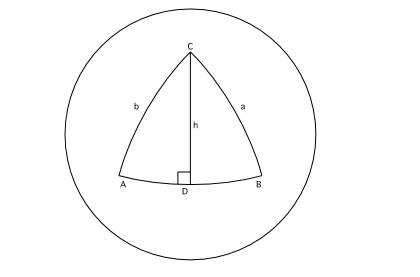

Some of properties of spherical triangles below:

Now when sides are very small, cos \gamma = 1- \frac{\gamma^2}{2}, cos \beta= 1- \frac{\beta^2}{2}, cos \alpha= 1- \frac{\alpha^2}{2}, sin \alpha= \alpha, sin \beta= \beta. Putting this approximations, we get
1-\frac{\gamma^2}{2}=(1-\frac{\alpha^2}{2})(1-\frac{\beta^2}{2})+\alpha \beta cos\Gamma

Simplifying, we get the celebrated cosine rules for normal triangles in the plane,

\gamma^2=\alpha^2+\beta^2+2\alpha\beta cos\Gamma

Thus we see that why our Euclidean fantasy worked nicely in our house or the city as we dealt with small objects.

I would urge the reader to look up the book I recommended above and take up spherical trigonometry rigorously. Atleast let us learn that with proper motivation and intuition and rigor unlike how we learnt plane trigonometry in school by blind manipulations and formulae. We will also end up learning plane trigonometry as when radius tends to infinity, sphere approaches the plane!

Happy Reading! See you next week!

And mind you, all of these play an important role in relativity. See you next time with another kind of geometry that is opposite to this geometry. Where given a line and a point not on the line, instead of NO parallels, we will have many parallels!!! Let us discover that brand new word which Bolyai said he had discovered. And some more insights on some aspects on geometry: from local to global!!

GAUSS and SPHERICAL GEOMETRY – HISTORICAL NOTE:

In the 1820s Carl Friedrich Gauss carried out a surveying experiment to measure the sum of the three angles of a large triangle. Euclidean geometry tells us that this sum is always 180º or two right angles. But Gauss himself had discovered other geometries, which he called non-Euclidean. In these, the three angles of a triangle may add up to more than two right angles, or to less. Using his new invention, a surveying instrument called a heliotrope, Gauss took measurements from three mountains in Germany, Hohenhagen, near Göttingen, Brocken in the Harz Mountains and Inselberg in the Thüringer Wald to the south. In his survey of Hannover, Gauss had used these three peaks as “trig points”. The three lines joining them form a great triangle with sides of length 69km, 85km and 107km. The angle at Hohenhagen is close to a right angle, so the area of the triangle as close to half the product of the two short sides, or about 3000km². Gauss assumed that light travels in a straight line. His sightings were along three lines in space.

Area surveyed by Gauss!! to verify the applicability of Euclidean geometry!

Week 3: The Voldemort who no one dared to talk about: Non Euclidean Geometry – Part 1

One of Euclid’s postulates—his postulate 5—had the fortune to be an epoch-making statement—perhaps the most famous single utterance in the history of science.”

— Cassius J. Keyser

Original statement of the fifth postulate

The ancient Greeks were the first set of people who formally lifted geometry out of the shabby materialistic real world. Points no longer meant just a dot or a mark in the land and lines no longer meant the edges of a taut string and volumes no longer meant the amount of mud inside a tunnel or the amount of water in a jar. They were the first to lift the geometric notions of points, lines, areas, planes, lengths,angles and volumes as abstract concepts that have a meaning by itself and independent of the real world. Although they called this subject as “geometry” which meant “measuring in earth”, they realized that mathematics could exist without the physical world and was one step above reality. Although mathematics is developed by humans who live in the real world and may use mathematics to explain the real world, the Greeks thought that there could be mathematics and concepts and systems that did not correspond to real world. They separated the abstract mathematics from the so called “modelling” where in mathematics is used to capture a real world scenario. Thus Euclid distilled geometry as an abstract logical system that talked about properties of a certain set of abstract undefined objects (points, lines, plane, length, angle, area, translation and rotation etc..) from a certain set of postulates (or axioms) which was believed to be true.

So far we have seen how geometry of the plane was summarised into a mere handful of five postulates of Euclid and how he could explain all the geometric aspects of the real world using them. And how Rene Descartes provided a brand new algebraic partner to the geometric plane of Euclid and thereby merging geometry with numbers. We also saw how things worked out perfectly between the geometric plane and the algebraic \mathbb{R}^2 with the distance formula that captures the geometry in the numerical set of the possibilities of two real numbers. Essentially now we have two ways of looking at the plane.

Marriage between the plane and \mathbb{R}^2

Even though Euclid ultimately was inspired by the real world, he didn’t think about what kind of properties would we have in a world where some of his five postulates were replaced by other ones. In fact he thought that the only consistent geometry was his set of postulates. Many people after Euclid believed that if the Euclidean postulates were messed with, the resulting geometric system would not be consistent. i.e. It will lead to some statements of the axiom contradicting the others. Of course one is not unreasonable to believe that the planar geometry of Euclid which also explains the real world is the only consistent geometry. If that were the case then any consistent goemetry has to be Euclidean and if the world had a geometry then it had to be Euclidean. So people thought the geometry what they thought (Euclidean) and that explained the world around them (measurement made with sticks and tapes and protractors) had to be the only possible geometry.

Science claims to be proud of itself in its ability to change its view point when subject to contradicting experimental observations. Newer theories are replaced by older ones for the want of more accurate explanations of old experimental phenomena or explaining new phenomena that was not in the scope of the older theory.

But yet for 2000 years, the Euclidean axioms reigned supreme without unquestioned legacy. The five postulates given in 300 BCE were to be taken as absolute truths and could not be questioned. Even though the fifth postulate seemed little more complicated and little less obvious than the other axioms, the mathematicians still wanted to prove it from the remaining four axioms. They did not think on the other hand “Is this postulate really true? Is the real world Euclidean? Is there possibly a consistent axiomatic system of geometry that is non-Euclidean?” Everyone wanted to prove the truth of the parallel postulate and they struggled. Little did they think “Perhaps if I come up with a consistent geometry that does not obey the fifth postulate, then I can assert that the fifth postulate is independent of the remaining four postulates”. But for a long time nobody thought so. The parallel postulate had to be true. Its status as an axiom (rather than a provable theorem) was what that troubled people. The postulate itself was not a problem to most people. So indeed there were lot of struggles to prove it and we shall recount some of them below:

After the Greek civilization collapsed (around 200 CE)and Roman empire formed, the Greek mathematics and science was forgotten and the Romans hardly had any scientific temper. For them, geometry was something that enabled to calculate how much mud could fill a tunnel or how much land was enclosed inside a fence.

Image result for hypatia mathematician
The burning of the magnificent library of Alexandria and the murder of Hypotia, the last surviving female Greek mathematician of Roman empire by Christian extremists marked the end of Roman scholarship

Even though the Romans destroyed everything Greek including the magnificent library of Alexandria (look up more on this history) and forgotten the rigor of Greek mathematics, it did survive through another route via the birth of Islamic civilization in modern Arabia. The Arabs had been known of translating many mathematical works of ancient India and Greece (including Euclid’s Elements) and had kept it alive and kept the spirit of mathematics going.

While Europe endured its “Dark Ages,” the Middle East preserved and expanded the arithmetic, geometry, trigonometry, and astronomy from the ancient Greek philosophers, such as Euclid. The most important contribution may be the invention of algebra, which originated in Baghdad in the House of Wisdom (bayt al-hikma).

Thus, Elements returned to the European world with the birth of the Renaissance in 12th century CE from Arabia. For more on Romans and Islamic mathematics, click here below.

https://www.irishtimes.com/news/science/what-did-the-romans-ever-do-for-maths-very-little-1.3940438

http://www.csames.illinois.edu/documents/outreach/Islamic_Mathematics.pdf

There were many attempts to prove the parallel postulate, from as early as 5th century CE.

List of people who attempted to prove the fifth postulate

But a careful examination of their proofs revealed that they had used some assumption that was not justifiable from the first four postulates and in most cases, that adhoc assumption used (even though it was more obvious than the fifth postulate) was then proved to be equivalent to the parallel postulate itself. We will present some of those equivalent statements below because in a geometry where Euclid’s fifth postulate is not valid, these statements would not be valid either!!

Attempt 1: Ptolemy (5th century CE)

He only established the equivalence between the original statement of fifth postulate of Euclid with the one I actually presented it to you (called also as Playfair’s axiom)

“Given a line l and a point P not on the line l, there exists a unique line passing through P, which is also parallel to l”

Playfair’s axiom (Ptolemy)

Attempt 2: Proclus (5th century CE)

Having proved that the fifth postulate was equivalent to the above statement, Proclus claimed that he had proved this equivalent version (Playfair’s axiom) but had supposedly used an assumption below that was equivalent to the fifth postulate itself. The assumption was:

Parallel lines are equidistant everywhere.

i.e. If l,m are two parallel lines, then every point in ‘l’ is equidistant from ‘m’ as every other point and vice versa.

Definition: Distance between a point and a line is defined as the perpendicular distance (which can be proved to exist and is the shortest distance between that point and any other point in the line!)

Proclus (5th century CE)

Attempt 3: Abu’ Ali Ibn al-Haytham (1000 CE)

Thabit of Baghdad and Ali Ibn al-Haytham tried to prove the equidistance of parallel lines (above) which would establish eventually the fifth postulate. But they also had an in-built assumption that worked as follows:

The curve traced out by the set of points equidistant and perpendicular to a given line , is a straight line! That is, if we translate every point in a straight line in the direction perpendicular to it and by same amount, and collect the set of such points, it is also a straight line!

– Abu’ Ali Ibn al-Haytham

Attempt 4: John Wallis (1663)

Wallis was a contemporary of Newton and one of the greatest mathematicians of the Renaissance Era. Unlike his predecessors, Wallis did not subconsciously assume something and claimed to have proved a parallel postulate but he claimed that he had replaced the parallel postulate with another postulate which was equivalent to it. But this form of the parallel postulate was so very obvious that mathematicians of the era were really stunned by it. His equivalent statement goes as follows:

Given a triangle and any positive number p where p \neq 1, there exists another triangle whose angles are exactly same as the given triangle but whose sides are proportional to the sides of the given triangle with the ratio p
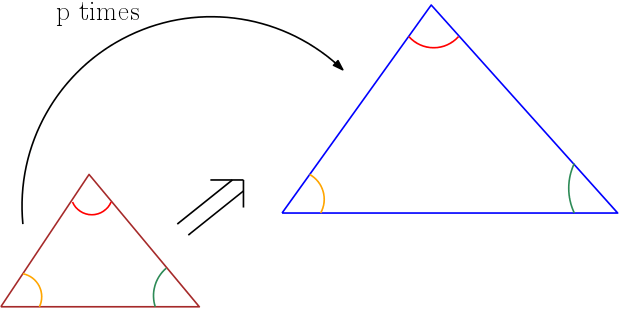
– John Wallis

Notice the significance of this statement. It states that given a triangle, there exists a larger or smaller triangle, by any proportion we desire, that has same angles of the original triangle but sides of proportional length of the original triangle. This is very significant that it allows us to magnify or shrink geometric objects so that the distances even though scaled, the shape is completely maintained as angles are maintained. (any object can be approximated as a lattice of triangles).

So, in a geometry where fifth postulate does not hold, it means that there are no similar triangles. It will be a crazy geometry. When you are constructing a new house and the civil engineer shows you the plan, you hope that the original house is of the same shape upto the fact that all distances are magnified by the same amount. In a geometry where fifth postulate does not hold, we can no longer do this and hence the concept of shrinking would lose its meaning. There is no way to enlarge or shrink objects in such a space without distorting the shape. When you shop for shoes on Amazon, you can no longer believe that the delivered shoe is proportional to the real shoe with same shape. (So next time you face such an issue with Amazon, think of the possibility that the shoe was designed in a space where fifth postulate does not hold. So the concept of scaling would not make any sense in a geometry that is devoid of fifth postulate!

There would be no similar objects in a geometry without fifth postulate

Attempt 5: Adrien Marie Legendre (1752-1833)

Legendre established the equivalence of the parallel postulate with the statement that the sum of the three interior angles of a triangle is 180^0 which we already saw.

The sum of the three interior angles of a triangle equals two right angles

Adrien Marie Legendre

Attempt 6: Giovanni Girolamo Saccheri (1667-1733)

There are some people who come close to making a history and climbing the peak unimagined but who give up when they are almost there. Such a man as Saccheri. Saccheri established that the parallel postulate was equivalent to the below statement. Before that, we define his construction, Saccheri quadrilateral:

A Scaccheri quadrilateral is a quadrilateral with opposite sides equal and one pair of adjacent angles as right angles. Then we have that the other two angles in the quadrilateral are equal. Saccheri proved that the parallel postulate is equivalent to the below statement

The other pair of adjacent angles of a Saccheri quadrilateral are right angles (In other words, there exist rectangles!!!)

– Saccheri

Saccheri hence sought to prove the parallel postulate as follows: If the Saccheri angles could not be right, then they could be acute or obtuse angles. If Saccheri could derive a contradiction based on these assumptions, then he could establish the fifth postulate. Saccheri could derive a contradiction for the case when he assumed that the angle pairs are obtuse. So, indeed we cannot have a Saccheri quadrilateral with obtuse adjacent angles. Now he wanted to contradict the acute angle case. Here is where he started a revolution but almost failed. He derived many remarkable results assuming that the Saccheri angles are acute. Although it did not lead to a contradiction, he proposed that they ought to be contradictions as they were highly counter intuitive. Some of those results he derived include:

1. The sum of interior angles of all triangles is less than 180^0

2. There is an upper limit to the area of a triangle. (It is impossible to have triangles of arbitrarily large area!)

3. Given a point P and a line L not containing P, there exists more than one line passing through P and parallel to the line L!

4. There is an absolute unit of length. We cannot shrink or expand objects without distorting their shapes. More technically, all similar triangles are congruent

5. The set of points equidistant from a straight line is not a straight line.

Instead of viewing these results as a discovery of a brand new world, that need not really exist but had a non Euclidean consistent geometry, Saccheri dismissed it as “contradictions” considering that they were counter intuitive. He couldn’t accept the fact that there could be other consistent geometries that need not exist in the real world. Had Saccheri thought otherwise, the discovery of non-Euclidean geometry would have been preponed by a 100 years. Saccheri published his findings in a book titled “Euclid Freed of Every Flaw“. But unfortunately, his work did not get even any critical attention until it was rediscovered later in the era of Voldemort!!

The era of Voldemort:

When a present era mathematician tries to prove something for 20 years and he fails, he would think that maybe the statement he is trying to prove is false. But not with the fifth postulate. When people did not succeed to prove it even after 2000 years, people only had faith on it more. Anyone lacking in the belief of the truth of the fifth postulate would be branded as a heretic. People who were working on non Euclidean geometry would have to fear the wrath of fellow mathematicians also apart from the church. So we saw a lot of secretive unpublished works in this geometry. But the thing I feel the most baffling is that there was already a non Euclidean geometry that was right under everybody’s nose studied from ancient Greeks and explained the world more accurately.

Once I was playing map quiz games in my childhood. One person names a place and another has to find it in the map. The usual norm is that the person who challenges will give a name that is so insignificantly lost among many main cities and too small and that which required deep focus. But I also discovered that the things that miss the attention of most people was the places that would be right under the eye. Some name like Russia that is all over everywhere but too spread and too obvious to capture the eyes of people. And I found people struggled to find such places.

It became a taboo to talk about non Euclidean geometries towards beginning of nineteenth century as it witnessed a secretive publication of many works in the era

The geometry that was different from Euclidean one yet consistent and explained the world is contained in the word geometry itself. Geo means earth and the surface of the earth which is our world is nothing but the surface of a sphere. In the surface of a sphere, geometry as we know from Euclid fails. This branch of geometry called “spherical trigonometry” was important in astronomy, navigation and time keeping for centuries before the invention of things like GPS. But what do you think is the geometry of the surface of the sphere? Think about it. Spherical trigonometry is the subject of the next post. Now let us continue the main story.

People wanted a geometry that was having four postulates of Euclid yet containing a negation of the fifth postulate so that it would establish the independence of it from other 4 postulates.

The following is an excerpt from the book “Euclid’s window” by Leonard Mlodinow” on one of the first men to discover this new geometry – genius Carl Fredrich Gauss.

“Between 1813 and 1816, as a professor teaching mathematical astronomy at Gottingen, Gauss finally made the definitive breakthroughs that had been waiting since Euclid: he worked out equations relating the parts of a triangle in a new,non-Euclidean space whose structure we today call hyperbolic geometry. By 1824, Gauss had apparently worked out an entire theory. On November 6 of that year, Gauss wrote to F. A. Taurinus, a lawyer who dabbled quite intelligently in mathematics, “The assumption that the sum of the three angles [of a triangle] is less than 180 leads to a special geometry, quite different from ours [ie., Euclidean], which is absolutely consistent, and which I have developed quite satisfactorily for myself. . ..” Gauss never published this, and insisted to Taurinus and others that they not make his discov-
eries public. Why? It wasn’t the church Gauss feared, it was its remnant, the secular philosophers.
In Gauss’s day, science and philosophy hadn’t completely separated. Physics wasn’t yet known as “physics” but “natural philosophy.” Scientific reasoning was no longer punishable by death, yet ideas arising from faith or simply intuition were often considered equally valid”

On November 23, 1823, Johann (Janos) Bolyai, son of Gauss’s longtime friend Wolfgang Bolyai, wrote a letter to his father saying that he had discovered another world (non euclidean geometry). In the same year in Russia, another mathematician Nikolay Ivanovich Lobachevsky explored conseuquences of negation of parallel postulate and wrote it in an unpublished journal.

Bolyai’s letter

Some fourteen years later, Gauss stumbled upon Lobachevsky’s article, and Wolfgang wrote him about his son’s work, but Gauss wasn’t about to publicize either of them and risk putting himself at the center of controversy. He wrote Bolyai a nice congratulatory letter(mentioning that he himself had already discovered similar results), and graciously proposed Lobachevsky a corresponding member of the Royal Society of Sciences in Gottingen (he was immediately elected in 1842).
Janos Bolyai never published another work of mathematics. Lobachevsky became a successful administrator and eventually president of the University of Kazan. Bolyai and Lobachevsky might have both faded into the distant unknown if not for Gauss.

In summary, these fifty years were years of a secret revolution. Gradually, in several countries, new kinds of space were discovered, but they were either not revealed or not noticed by the community of mathematicians. Not until scholars studied the papers of a recently deceased old man Gauss, in Gottingen, Germany, in the middle of the nineteenth century did the secrets
on non-Euclidean space become known. By then, most of
those who had discovered them, like him, were dead.

But what was this new non Euclidean Space? How does it look like to draw figures in it? How does it feel like to live there? Could the real world be non Euclidean? What about the the geometry of the sphere and this new geometry? What are their new features? We shall dwell into the technicalities next post. But all we do know now is that in such spaces, parallel lines won’t be equidistant, it is impossible to scale figured without distortion and sum of angles of a triangle don’t add to 180 and many theorems like that of Pythagoras don’t hold.

Finally in 1868, the Italian mathematician Eugenio Beltrami laid to rest once for all the issue of proving the parallel postulate: he proved that if Euclidean geometry forms a consistent mathematical structure, then so must the recently discovered non-Euclidean geometries! So Beltrami can be said to have boldly subjugated the Voldemort of non Euclidean geometry. .

Week 2: The Revolution of 1637 – The plane of Euclid gets married after 2000 years!!

In 1637, a silent revolution happened in France. No, I am not talking about the political French Revolution which came much later in 1789. This was a revolution without swords. But neverthless like all great revolutions in histrory, it was to topple the very basic structure of the mind sets of the people of not only France but all of the world who did mathematics. But it would find no place in any history textbook and it would not be emphasized in many mathematics texts as a big shot but rather to be taken for granted as the standard state of affairs by the people of the present times. The man of this revolution would be Rene Descartes, a young French man who would surpass Euclid and drastically change the structure of his geometric plane. It would be fair to say that without this revolution, we would not have had any basic technology or industrial revolution or scientific progress. You will realize soon why. Let us unravel what Descartes did step by step.

We saw that Euclid’s Elements served as the standard model of the geometry of the plane. It was unsurpassed in its glory and continued to dominate the viewpoint of planar geometry for over 2000 years from the time it was written. It contained as basic vocabulary, words like point, line, line segment, plane and parallel lines and had five axioms (along with 5 other axioms on numbers called as common notions) as the assumptions about such objects in the plane. Recalling them,

1. Given a line segment, it can be extended uniquely to an infinite line segment that contains the original line segment

2. Given two distinct points, there exists a unique line segment (and hence by postulate 1, a unique line) that contains the given two points

3. All right angles are equal. They can be obtained by translation and rotation of any given right angle.

4. Given any point P in the plane and given any positive number radius r>0, there exists a circle whose centre is P and radius r

5. Parallel Postulate: Given a line L and a point P not lying on the line, there exists a unique line L' passing through P and parallel to L.

So, this continued to be the only face of planar geometry till 1637 until our friend Rene Descartes arrives on the scene. He saw that any line can be put in one-to-one correspondence with real numbers (famously called the “number line” in primary school). So once we put a number system on the line, we essentially can forget about the points in the line and replace them by their respective numbers as every number gets a unique point and every point corresponds to a unique number. So far so good. Once we decide which point to assign the number 0 and which other point to assign 1, then everything would be done.

What Rene Descartes thought of was could we also do the same thing to Euclid’s plane? Can we replace tbe abstract points in the plane by concrete numbers? This is where Rene Descartes toppled the face of geometry by merging it with the algebra of numbers. Descarte proved using Euclid’s postulates that every point in the plane can be put in one-to-one correspondence with two sets of real numbers (instead of one for the line). The way it is done is now seen as obvious by high school students at present but I severely doubt that any child for whom this information had not been dumped early, whether he/she would come up with this idea himself or herself.

Before that we need two lemmas and theorems from Euclidean geometry that are proved below:

Lemma: Two distinct lines can intersect at utmost one point

Lemma: Vertically opposite angles are equal

Lemma: Parallel lines make same angle with a given line

For proof of this lemma, see the PDF attached at the bottom of this post.

Lemma:

If a line l is parallel to m, and line m is parallel to line n, then l is parallel to n (Assume l, m, n are distinct).

Proof: Let us assume not for the sake of contradiction. Let l and n be not parallel. By definition of parallelism, they meet at a point P. Now both l and n pass through the point P and are parallel to m. But by parallel postulate since P is not in m, there can only be one unique line parallel to m and passing through P which is contradicting the fact that both distinct lines l and n pass through P and being parallel to m.

The next theorem by Pythagoras is notoriously famous!

Theorem (Pythagoras)

In a right angled triangle, the square of the length of the hypotenuse (the side opposite to the right angle) is equal to the sum of the squares of length of other two sides.

Proof: (using areas of triangles and squares – my favourite and simplest proof)

Coming back to Descartes as to how he reasoned. Descartes reasoned as follows:

Take a point P in the plane. Draw a line segment PA such that length of PA is unity and extend it to a line.(Unique extension is possible by Euclid’s P1) Make that line into a number line by taking P as zero and A as 1. Draw another line PB perpendicular to PA such that PB is of unit length and extend it to a line. Make that also into a number line by marking P as 0 and B as 1. So now we have two perpendicular lines meeting at P, with numbers in each of the two.
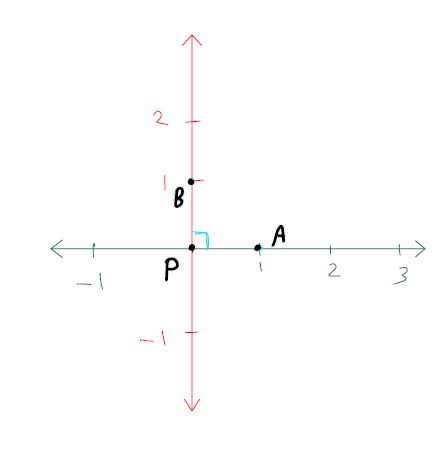
Take an arbitrary point Q in the plane now with the perpendicular lines PA,PB drawn and extended. Now I am going to tell you how to assign two numbers (x,y) associated with the point Q. Now, if Q is in the line PA, assign y=0 and the number x such that it equals the number on the number line PA.\item If Q lies on the line PB, then assign x=0, y as the number on the number line PB.

Now if Q does not lie on either of the lines PA and PB, by Euclid’s parallel postulate, there exists unique lines l_x, $l_y$ passing through Q that are parallel to PA, PB respectively. Now, l_x has to intersect the line PB at a point. (if l_x does not intersect PB, then by definition of parallelism, l_x parallel to PB, and we already have l_x parallel to PA by construction of l_x, and by Lemma 1, PA would be parallel to PB which is a contradicton as PA,PB are perpendicular). Hence l_x has to cut PB at a unique point. (Lemma). Now let Y be the intersection of l_x with PB. Assign the number y to Q as the number associated with the point Y on the number line PB. Now similarly, let l_y be the unique line passing through Q and parallel to PB. By same reasoning above, l_y has to intersect PA. Let X be that point of intersection. Assign the value x as the number associated to the point X on the number line PA.
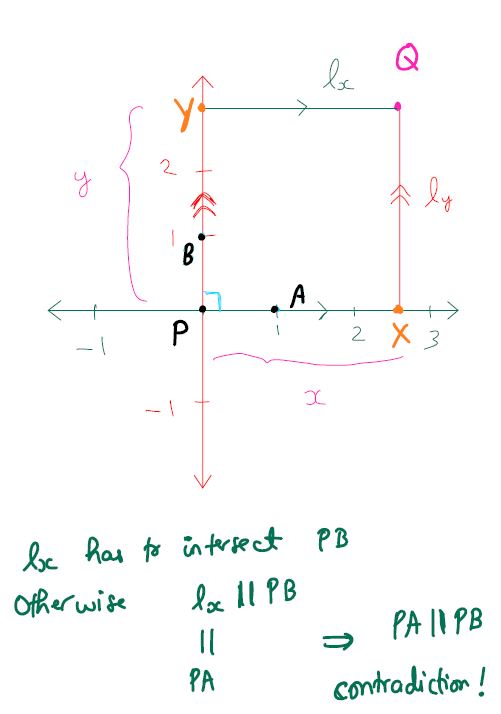
Now we have associated a unique pair of two numbers to every point on the plane. We will first show that no two points get the same pair of numbers. Let two points Q,Q' share same x,y. Then, they share the same points X,Y in PA,PB respectively. By construction, QX and Q'X meet at X and are both parallel to PB. Since QX,Q'X both are parallel to PB and meet, the only option is that the lines QX,Q'X coincide. Hence, Q' lies in QX. Now applying the same logic for Y, Q' lies in the line QY. But two distinct lines QX,QY intersect at a unique point. QX,QY already meet at Q by construction and hence if Q' lies in both QX,QY, it has to be Q. So, Q'=Q. So, if both the coordinates (x,y) of two points Q,Q' are same, then the points themselves have to be the same. Hence, no two distinct points share the same coordinate pair.

Now we show that corresponding to any pair (x,y), there exists a point Q having the coordinates (x,y). Given x,y, locate the point X in PA having the number x and the point Y in PB having number y. Now, draw a line l_y passing through X parallel to line PB. And draw another line l_x passing through Y parallel to PA. They both will intersect (if they dont, then they are parallel, which as usual means PA,PB are parallel which is a contradiction). Let the point they intersect be Q. By construction, the coordinate of Q is (x,y) (reverse this construction process)

Thus, we have achieved a remarkable feat!! We have put the plane that obeys Euclidean Geometry in one-to-one correspondence with a pair of real numbers (x,y). One-to-one correspondence means that every point has a unique pair of coordinates and every pair of coordinates corresponds to a unique point.

Descartes is said to have thought of this while he was laying in his bed, watching an insect moving in his ceiling and thinking ‘How can I describe the position of the insect using the numbers assigned to the corner of the walls?”.

Unfortunately, in this present day schooling, this is not allowed to be self discovered by students but rather the suspense is spoilt and the teachers give us a haywire explanation of this correspondence without proof also from Euclid’s axioms. But this is very important juncture. Suddenly, we can forget about the plane and look at the set \mathbb{R}^2=\{(x,y)|x,y \in \mathbb{R}\} as we have put a one-to-one correspondence of the plane with this set. Even for mensuration (measurement of distances and angles), we can forget about the plane and use the below formula to compute distances:

Theorem (Distance Formula:)

The distance between points P, Q with coordinates (x_1,y_1) and (x_2,y_2) respectively is given by dist(P,Q)=\sqrt{(x_2-x_1)^2+(y_2-y_1)^2}, independent of the choice of the origin and x-axis of coordinates.

Proof: First, let us prove it for the case when one of the point is the origin P itself. Consider the construction as usual for determining the coordinates. In this case, consider the quadrilateral PXQY. Now, by construction, opposite sides of the quadrilateral are parallel (l_y=XQ parallel to PB and l_x=YQ parallel to PA). So, the quadrilateral PXQY is a parallelogram (opposite sides parallel). Now in that parallelogram, one of the angles is right angled (the angle BPA). So, all the angles are right angled. (By properties of angles cut by two parallel lines on the same line being equal). So, the quadrilateral is actually a rectangle. (a rectangle is a quadrilateral where all angles are right angled). Now use the following lemma below:
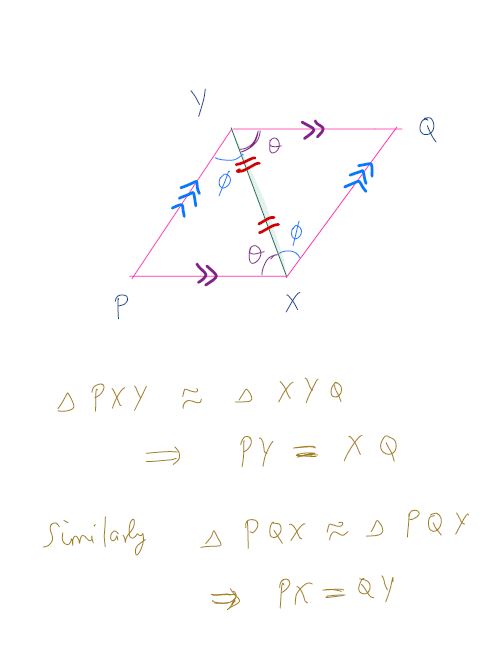
Lemma: Opposite sides of a parallelogram are equal

Proof: Consider a parallelogram PXQY. Join the points XY to make it the diagonal. Now, consider the triangles PXY and XYQ. One of their sides XY are common and hence of equal length. (XY=XY). Now, angle PYX=angle YXQ (property that alternate interior angles are equal). Similarly, angle PXY = angle QYX (same property). Hence, we have that the two triangles share the same side and the two included angles. If we prove that both the triangles are congruent (called ASA), then as corresponding parts of congruent triangles are equal, we have length of PX=length of QY and length of PY= length of QX. So as PX,QY and PY,QX are opposite sides of the parallelogram, the lemma follows after we prove the ASA congruence.

Lemma (ASA congruence):

If two triangles ABC,A'B'C' share an equal side length (say lengths AB=A'B') and share the same pair of angles that emante from the sides (i.e. Angle CAB= Angle C'A'B' and Angle CBA=Angle $C’B’A’$, then the two triangles are congruent. i.e. They can be obtained from translating and rotating each other
Proof: First, move A' to A by translation. Then, rotate the line segment A'B' to coincide with the line AB. Now since length of AB is same as A'B' and A=A' and has same angle, B=B'. Now, C=C' as well since the angles CAB,CA'B', $CBA,C’B’A’$ are equal. So, we have that triangle A'B'C' could be translated and rotated to give ABC. Hence the two triangles are congruent.
Proof of distance formula: Now coming back to the proof of the distance formula. The quadrilateral PXQY is a rectangle and hence as opposite sides are equal in a parallelogram, XQ=PY=y and PX=YQ=x. Now as triangle PQX is right angled, by Pythagoras Theorem, PQ^2=PX^2+XQ^2=x^2+y^2 and hence, since length of PQ is distance between P,Q, we have dist(P,Q)=\sqrt{(x_2-x_1)^2+(y_2-y_1)^2} with x_1=y_1=0, x_2=x,y_2-y. Now here comes the general case. If P is not origin, construct two perpendicular lines from P such that the first line is parallel to the given x-axis and the second line is parallel to the given y-axis. Now, complete this proof as an exercise (Trust me you will always feel good after proving something by yourself in mathematics – however trivial it may be!! I will post this complete proof next week).

Having looked back, we have achieved a lot. We have associated a pair of numbers to every point on the plane in a unique manner with the set \mathbb{R}^2 that is compatible with a notion of distance given by dist[(x_1,y_1),(x_2,y_2)]=\sqrt{(x_2-x_)^2+(y_2-y_1)^2}. Suddenly, geometry becomes about numbers. We can compute with points. In fact, a plane is now just a set of possibilities of a pair of real numbers. But notice that the set of pair of real numbers is abstract compared to the concrete notions of points, lines and planes. So, this computational aspect of turning the plane into \mathbb{R}^2 comes at the cost of an abstraction. We can no longer draw diagrams and talk about lines and angles. We have to argue with numbers instead. But we do this because numbers are easier to manipulate than geometric objects.

So, on one hand we have geometric objects that are concrete, less abstract but that concretness makes it too rigid to manipulate them whereas numbers on the other hand, being abstract (a number is an abstract entity indeed – two bananas are concrete, two elephants are concrete entities but the concept of the number two as you see is indeed very abstract!!). are easier to manipulate (we have lots of manipulations on numbers like arithmetic operations, ordering, etc..)

So, as humans can sacrifice concreteness and visualization for the sake of manipulation, \mathbb{R}^2 is the stunning example of demonstrating this fact as in fact I bet that most people would be comfortable with the algebraic set \mathbb{R}^2 rather than the purely geometric plane with its shapes.

Now that we have corresponded the plane with \mathbb{R}^2, we now ask. Is there any other geometric object that can be corresponded with \mathbb{R}^2? Or is it only the Euclidean plane that can be one-to-one corresponded with \mathbb{R}^2 with the distance formula also coming out to be the same?

NOTE: Hereafter when we say \mathbb{R}^2, we not only mean the set of all pairs of real numbers as a raw naked collection but also with the distance formula given by dist[(x_1,y_1),(x_2,y_2)]=\sqrt{(x_2-x_)^2+(y_2-y_1)^2}

What turns out is that if you have any geometrical set with a notion of distance and angle, that can be corresponded with \mathbb{R}^2 in a one-to-one manner, with the distance as above, then the object has to satisfy Euclid’s axioms!!! So \mathbb{R}^2 with the distance formula completely captures the geometry of the plane!

Before proving this, let us prove another small theorem:

Theorem : (Vector addition in $latex \mathbb{R}^2 – inspiration): Let P be the origin of the plane and let PA,PB be the adjacent sides of a parallelogram with coordinates of A being $(x_a,y_a)$ and that of B being (x_b,y_b). Then, the tip of the diagonal Q of this parallelogram will have coordinates (x_a+x_b,y_a+y_b)!

Proof: I will draw the necessary diagram and I leave the climax of the proof to you.

PAQB is a parallelogram and the constructions are as below:

Similarly, prove for the x-coordinates!!

This is inspired by the parallelogram law of vector addition that says that if two vectors represented by line segments PA,PB share a common tail P and are treated as the adjacent sides of a parallelogram, then the resultant vector sum of the vector is the line segment PQ where Q is the diagonal of the parallelogram obtained by completing the sides PA,PB. Note that in terms of components, it is just the addition of components!!

So, now we can define angle between two lines PA,PB: We refer to a lemma in Euclidean geometry:

Lemma: Cosine Rule

If two adjacent sides of a parallelogram PA,PB have lengths a,b and have an angle \theta from A to B, then the length of the diagonal is given by \sqrt{a^2+b^2+2abcos\theta}. If P is not the origin, then in the above formula, the word “coordinate” should be replaced by “coordinate difference with P”

(Look the proof up in any geometry text (like the link below) or try yourself – it is standard)

https://www.mathopenref.com/lawofcosinesproof.html

Now, let PA,PB be two line segments. Finding the angles as follows:

Let PA' be the segment obtained by extending $PA$ in the opposite side of same length. Then the tips of the diagonals of the parallelograms completing PA,PB, PA',PB are respectively, by cosine rule, \sqrt{a^2+b^2+2abcos\theta},\sqrt{a^2+b^2-2abcos\theta} respectively. From this we can determine the angle \theta as \cos^{-1}\frac{(length^2(PA,PB)-length^2(PA',PB))}{4ab} where a=length(PA), b=length(PB). But lengths of PA,PB can be calculated by distance formula from coordinates. And length(PA,PB) is nothing but the length of the tip of the diagonal of that parallelogram. We know its coordinates if P is the origin. Use distance formula again to calculate its length. When P is not the origin, the formula should be interpreted as the coordinate difference between the point and P. Again, now distance formula.

The Grand Theorem:

Any geometrical set having a one-to-one correspondence with \mathbb{R}^2 obeying the distance formula, has to satisfy Euclid’s axioms. In other words, Euclid’s plane is the only geometrical set that has this one-to-one correspondence with \mathbb{R}^2 with the above distance formula!

PROOF:

Defining Lines, Line segments and Parallel Lines: First what are the lines in the set? Given any geometric set we need to define what we mean by lines and parallel lines of that set in a way that the postulates of Euclid are obeyed. That is what the theorem claims. For this, we need to come up with the abstract notion of a line in \mathbb{R}^2. Then, we can look at the points corresponding to the line in \mathbb{R}^2 in the geometric object (through the correspondence) and hence define that as the line in that geometric object. In the most intuitive manner, define a line L as the set of all numbers (x,y) satisfying ax+by+c=0 for some a,b,c \in \mathbb{R} such that ab\neq0. Define two lines (a,b,c), (a’,b’,c’) as parallel lines if they satisfy \frac{a}{a'}=\frac{b}{b'}\neq\frac{c}{c'}. Notice that two lines are the same if \frac{a}{a'}=\frac{b}{b'}=\frac{c}{c'}. [The above definitions might look obvious to you as this is what was defined as the equation of a straight line in high school. But the subtle logic here is that in a straight line, the ratio of increments between the two coordinates has to be constant – called the slope – from Euclidean geometry – try drawing and seeing for yourself and proving this that for straight line making angle \theta with a horizontal line and 90-\theta with its perpendicular vertical line, should satisfy that the ratio of increment in vertical distances and horizontal distances between any two points is tan \theta and hence a constant ]. Translating this fact into coordinates using the correspondence inspires the equation in the definition.
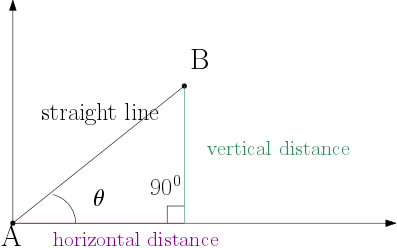
Define the line segment joining two points (x_1,y_1),(x_2,y_2) as the set \{(tx_1+(1-t)x_2,ty_1+(1-t)y_2)|0\leq t\leq 1\}. Inspiration is below:

Line segment joining two points

Verifying Eulcid’s P1: Now, it is easy to verify Euclid’s postulate 1: Given any line segment as defined above, it is easy to see that all points in it satisfy the equation \frac{y-y_1}{x-x_1}=\frac{y_2-y_1}{x_2-x_1}, which can be rearranged to give an equation of the form ax+by+c=0. Notice that this is the only line that extends the segment. Let us prove it below:

Let two lines (a,b,c),(a'b',c') extend the two points (x_1,y_1),(x_2,y_2). Since both the lines contain both the points, we must have

ax_1+by_1+c=0

a'x_1+b'y_1+c'=0

ax_2+by_2+c=0

a'x_2+b'y_2+c'=0

Now these are nothing but a system of two linear equations in two variables (x, y) with two distinct solutions (x1,y1) and (x2,y2). Hence the first equation must be a scalar multiple of second equation and hence (a, b,c) is proportional to (a’,b’,c’) and hence the two extending lines got to be the same.

Verifying Euclid’s P2: We defined a line segment itself by taking two points as reference. So, define the line segment joining the two points as above and uniqueness is same proving uniqueness of the extended lines which was done above

Verifying Euclid’s P3: First we need to define what is an angle and hence what is a right angle. We can use the vector addition theorem to define angle as we know from it, how to determine angle between two segments. The proof of P3 is quite involved and will become easier when we are equipped with some matrix notation and hence we will return to it when the appropriate time comes.

Verifying Euclid’s P4: By distance formula, define a circle in \mathbb{R}^2 with centre (a,b) and radius r>0 as the set \{(x,y)|(x-a)^2+(y-b)^2=r^2\} and this obviously has a non empty solution set (take x=a, y=sqrt{r} for instance) . So this holds.

Verifying Euclid’s P5: Now comes the most interesting part. Let a line L be described as ax+by+c=0. Let a point (u,v) not on that line L be given. Which means au+bv+c=d \neq 0. Define the line L’ as ax+by+(c-d)=0. Obviously (u,v) lies on this line L’ as we have au+bv+c=d. L and L’ are parallel as \frac{a}{a}=\frac{b}{b}\neq\frac{c}{c-d}.

Uniqueness proved via picture: Now to prove uniqueness of the parallel line. Let another line L” pass through (u,v) parallel to L. Let it be described by a”x+b”y+c”=0.

So, a''=\lambda a, b''=\lambda b, c''=\lambda (c-d). So, L” is same as L’ as all the coefficients are proportional!!!!

At last, we have achieved a remarkable feat!! Only the geometric object of Euclidean plane , by redefining lines and angles and appropriate notions “can be” put in one-to-one correspondence with \mathbb{R}^2, where we first proved the “can be” part and then proved the “only” part. Oh my god – who would have thought there would have been such an intimate monogamous connection between the plane of Euclid and \mathbb{R}^2. Suddenly geometry and algebra or numbers become interchangeable and due to this marriage we can now switch back and forth at our will between the geometric plane and the algebraic plane. The representation of a plane by numbers and their freedom of manipulating numbers is what enabled other concepts like calculus to be invented and thus ushered the era of physics!! It was surprising atleast for me when I first saw it. So, by putting numbers in the plane, we are not destroying or losing any geometrical information as long as the distance formula in \mathbb{R}^2 is not screwed with. If that is screwed with, we shall see that the connection is polygamous. Many exotic geometric objects can then be put in one-to-one correspondence with \mathbb{R}^2!! The sacredness of Euclidean axiom is lost then!!

NEXT WEEK: WHAT HAPPENS WHEN THE DISTANCE FORMULA IS INDEED SCREWED WITH? ARE THERE ANY GEOMETRIES THAT ARE NOT EUCLIDEAN? Get excited till then!!

Bubboi!!

About Me

I am Rama Seshan C, a 23 year old research scholar in the Dept of Electrical Engineering, IIT Madras, Chennai, India. I work in geometric mechanics and control. I am passionate about theoretical physics and hence started this blog.

I am broadly interested in Mathematics (focusing on geometry and topology) and Theoretical Physics.

Why do this?

  • I found that the theory of relativity is inherently simple when presented in a pedagogic way and each concept has a deep geometric interpretation that can be visualized.

My hobbies include reading history ,listening to carnatic music and yoga

Design a site like this with WordPress.com
Get started