Mathematics is the language in which God has written the universe
Galileo Galilei
Many people think it was Einstein who invented relativity. They could never be more wrong. Relativity is a 400 year old tale. It was there since the beginnings of physics. What Einstein did was merely to modify the pre existing model of relativity. The modification that Einstein made was so drastic on the existing theory (that was very natural and obvious) and hence people think that Einstein invented the concept of relativity. But here we will explore the old theory of relativity that was invented long back and prevailing physics till the beginnings of the last century. The man who started it was Galileo Galilei
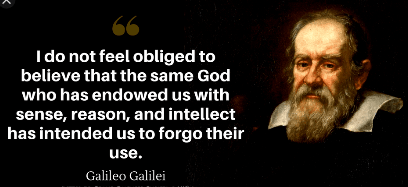
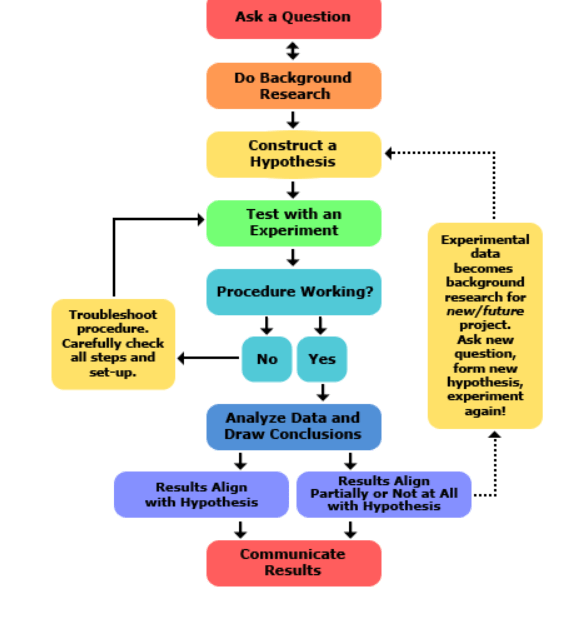
I admire this man too much. For many reasons. First is, he established this concept of scientific method – making hypothesis and testing them against reality to verify them as a foundation of reasoning and it was in staunch opposition to the Biblical concept of belief based on authority due to which he was subjected to immense difficulties and eventual death.
Next is that he laid the very foundations of mechanics without which no worthwhile invention would have been made today. Galileo came nearly closed (or converged – to say in Zeno’s language :P) to the laws of mechanics that Newton invented – in fact the laws that Newton invented were the only simplest ones that were plausible which were compatible with Galileo’s principle of relativity that he hypothesized. Galileo Galilei is also the first person who started the trend that if a simpler model could explain phenomena, then it ought to be accepted with grace. The prevalent model of the solar system then was that the earth was center and stars and the sun moving around them in circular orbits and planets moving around them in even more complicated orbits. But Galileo proved that placing the sun at the center and at rest with the other stars and the planets including Earth moving around the Sun in circular orbit constitutes a more simpler explanation of natural phenomena in sky that was first hypothesized by Copernicus. We know what Galileo had to undergo for sticking to this view point.

Events, space-time and geometry:
Having mastered geometry, it is time to come to physics now. Geometry studies some collection of fundamental objects called as ”points”. But in physics, we intend to study how things move and why things move. So, some notion of timing is also important. So, the fundamental objects are no longer points. Some notion of timing associated to each point is important. At first we shall be vague about the concepts ”point” and ”time”. Later we will develop a proper axiomatic system out of them. The fundamental objects of interest in mechanics no longer are points because we need to take time also into consideration. It makes sense to distinguish between ”this point P at 12:00” and ”the point P at 1:00”. Because mechanics is the study of how things move with respect to time, the additional detail of ”when at this point” is also important.
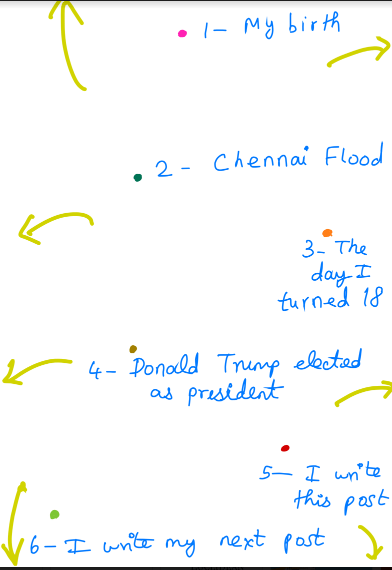
Having said this, let us now come back to square one. The fundamental object of mechanics is said to be an ”EVENT”. Again, I am going to assume that we all have the intuitive and unambiguous understanding of what is meant by the word EVENT and as I said it talks about a point but with a label of timing. The set of all events is denoted by E, and is called space-time! Mechanics is nothing but the study of events associated to moving objects.
Galileo wanted to study motion. How do objects move? Why do they move the way they move? This is a natural and first curiosity in nature and hence mechanics was the first branch of physics to be discovered. As usual we have to start with a bunch of axioms. (In physics they are called postulates or laws)
In Euclid’s geometry, the fundamental object of study was the infinite plane and the fundamental constituent of the plane were points. Galileo realized that to study movement, the fundamental constituent or object is “event”!
The fundamental vocabulary, according to Galileo were:
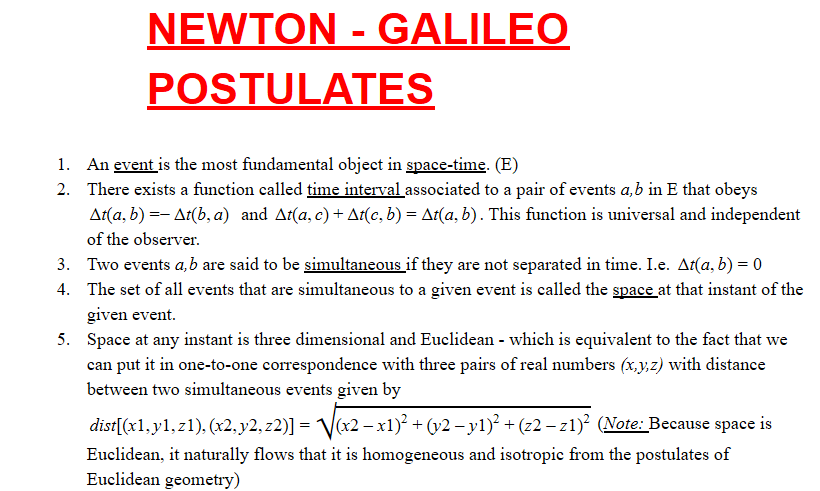
1. Event: An event is the most fundamental object in physics. Physics is the study of events associated to objects. Motion is the set of events associated with a particular object. Chemistry is the study of events associated with combination and splitting of molecules. Biology is the study of events associated with living beings. History is the study of events related to mass human behavior.
2. Space-time: The set of all events is called space-time. Although Galileo didn’t call it so, let us use this name as Einstein used it. Space-time is the word for the set of all events that happens in the universe. It is denoted by 
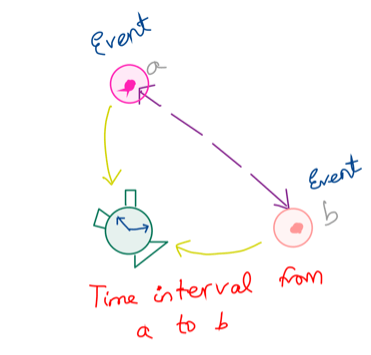
3. The notion of a universal Time interval/clock : Galileo postulated (although not in this exact words): There exists a function called “time interval” associated to any two events A and B in space time
i.e.

(Forget it if you cant understand it)
What he says is that, given any two events 
(i) 
(ii) 
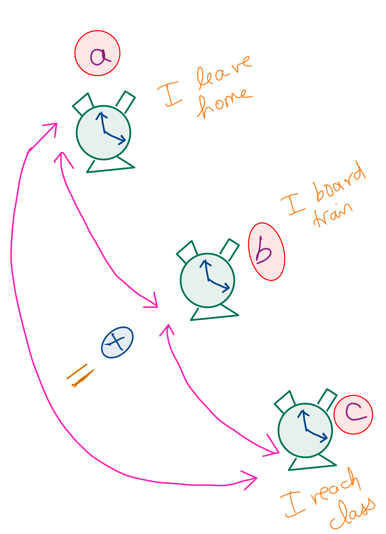
(The time interval between ‘a’ and ‘c’ is the sum of time intervals between a,b and b,c: One can always calculate time intervals between a pair of events ‘a,b’ with reference to any third intermediate event ‘c’)
Consider the following:
Event a: Clock at home reading 8:00 am when I leave
Event b: Clock at metro station showing 8:10 am when I board the train
Event c: Clock at my classroom showing 9:30 when I reach my college
It better be that time interval between ‘a’ and ‘c’ is 10 min (a,b) + 1 hr 20 min (b,c) = 1.5 hours
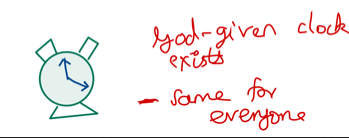
Galileo says that this function “time interval” is universal. There is a universal clock ticking that enlightens one about the time interval between two events. Any observer in whatever state, will measure the same time interval between two events! Thus, the Galilean concept of time is universal. It is same for everyone no matter whatever they are doing. This is a very obvious and intuitive assumption but nevertheless needs to be explicitly stated.
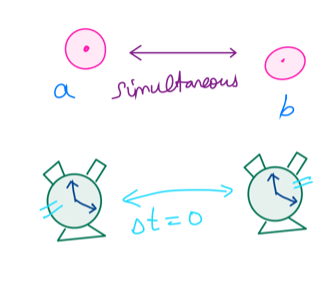
4. The notion of simultaneous events: Two events ‘a’ and ‘b’ are called simultaneous if 
Theorem 1: Two events ‘a’ and ‘b’ that are both simultaneous to another event ‘c’, are also simultaneous to one another!
Proof: If 


Theorem 2: An event is simultaneous to itself. i.e.

Proof: 
5. The notion of space: The collection of all events simultaneous to a given event is called the “SPACE”. SPACE in space-time is the set of all events simultaneous to a given event. So when I say space, when I am typing this blog, this means that the set of all events simultaneous to the event of me typing this blog. The collection of all such events is called space at the instant when I am typing this blog. But the space associated to another event not simultaneous with my event can be different. For example, the space associated with the event “my birth”, is different from the space associated to the event “I am typing this blog”. Galileo believed in the existence of space and events, independent of the existence of any other material object.
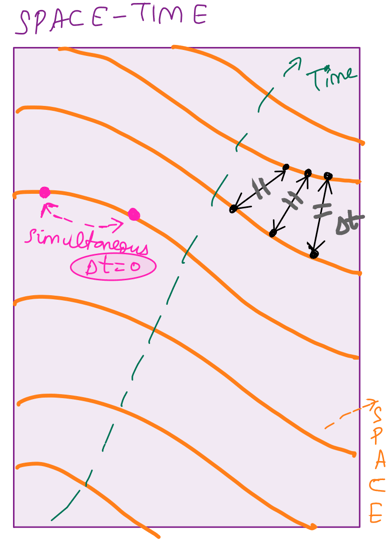
NOTE: Even though we refer to events by giving a certain phenomenon happening related to some objects, the entity which is referred to – the event corresponding to “I am typing this blog” – that dot in space and time is absolute – and whose existence is independent of my existence and me typing here. It is like this. Just because I may refer a piece of land by referring to its current owner, the existence of land is independent of the owner and the owner may change in future and it may not have been owned at all in the past. The notion of that piece of land is independent of who owns it, who does what with it, who mines on it, who grazes on it, who shits on it, or who walks on it even though I may use them for referring to it or identifying it. Similarly, the event referred to as “me typing this blog” is absolute and has an ethereal existence of its own even though I use my activity to refer to it. I may not have been born at all in this world, and still at this event, someone else would have been doing something at this event I am referring to, and still that also is a valid pointer to the event. So the concept of an event is part concrete and part imagination. But then the only difference is that all of mankind can have this same fantasy of an “event”, “space” and “time”. For that sake, even the concept of numbers are like that. Even though we use symbols and objects to learn and refer to them, their existence is independent of all such objects and persistent and consistent in all of our heads. (just like the fantast of a “point” in geometry)
Similarly, the notion of a space, which is the dark naked empty space at a given time, independent of objects was imagined by Galileo!
6.Space is three-dimensional and Euclidean:
As we have seen that Euclid’s infinite plane can be put in one-to-one correspondence with two sets of real numbers 
![dist[(x_1,y_1),(x_2,y_2)]=\sqrt{(x_2-x_1)^2+(y_2-y_1)^2}](https://s0.wp.com/latex.php?latex=dist%5B%28x_1%2Cy_1%29%2C%28x_2%2Cy_2%29%5D%3D%5Csqrt%7B%28x_2-x_1%29%5E2%2B%28y_2-y_1%29%5E2%7D&bg=FFFFFF&fg=181818&s=0&c=20201002)
As an exercise: I leave it to you to come up with what all notions are required to capture the full space around us and extending Euclid’s postulates to this extended space. There are many ways to do this and these go under the name of Hilbert’s axioms, Tarski’s axioms and these are all ways to extend this Euclidean system to the space that seems to be insufficient to be covered by a plane.
Fundamental vocabulary and definitions: Almost same as Euclidean plane with few extra notions in bold letters – point, infinite space, distance, angle, translation, rotation, point, line segment, infinite line, congruence, containment, plane, infinite plane, parallel lines in a plane (notion of parallelism of lines is defined only in a plane – two lines are parallel if they lie in the same plane and they do not intersect how much ever extended) , parallelism of planes (two planes are defined to be parallel if they do not intersect, no matter how much ever extended)
You can look up Hilbert’s / Tarski’s axioms but more or less the flavor of axioms will look something like:
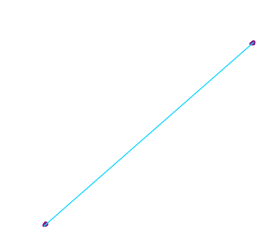
Given two distinct points in entire space, there exists a unique straight line joining them
Euclid’s postulates hold in any plane
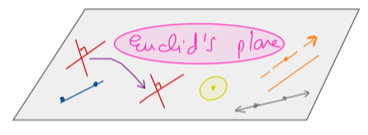
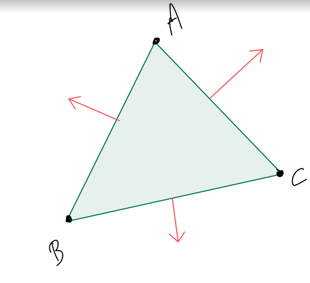
Given three points, not all of them lying in the same line, there exists a unique plane containing all of them (and any plane can be extended uniquely into an infinite plane)
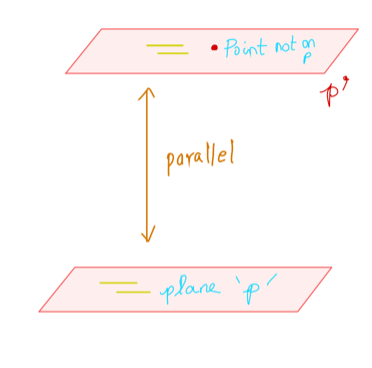
Given a point P not on a given plane p, there exists a unique plane p’ passing through P and parallel to P.
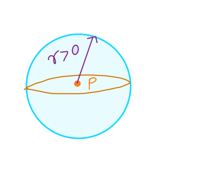
Construction of spheres of any centre and positive radius or some equivalent of them
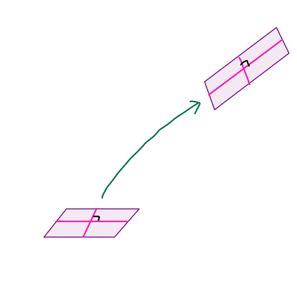
Some form of homogeneity and isotropy like “All right angles are equal”. Some notion of congruence between any two points and any two directions (just to say that space looks the same everywhere and in every direction – homogeneity and isotropy!)
And some other formal notions and common notions regarding numbers….
So with all this, we can prove that the “Euclidean space” can be put in one-to-one correspondence now with 
![dist[(x_1,y_1,z_1),(x_2,y_2,z_2)]=\sqrt{(x_2-x_1)^2+(y_2-y_1)^2+(z_2-z_1)^2}](https://s0.wp.com/latex.php?latex=dist%5B%28x_1%2Cy_1%2Cz_1%29%2C%28x_2%2Cy_2%2Cz_2%29%5D%3D%5Csqrt%7B%28x_2-x_1%29%5E2%2B%28y_2-y_1%29%5E2%2B%28z_2-z_1%29%5E2%7D&bg=FFFFFF&fg=181818&s=0&c=20201002)
This is something again that has got drilled into you right from high school.
So what Galileo says is that
The set of events simultaneous to a given event, called “space” at an instant, is a Euclidean space and can be put in one-to-one correspondence with
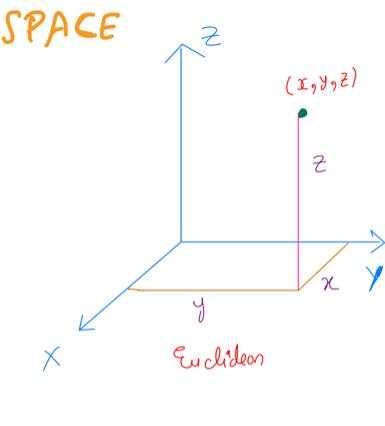
Again, as I have warned already, what we observe is a tiny portion of space-time and postulating that the entirety of space is Euclidean seems so far fetched but it works and it is the most natural thing as pointed out already in Week 4.
So what we have done so far is summarized below:
So, if we take all the events simultaneous to a given event, called as space at that instant, then it is natural that it is 3 dimensional and Euclidean as it is indeed so according to our experience.
THE IDEA OF AN ABSOLUTE SPACE:
The notion of an absolute space!!??!!??!!?? – Intense philosophical debates
Now starts one of the intense debates in physics. But this debate can never be settled as it can be proved to be impossible to regard one claim as correct. The issue is as follows:
The issue is as follows: At each fresh instant of time, we are blessed with a three-dimensional Euclidean space (which is homogeneous and istropic). At a given instant, we can compare points and we can distinguish between points – say right now – the point where the close icon X of your laptop or desktop is the point P and the point where your index finger tip is Q. But at the very next instant, we start afresh. We are now given another fresh set of points that forms a three dimensional Euclidean space and we can now label these set of points as well. Now the question is as follows:
Is there something – a single 3D Euclidean space – called the absolute space – whose points when labelled with time, constitutes the set of all possible events? To rephrase it, if an event at a particular time is labelled as point P in space, then, at later time, does it make sense to ask where is that point P? Is space-time really a single absolute still space that is running through time, or is it really a bunch of fresh Euclidean spaces, each arising at different instants of time?
This is very deep. Note that we are talking about only properties of events. As I said, even though I may use external objects and phenomena to refer to events, the notion of event still makes sense and has an independent existence. So, let us strip our entire universe of any external objects and stare at only the dark naked and empty universe – we are asking about that. Is it really a fresh bunch of Euclidean spaces at each instant of time – or is it just a single Euclidean space labelled by time? All we know for sure is that at each instant, the collection of all events at that instant (called space) is three dimensional and Euclidean. Most of us would prefer to say that the answer is latter. i.e Space-time is a single space running through time.
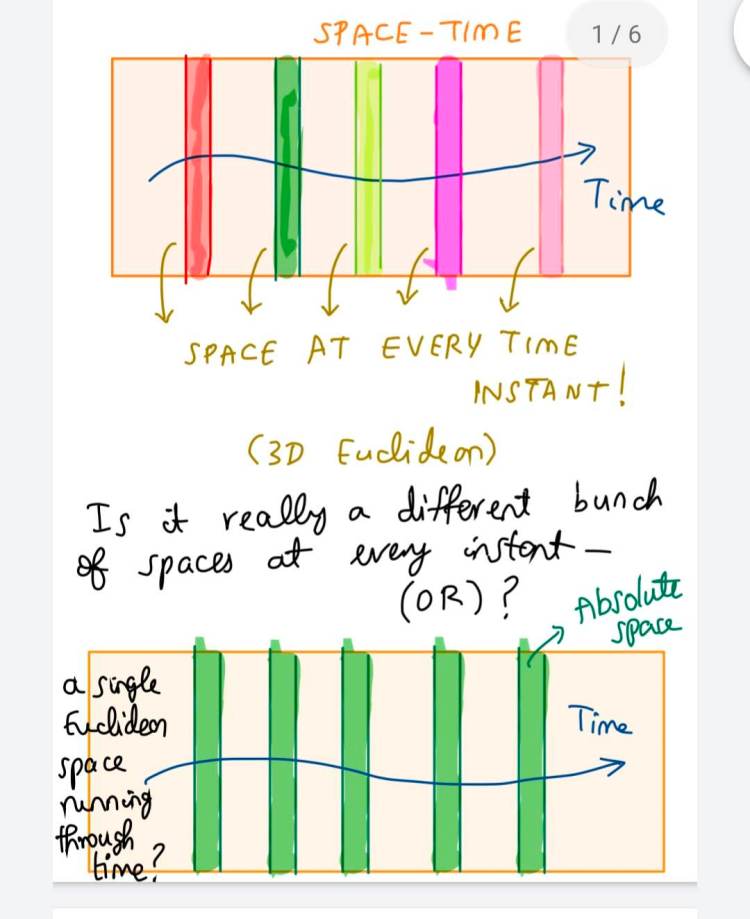
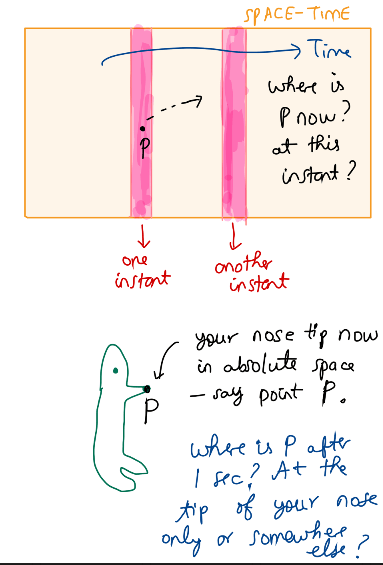
If yes, let us ask this question. Let us say the point corresponding to your nose tip, is labelled P at this instant. Since space-time is just a single space running through time, I ask you where is the point P after say 1 seconds? You might say, it is ridiculous. After 1 seconds, the point P is the same tip of my nose, as it was before.
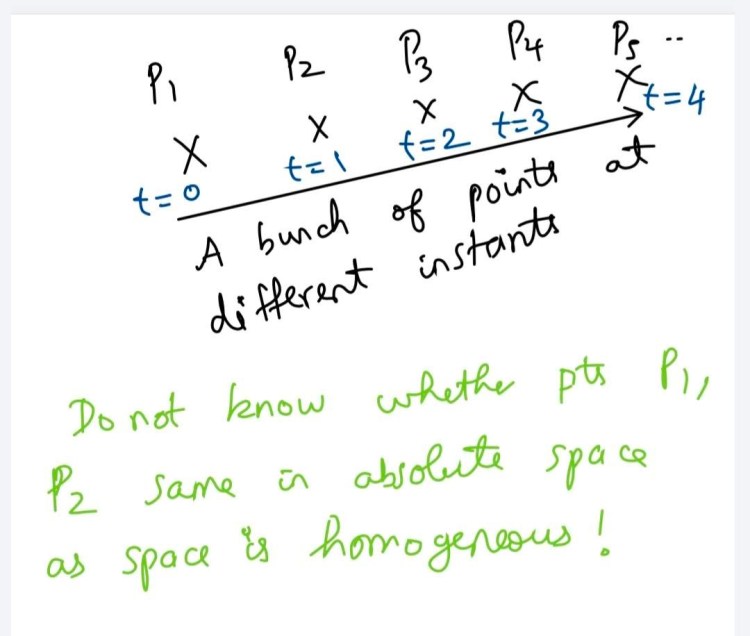
But is it true really? How do you know that the tip of your nose stays at the same point of absolute space, as time progresses? After all, you are sitting on earth which is rotating and revolving around the sun. So the point where your nose tip was 1 seconds ago, would now be lagging behind the tip of your nose now, as your nose is moving with the earth and I asked you for the point P. Will you be satisfied if you are now at the sun 😛 and I ask you the same question? Say, you are now standing on the SUN and let point P now correspond to the tip of your nose. Where is it after 1 seconds? Is it still the tip of your nose? No! THe sun is moving with respect to the Milky Way Galaxy and who knows – the point P that was in your nose tip 1 seconds before might have moved with the Sun and hence the point that was your nose tip 1 second before is no longer your nose tip now! You see what is happening!! We can never know if a collection of points, running through time, is the same collection of points, or moving with respect to absolute space. The root cause of this is the homogeneity of absolute space. Since all points in absolute space look the same, we never know, if any collection of points running through time, (say my nose tip running through time) is indeed the same collection of points indeed. We never know that whether we are moving with respect to absolute space (in a purely geometric way – independent of reference to external objects and phenomena). Because a transport of us to a different point in absolute space would be
undetectable. If you are now at a point in the dark absolute space without any objects or external phenomena, ad while you are sleeping and someone suddenly transports you to some other point while asleep, then after waking up, you would never notice whether you are transported or not without reference to external objects as every point in absolute space is the same geometrically. So even if an absolute space exists, which when labelled by time, corresponds to all events of space-time, it is impossible for us to talk of or label individual points in a geometric way. So, while the existence of absolute space may be true, in practice it is not a useful construct as a purely geometric object as we can never keep track of points in the absolute space, through different time instants, as every point in that absolute space looks the same (homogeneity of Euclidean space).
While Galileo and Newton believed in the concept of absolute space, Leibnitz, Mach and others who were his arch enemies (both mathematically and personally) did not believe so and said that motion makes sense only when relative to external objects.


HOMOGENEITY OF SPACE-TIME AND FRAMES OF REFERENCES:
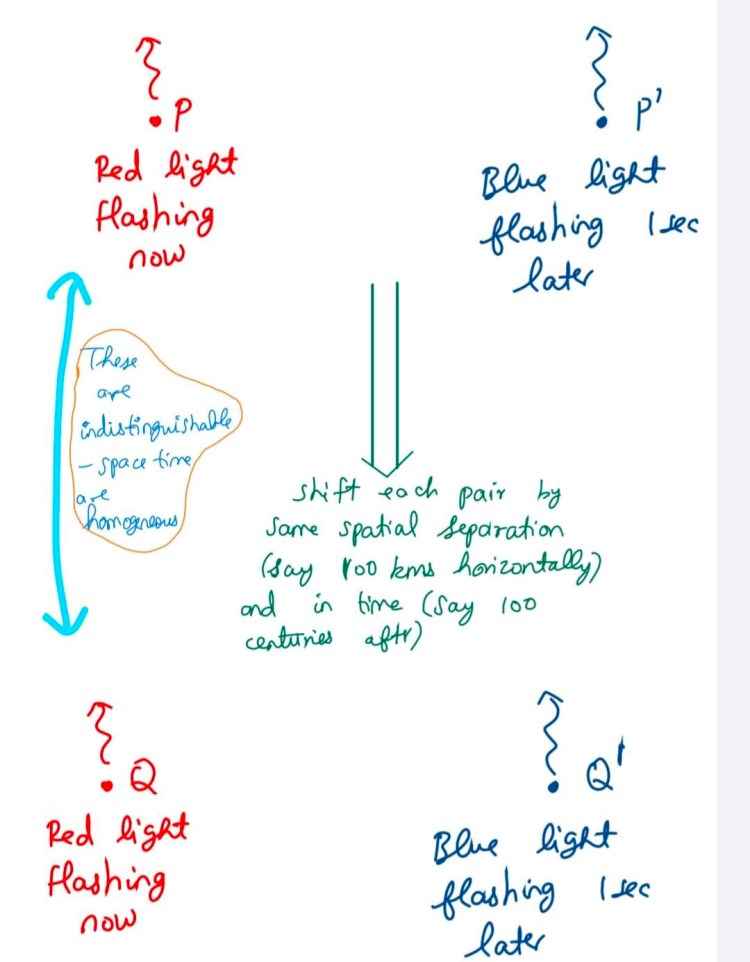
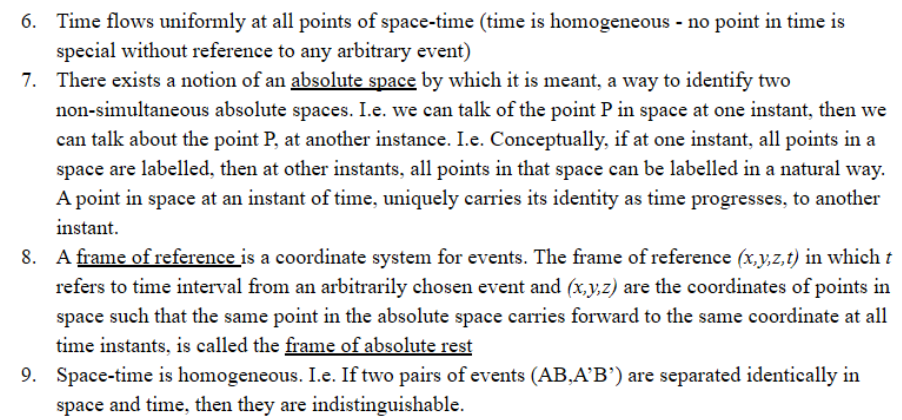
We know that as all right angles are equal, space at an insant or absolute space (if it exists) is homogeneous. Which means every point in the space and hence absolute space (if you believe in it!) is the same geometrically. Any distinction between two points in absolute space comes only with reference to some external object or phenomena while the existence of space-time is assumed to be independent of all such external stuff. And also every instant in time is same. Every moment in time is same. Time flows uniformly everywhere. It is impossible to know how much time you have slept without any reference to external objects like clocks or stuff. Galileo combined homogeneity of absolute space and time and came up with a homogeneity of space time as follows: There is no privileged event in the universe. Every event in the absolute space-time universe is the same. If there are two pairs of events (P,P’) and (Q,Q’) such that the time separation and space separation is the same for the pairs (P,P’) and (Q,Q’), then according to Galileo, you can never distinguish between the two pairs. Let P: a red light is flashed now and here and P’: Blue light flashed 1 second later and 1 metres to the right. Now, let Q: red light flashed 100 centuries later and 100 kilometres to the right from here and Q’: Blue light flashed 1 second after Q and 1 metres to the right of the point corresponding to Q. Then according to Galileo, without reference to anything external, we can never distinguish between the pairs. The absolute point in space-time does not matter and cannot be inferred by just the geometric measurement of distances and angles in absolute space and time interval measurement in space-time. As everything we can measure is only separation of points and time intervals between events, it is impossible to determine without anything external, the absolute location in space-time of a pair of events.
Frame of reference:
As we could do Cartesian coordinates for geometry, frame of reference is the generalization of assigning numbers to space-time. A most obvious way to assign coordinates to space-time is as follows: We can assign 3 numbers (x,y,z) called Cartesian coordinates for space at a given time instant. All we need to do is to choose an origin in space at that instant and three set of perpendicular right handed directions. With this, we have exhausted labelling space – i.e. events at a given instant of time. But now we have to do this process yet again at another instant. We have to assign fresh coordinates to space at some other time. So, to exhaust all possible events, we have to assign Cartesian coordinates space at each instant. Such a process of assigning a set of Cartesian coordinates to space at all times is called FRAME OF REFERENCE. A frame of reference is a choice of a Cartesian coordinate system to space at every instant of time. So the labels (x,y,z,t) where ’t’ is the time interval from a reference event and (x,y,z) is the set of Cartesian coordinates to space at that instant ’t’ is called a frame of reference. A frame of reference is nothing but a choice of Cartesian coordinate system to space at each instant of time which is then used to parametrise space-time.
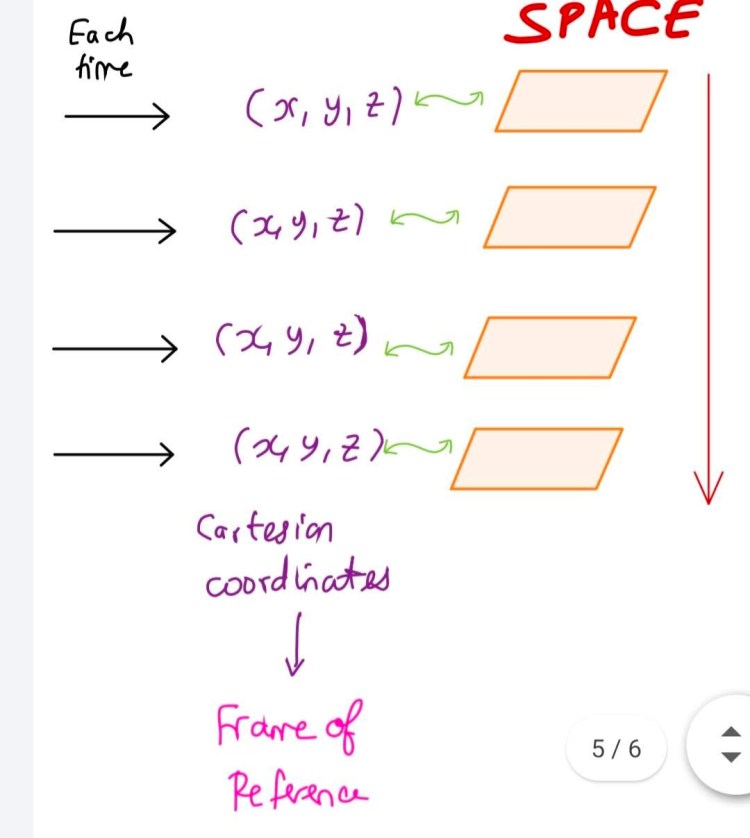
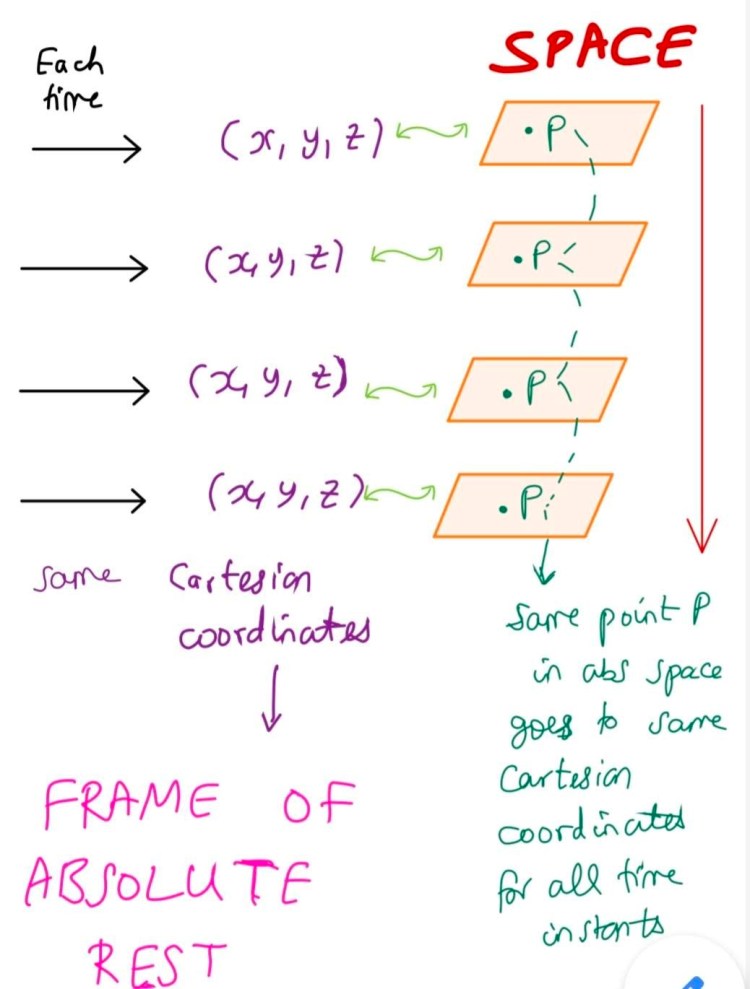
Note that there are many choices. At each instant I can make an arbitrary choice of coordinates. There is no natural frame of reference in space-time. But this is where the notion of absolute space helps, if we believe in it. If we believe in absolute space, then a natural way to assign frame exists. We can choose frame of reference such that the same point in absolute space goes to same coordinates (x,y,z) at all instants. Since space-time is really one single absolute space running through time, if we assign Cartesian coordinates at a single instant of time, then we can
extend it to other instants by making the same point in absolute space go to the same coordinates that it was assigned at the reference instant. Such a frame of reference is called the FRAME OF ABSOLUTE REST or ABSOLUTE REST FRAME. Note that this is only when we believe in the idea of absolute space. Note that the ABSOLUTE REST FRAME is a theoretical construct. As we saw before, it exists theoretically, but since space time is homogeneous, we can never know if
our frame is absolute rest!
We are now done with the vocabulary for Galilean relativity in space-time.
We shall summarize what we learnt so far below that contains the definitions and postulates of space-time from Newton-Galileo point of view.
Note that this is not the end. We shall explore some consequences of these postulates in the next week.
 Understanding Einstein in 52 Weeks!!