STORY SO FAR:
So last time, we saw that Newton and Galileo believed in the notion and existence of an absolute space (independent of any object) which when witnessing different instants of time, create the stage for every event in this universe to happen. (So every event has a unique location in absolute space independent of any other concept and a time of occurrence). Also Newton postulated that this space was three dimensional and Euclidean which meant that it obeyed Euclidean axioms of spatial geometry which implied:
1. Such a space is homogeneous and isotropic everywhere. There is no preferred point in space and a preferred direction in space geometrically, without any prejudice to any other external object or event.
2. It can be put in one to one correspondence with 


A small technical note: (CAN BE SKIPPED AND REFERRED TO WHEN USED LATER)
Before we proceed to this week’s formal contents, let us prove a small mathematical result so that it will provide us with the right insight when the time comes. Let (x,t) be two variables and let 

Let
satisfy the following properties:
1. Let
and
satisfy
and
. Then,
![f[(x_1,t_1)]-f[(x_2,t_2)]=f[(x_1',t_1')]-f[(x_2',t_2')]](https://s0.wp.com/latex.php?latex=f%5B%28x_1%2Ct_1%29%5D-f%5B%28x_2%2Ct_2%29%5D%3Df%5B%28x_1%27%2Ct_1%27%29%5D-f%5B%28x_2%27%2Ct_2%27%29%5D&bg=FFFFFF&fg=181818&s=0&c=20201002)
2. For a given t,
What do you think f(x,t) can be if it has to satisfy these properties? Think yourself before looking at the answer discussed below:
![f([x,t])-f([x',t])=x-x'](https://s0.wp.com/latex.php?latex=f%28%5Bx%2Ct%5D%29-f%28%5Bx%27%2Ct%5D%29%3Dx-x%27&bg=FFFFFF&fg=181818&s=0&c=20201002)
The second property says that for a given 


Now applying the second condition, it says that identically separated (x,t) pairs 12, 1’2′, goes to identically separated values in f. If we put this assuming 


So, we have 


COMING BACK TO OUR MATTER:
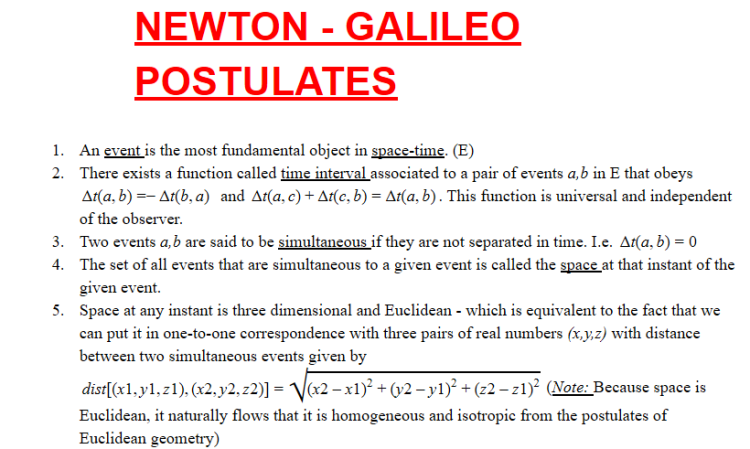
So last time we saw that how Galileo and Newton postulated the existence of an “absolute Euclidean space” – which when witnessing the passage of time, generates the set of all possible events. Since that absolute space is homogeneous and isotropic (as all Euclidean spaces are)[looks same everywhere and in every direction], it is impossible to detect where we are in a purely geometric basis without reference to any external objects. In the dark space where there is nothing, but plain space without any objects, one cannot determine if an object is moving through that absolute space – as even when it is moving and it traverses different points at different instants of time, we cannot deduce it as every point in that dark space looks the same.
In other words, let us say if you are put in a rocket that is in deep empty space without any visible star or planet or any object but just sheer darkness outside. The rocket is now at rest in absolute space. When you fall asleep, the rocket switched on its engine and moved to some other place in that dark empty space. What I claim is that after you wake up, you cannot determine if the rocket had moved or stayed at the same place. Because the point you were before you slept and the point you are at now, look the same in dark absolute space without reference to any other objects. So you never know if you have moved. So, absolute motion is undetectable without reference to any external objects. Similarly, absolute time is undetectable. Without an external event, it is impossible to tell how much time you have slept. Only time intervals are detectable – absolute time is undetectable. You have to have two events to talk about time. Every instant of time is same (time flows uniformly). In the rocket, without a clock or someone watching, it will be impossible to determine how much time you have slept!!

In other words, the so called absolute motion through absolute space cannot be detected and only relative motion w.r.t another object can be detected. We summarise our last week’s findings below:
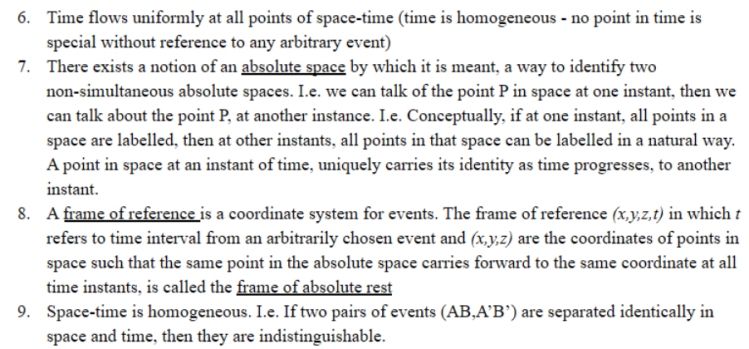
This homogeneity of space, when combined with the homogeneity of time, results in space-time homogeneity where in
Two pairs of events having same spatial and time separation are indistinguishable from each other without any reference to external objects and events
FRAME OF ABSOLUTE REST:
Note that last time we talked about a natural frame of absolute rest, where in, with reference to an event, the coordinates of an arbitrary point P in space-time are 
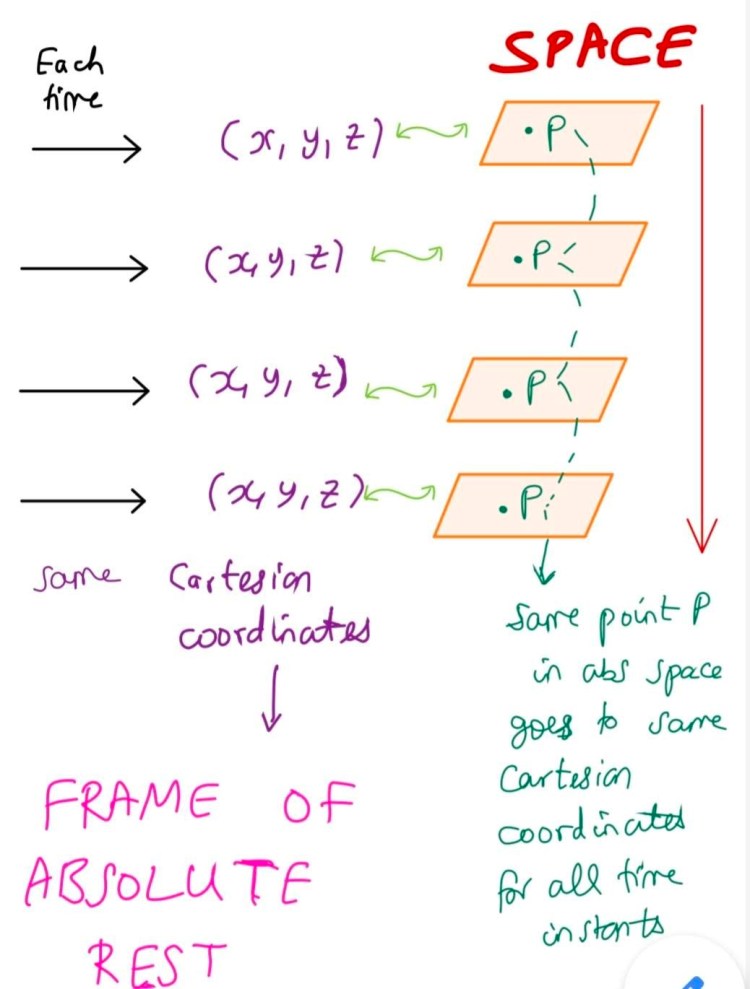
In this frame, the spatial separation between two events P_1 and P_2 in absolute space with coordinates 


The coordinates of absolute rest frame $latex (x,y,z,t) satisfy the following properties:
1. t is the time interval measured from a reference event
2. The distance between two simultaneous events 


3. Two pairs of events have 


The third statement is quite profound. It says that two identically separated pairs of events (which are indistinguishable in homogeneous space–time: as they have same spatial separation in absolute space and same separation in time) also have same coordinate differences and vice versa in the rest frame. i.e. If a pair of events 1,2 is identical to another pair 1’2′, the event 1′ should be shifted from 1 exactly the same amount in which 2 has shifted from 2′ in space-time. So, their coordinate differences should match. (Word description of the contents of Eqn *)
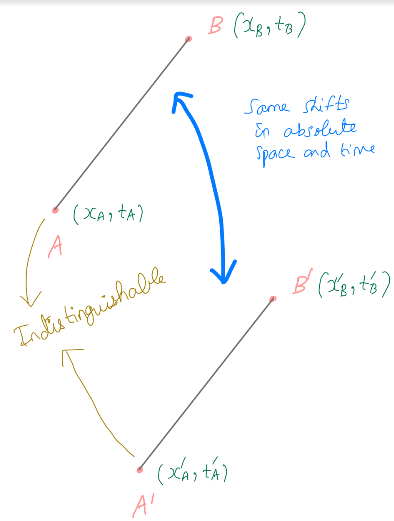
In other words, space time homogeneity is reflected as coordinate differences in the absolute rest frame. Two pairs of events in space-time are indistinguishable if and only if their coordinate differences are the same.
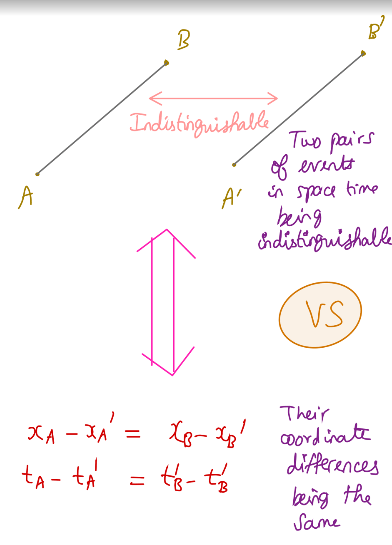
Now let us ask: What other coordinate systems satisfy these properties? Is it only the rest frame coordinate system that satisfies these three properties? For now, let us assume that space is only one- dimensional so that we need only one coordinate (x) to capture. So, the coordinates for our space time is 

To preserve the fact (1) even in the new coordinates, which is “t is the time interval measured from a reference event”, we need that

To preserve the fact (2),in the new coordinates, which is “The distance between two simultaneous events 


Now we want the fact (3) to be true of 
So, we want this equation Eqn * to be true in both the coordinates and denoting the new coordinates x’ as

So, if
Set of all coordinate systems (x’,t’) in which homogeneity of events in absolute space-time is preserved

Now, these are very special. The thing is that anyways it is impossible to detect absolute motion in homogeneous space as I was saying before. All we can do is measure distances between two simultaneous events and measure times. For that any function
will work.
But the event pairs that the rest pair observer decides as indistinguishable by considering his spatial separation and time separation (in his absolute rest frame) need not be indistinguishable as observed in the other frame for random 


So, even though absolute rest frame has the sacredness of being special, its homogeneity and indistinguishability is carried to other frames satisfying the equations
So, this frame is as good as absolute rest frame as I can decide if two pairs of events are indistinguishable by just observing their coordinate differences. (spatial and time differences). The value of those differences may not be the same as in absolute space but indeed that does not matter as anyways we cannot detect motion through absolute space and we cannot talk about spatial separation at different times purely geometrically.
So, all these frames must be of equal importance if the laws of physics respect the fact that there is no absolute motion and there is only this space-time homogeneity.
So, here we have the Galilean principle of relativity:
GALILEAN PRINCIPLE OF RELATIVITY:
I do not know the laws of physics, but whatever they are, if they are true in the frame of absolute rest with coordinates
Physically, when 


So, another equivalent statement of Galilean principle of relativity is:
I do not know the laws of physics, but whatever they are, if it is true in the frame of absolute rest, then they should take the same form in a ship moving in absolute space with some constant velocity
OR
Uniform motion with a constant velocity ‘v’ in absolute space time should not be inferable from the laws of physics. i.e The laws of physics must look the same in all frames moving with uniform velocity relative to the rest frame (Hereafter lets call such frames as inertial frames)
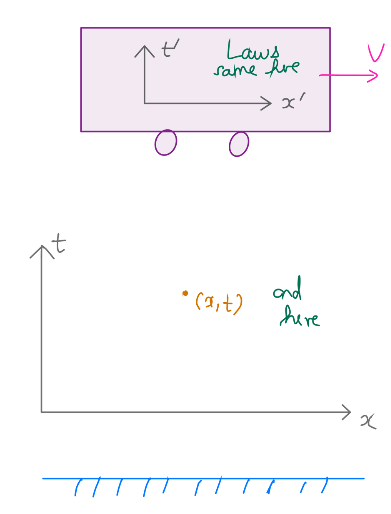
So, a short restatement of Galileo:
THE LAWS OF PHYSICS ARE SAME IN ALL INERTIAL FRAMES!
In original words of Galileo and Newton

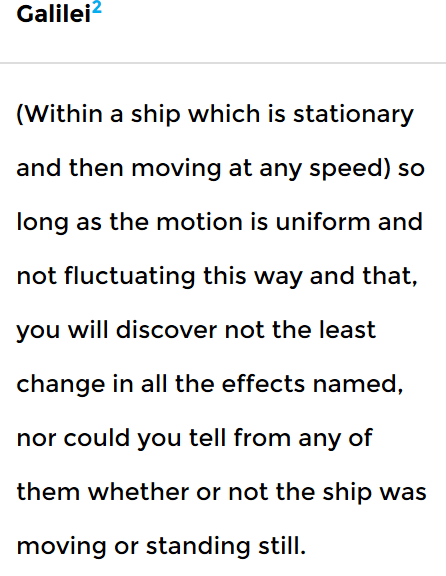
A consequence: Uniform velocity motion in absolute space should not have a cause. The laws of motion should not involve velocities as velocities change when going from one inertial frame to another.
This was in contrast with Aristotle who postulated that rest in absolute space is the natural state of motion of any body. Any body naturally comes to rest. To make it move, it needs a cause. But this is not true in any other inertial frame. For example, if a body is at rest with respect to me, for a person moving in car with uniform velocity, it will appear that the body (that according to Aristotle is at is “state of natural rest” from the point of view of the person on the ground), is moving now as seen from the car, say at 30 kmph So, he will conclude that in his frame of the car, “motion with uniform speed of 30 kmph is the natural state of motion for any body. To make it deviate from that uniform velocity of 30kmph, we need a cause”. So, this is not a frame invariant statement. In my frame rest is the natural rest and Aristotle is right whereas in the other frame Aristotle is wrong. So Aristotle’s statement as the law of mechanics is not correct as it is not possible to be true in all inertial frames. 🙂 🙂
Newton realized that only the derivative of velocity, which is acceleration can have a cause according to Galileo’s principle.
Because if 


(acceleration is defined as the instantaneous rate of change of velocity – derivative of velocity)
So we see that any two inertial observers always agree on their accelerations. So, acceleration can have a cause. So, Newton said that in his first law
Newton’s first law:
Any body far away from other bodies (under no influence from anything) will move at a constant velocity in absolute space. (The acceleration of a free body is zero)
So according to Newton, a body does not need any exeternal agent to maintain a state of uniform velocity. So motion with a uniform velocity (whatever the value may be) is the natural state of motion for every body. This is a frame invariant statement as if the body is moving with uniform velocity in one inertial frame – it is also doing so in another inertial frame (although the value of the uniform velocity may differ). Or if acceleration is zero in one inertial frame, it is zero in another inertial frame as well (coz acceleration is same in all inertial frames as we have established)
Now to make it accelerate, and hence change its state of uniform velocity, we need a cause. The simplest relation between cause and an effect is a proportional relationship. So, Newton says
Newton’s second law:
For a body to accelerate or deviate from the state of uniform motion, needs a cause called the force (F) and that cause is proportional to its effect (acceleration a)
So, F=ma
where the proportionality constant is called “mass” of the body and it determines the resistance of the body to accelerate.
So, we see that Newton’s first two laws are the simplest laws that respect Galilieo’s principle of relativity.
 Understanding Einstein in 52 Weeks!!