Some infinities are bigger than other infinites
John Green
This week we take a detour from geometry. I was telling you the other kind of geometry that is non-Euclidean and has the feature that given a line and a point not in it, there are many lines passing through the point and parallel to the given line. But that geometry is not quite natural to develop as was the geometry of a sphere. It will require some tools and some familiarity with coordinates and numbers and some calculus. As calculus is an unavoidable toolkit in a physicist’s toolbox, it is better confronted sooner than later. Also historically, the new geometry was invented after the invention of calculus. So this week shall be purely about numbers and functions.
Once again the story starts in ancient Greece! This time it is not with Euclid but another philosopher called Zeno. He put forth several paradoxes (not really paradoxes) which can be explained only when one has familiarity with the infinite.
First paradox of Zeno – Achilles and the tortoise:

The first paradox concerns this: Imagine that Achilles is initially at x=0 of the number line shown below and travels at a uniform speed of 1 metres every 1 second. The tortoise on the other hand is initially at x=1 in the number line (it gets a headstart) but has a speed of only half a metres every one second. Now any child will know that even though the tortoise gets a headstart, since it is running slower than Achilles, Achilles eventually will overtake the tortoise in some time

Let A(t) denote the position of Achilles at time ‘t’. Since Achilles travels at 1 metres every 1 second, we have 


And similarly,

So, we have that for the first two seconds (t<2), Achilles is behind the tortoise (A(t)<T(t)), and after two seconds, Achilles beats the tortoise and keeps moving ahead. i.e. A(t)>T(t). This is common sense. A fast person will eventually beat a slow person even if the slow person has an initial headstart. It is only a matter of two seconds or whatever depending on the exact speeds and the initial headstart.
But Zeno argues that this will not happen and it is called the Zeno’s paradox.
He argues as follows:
1. Initially, the tortoise is farther – T(0)=1, A(0)=1. So it will take some time 
2. But in this time 
3. Achilles now should has to reach 

4. But again in this time 
5. Now Achilles has to start afresh. From the current position 
6. And so on…….
This continues forever
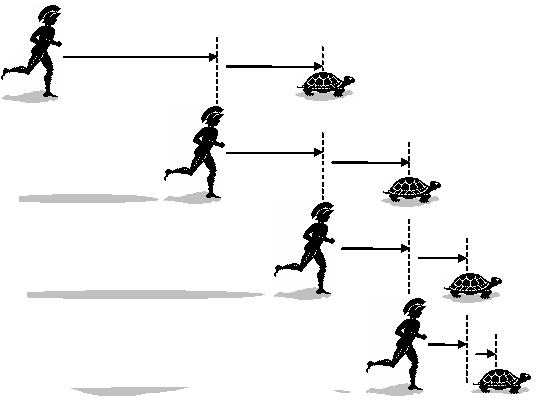

So Zeno argues that Achilles can never reach the tortoise as he has to keep on chasing the tortoise “infinite” times where the tortoise is going. Achilles will take 

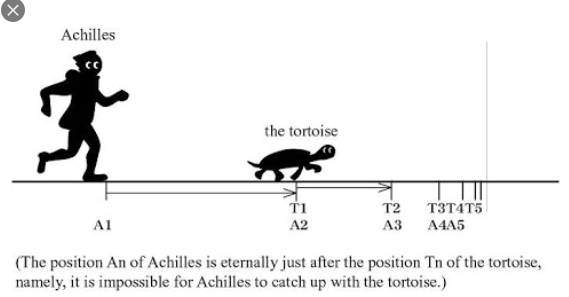
But we know there is something fishy in Zeno’s argument as we intuitively know and also from the equation of motion for A(t) and T(t) that within two seconds, Achilles should overtake the tortoise. It looks like if Achilles has to think about covering the distance that the tortoise traverses, it looks like it will take forever as he has to keep on covering the tortoise’s old positions again and again. But looks like if he does not care about it, things are normal.
Second paradox of Zeno – motion is impossible logically and is an illusion!
According to Zeno, by similar arguments, he argues that motion is impossible logically and it is hence an illusion. He argues that it is impossible to move from a point A to another point B in a line (say).
1. Then first I have to reach the point that is halfway between A and B, say A1. It will take time t1. (non zero time – as I cannot be in two different places at once)
2. Having reached A1, I now have to cross the point halfway between A1 and B – say A2. Again I will take some non zero time t2 to reach from A1 to A2.
3. Having reached A2, I now have to reach the point that is half way between A2 and B and I will take some time t3 to reach that.
4. And on and on. So I have to keep chasing infinite number of half way points A1,A2,… in times t1,t2,…. and hence I can never reach from A to B.
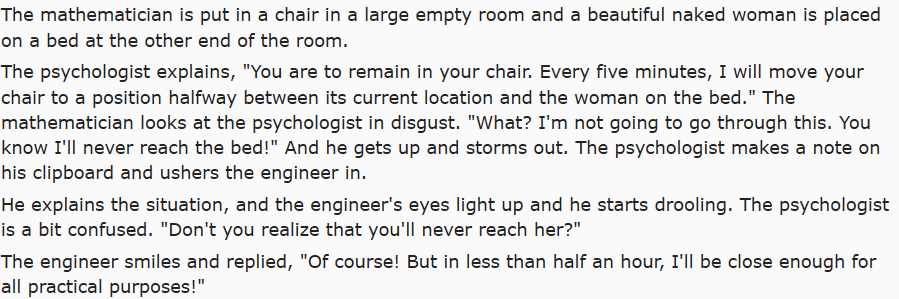
If you continue traveling half the distance that is left, you’ll never get to point B because you can always slice the remaining distance in half again
So according to Zeno, motion is an illusion and I can never reach from any point A to any other point B.
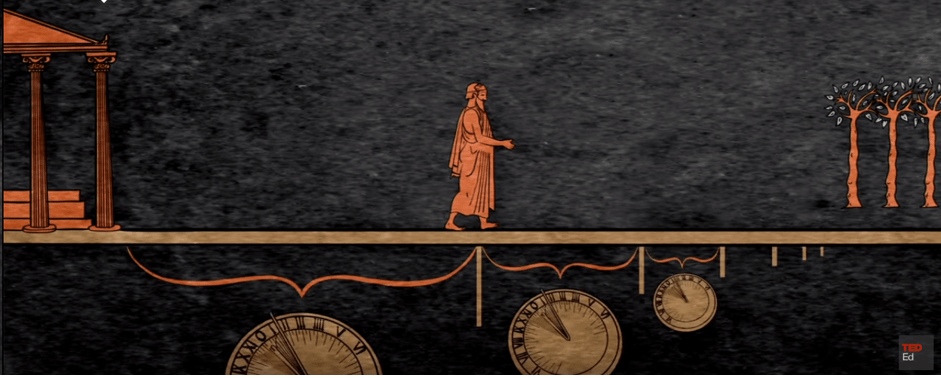
But everyday experience shows that I can reach from A to B in finite time. If B is 1 metres to the right of A, then travelling at a constant speed of 1 metres every one second, I can reach B in 1 second.
What is wrong in these flow of arguments by Zeno although they seem logically solid!
This is where the delicate issue of limits come into picture. Normally, the concept of limits is introduced only in high school that too in a highly unmotivated manner but with these examples, we can introduce it to even small children who would be more curious about these things.
Let us now prove deeper into this. First let us take the first problem. Achilles and the tortoise. The first logic that involved calculating A(t) and T(t) (where we did not think about Achilles covering the tortoise’s old way points), it was found that Achilles would beat the tortoise in exactly two seconds.
Let us now calculate the explicit time involved:
Initially, Achilles is at 0 and tortoise at 1. Since Achilles is moving 1 units of distance every 1 second, it will take 1 second for Achilles to cover from x=0 to x=1
So, t1=1
Now, in this this 1 second, the tortoise, moving at 0.5 units per second, would have covered a distance 0.5. So it will be at T(1)=1+0.5 (1: initial point, 0.5: additional distance covered from there)
Now, Achilles has to move from his present position (x=1) to tortoise’s new position (x=1.5)
So, he has to cover 0.5 units. Since he travels at unit speed, it would take 0.5 sec.
So, t2=0.5
Now in this 0.5 seconds, the tortoise would have covered 0.25 metres as it is going half metres every second.
Now to cover this 0.25 metres , Achilles would take t3=0.25
Repeating this, we get

Achilles, to cover n waypoints of the tortoise, will take time 

I think if you had studied high school, you might have seen this somewhere! It is called the geometric series.
If you struggle with it, a little bit, you can evaluate this sum
Let 


We now see that the terms cancel nicely and we are left with

So,
![S_n=2(1-[\frac{1}{2}]^n))=2-(\frac{1}{2}^{n-1})](https://s0.wp.com/latex.php?latex=S_n%3D2%281-%5B%5Cfrac%7B1%7D%7B2%7D%5D%5En%29%29%3D2-%28%5Cfrac%7B1%7D%7B2%7D%5E%7Bn-1%7D%29&bg=FFFFFF&fg=181818&s=0&c=20201002)
So, it will take 

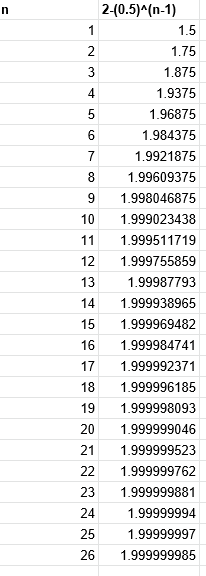
Plot:
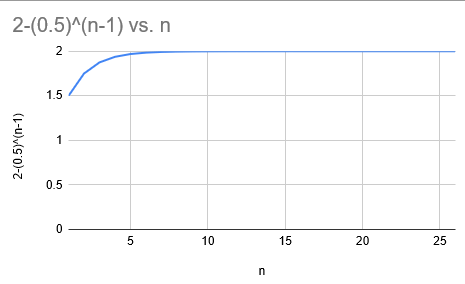
Now here comes the cool part:
Although Achilles has to chase the tortoise infinite times, looks like he will cove rall these infinite steps in just two seconds (see the graph or data above)
As 

Another way to convince yourself that the “infinite sum” 
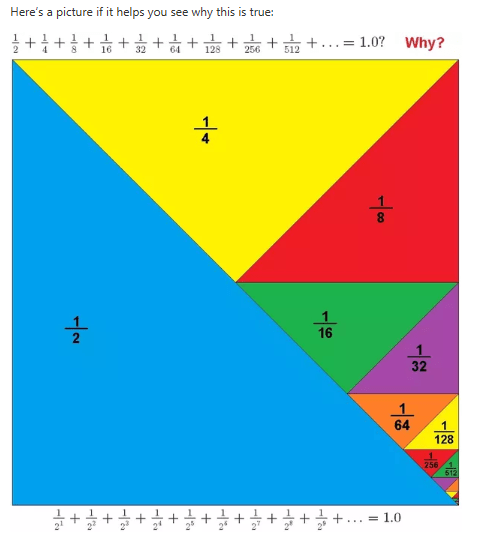
We can see that we can divide a unit square into infinitely many pieces, each of area 


We see that although we are pasting together infinite number of triangles, the area resulting in it can still be finite.
What Zeno has done is divide the 2 seconds gap where Achilles beats the tortoise into infinitely many gaps where in, at each gap, he chases the previous position of the tortoise.
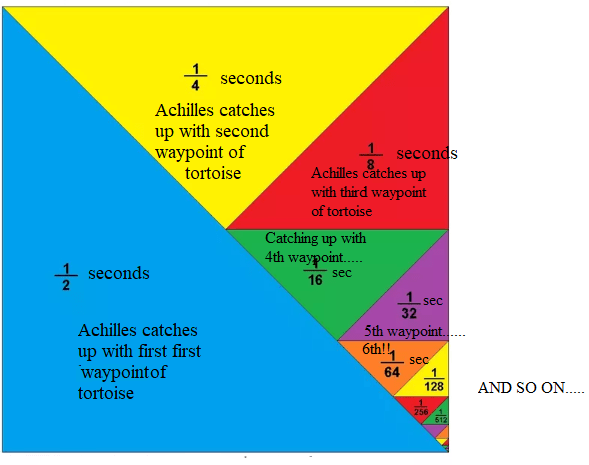
SO a resolution of Zeno’s paradox lies in the fact that a finite part of length/time/real number can be broken into infinite pieces of segments and eventhough we do not get the original piece back by merging how much ever finitely large number of pieces back, we somehow get the original segment back when we merge all the infinite pieces!!
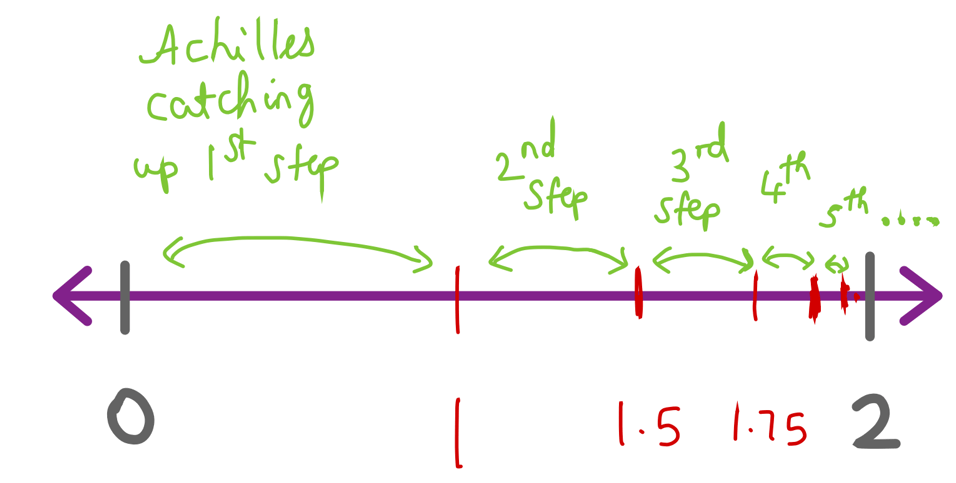
The resolution of Zeno‘s second paradox is also exactly similar. We have divided the segment of the journey between A and B into infinite number of way points by continuous halving of the segments. So we cannot expect to get the original segment back by merging/adding finite number of steps. Following this we are tempted to believe that “we can add infinitely many numbers” .
But it is at this stage, we must be careful. We can repeat the same paradox with Achilles running slower than the tortoise and this time, truly, Achilles cannot catch up with him. So when we add the infinite segments together, we cannot expect to get a finite answer.
Example: If 
Now, based on this, we give the following definition:
Definition 1: A sequence of real numbers 


where

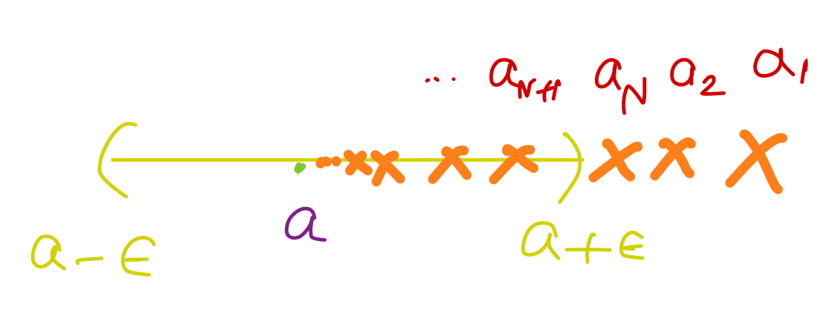
 to a, after a certain stage, the sequence gets that close to a
It captures intuitively that even though the sequence may not become the number 

So, we have that the sequence 


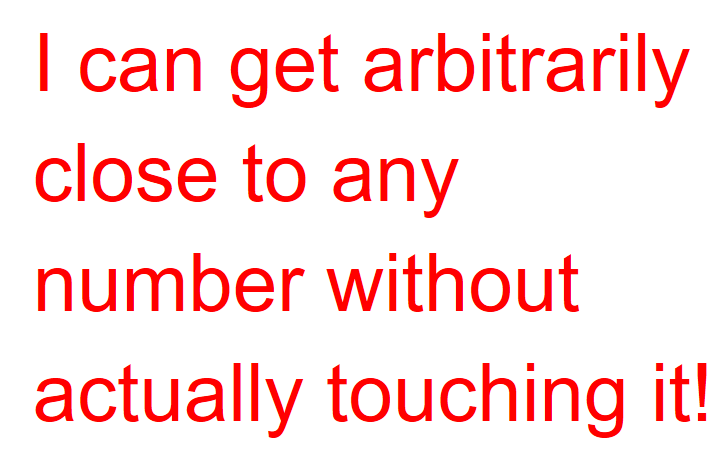
So the moral so far is:

THE BIRTH OF CALCULUS:
PIC: Founding fathers of calculus – Newton and Leibniz
This spirit of limits is what gave birth to calculus. Newton was watching the motion of a cart in a road and he observed the behavior of the position of the cart at each instant of time. Assuming the road to be a line and making it into a numbered line, we can capture its movement by having a table of position vs time as follows:
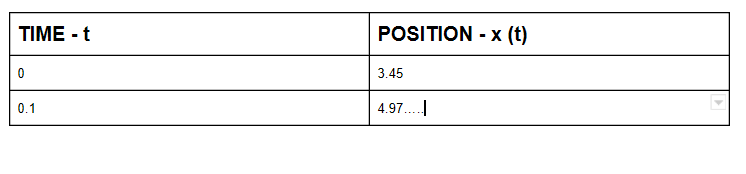
In other words, motion in a line can be specified by a function from a number “time” to another number “position”, denoted by
In other words, for every time 
Now, Newton asked, what is the speed of an object moving arbitrarily in a line as 


Now Newton asked, what if the object is moving in a completely arbitrary way such that the speed is not constant in any segment of the journey? Lets say the object travels in a line according to the relation 
To define speed at say time ‘t’, we run into a paradox. To define speed, we need two distinct instants of time (
But we have only one instant given to us, which is time t.
We can take one of the instants (say 

So, we run into a conundrum. We want to make 
But if we take 

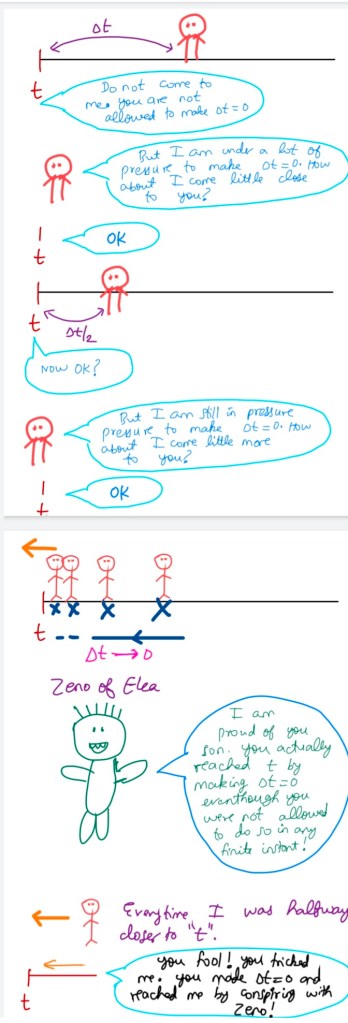
Now the below cartoon signifies the thought process that led to the birth of calculus – or notion of speed at an instant of time , even though we need two instants of time to talk about speed!
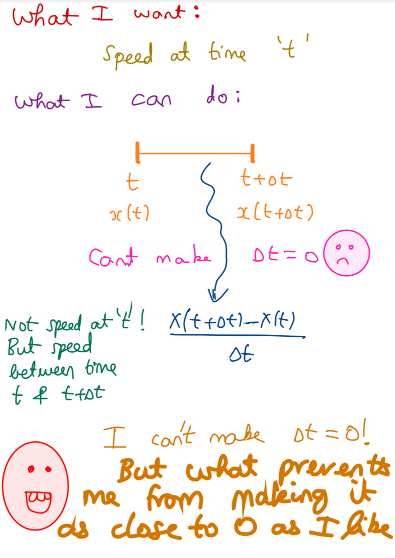 can never be made to 0 but can be made to converge to 0!!
Now the cunning mind of Newton thought: I cant make
Now as we choose a sequence of
Such a limit if exists, is called instantaneous speed at time ‘t’.
Instantaneous speed is defined as:
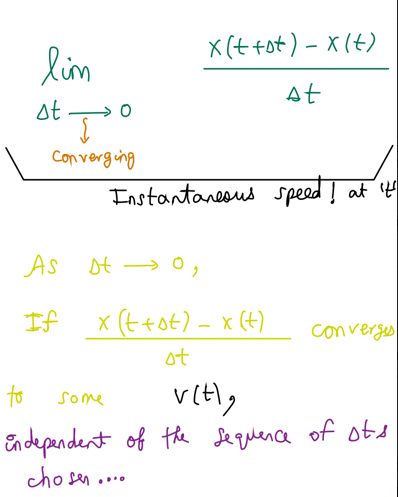
The limit of the sequence of the average speeds around 
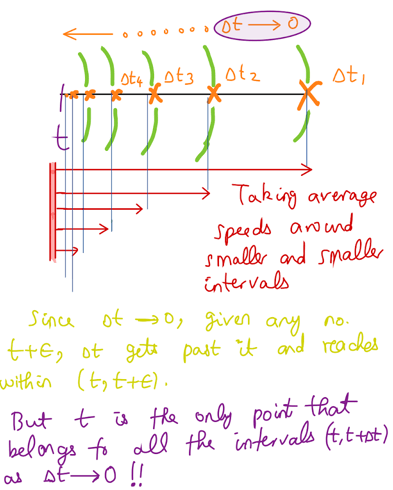
The limiting speed that is calculated, called the instantaneous speed at time t is not the speed between time t and any other instant. Because for every imaginable separation 
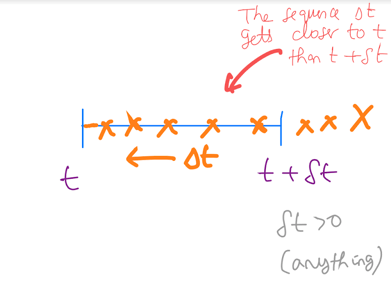
 for any
 Such a limit, if exists, independent of the particular sequence of
It is not the speed between t and any other point as we eventually will make 
Another perspective to convince you that it is the speed at an instant really, what we have essentially done is this:
I found the speed 


Let us evaluate this for the function

Hence

Now, since 

This says that the instantaneous speed increases linearly with time. Another notation for 
So, we have proved that 
Exercise: Prove that 

So we have learnt two things so far:
1. A finite number can be divided into infinite number of pieces – which when all of them put together will give the original number – but if only finitely many of the pieces are put together, will get arbitrarily close to the number!
2. I can get close enough to 0 arbitrarily without becoming zero by choosing a sequence converging to zero and this enables me to talk of an instantaneous speed at time t even though I need another nearby instant
We will return to geometry next time. See you 🙂
 Understanding Einstein in 52 Weeks!!