“One of Euclid’s postulates—his postulate 5—had the fortune to be an epoch-making statement—perhaps the most famous single utterance in the history of science.”
— Cassius J. Keyser
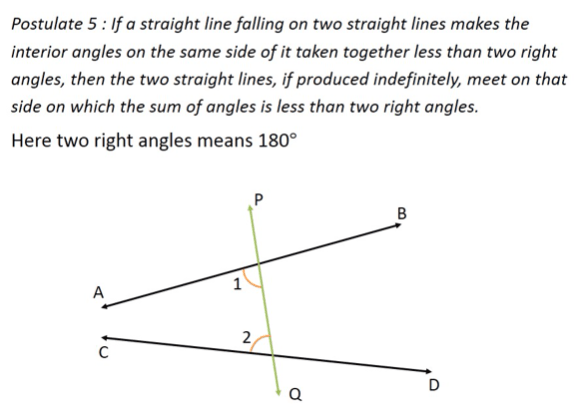
The ancient Greeks were the first set of people who formally lifted geometry out of the shabby materialistic real world. Points no longer meant just a dot or a mark in the land and lines no longer meant the edges of a taut string and volumes no longer meant the amount of mud inside a tunnel or the amount of water in a jar. They were the first to lift the geometric notions of points, lines, areas, planes, lengths,angles and volumes as abstract concepts that have a meaning by itself and independent of the real world. Although they called this subject as “geometry” which meant “measuring in earth”, they realized that mathematics could exist without the physical world and was one step above reality. Although mathematics is developed by humans who live in the real world and may use mathematics to explain the real world, the Greeks thought that there could be mathematics and concepts and systems that did not correspond to real world. They separated the abstract mathematics from the so called “modelling” where in mathematics is used to capture a real world scenario. Thus Euclid distilled geometry as an abstract logical system that talked about properties of a certain set of abstract undefined objects (points, lines, plane, length, angle, area, translation and rotation etc..) from a certain set of postulates (or axioms) which was believed to be true.

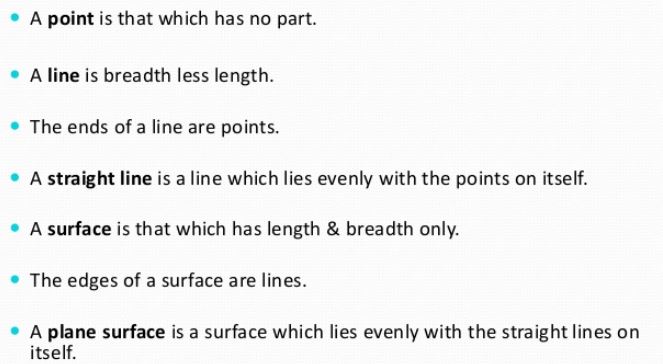
So far we have seen how geometry of the plane was summarised into a mere handful of five postulates of Euclid and how he could explain all the geometric aspects of the real world using them. And how Rene Descartes provided a brand new algebraic partner to the geometric plane of Euclid and thereby merging geometry with numbers. We also saw how things worked out perfectly between the geometric plane and the algebraic 
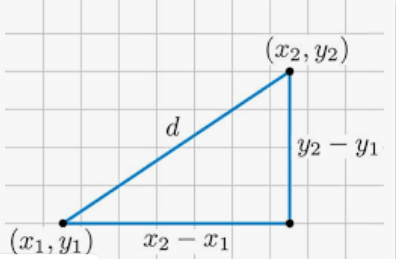
Even though Euclid ultimately was inspired by the real world, he didn’t think about what kind of properties would we have in a world where some of his five postulates were replaced by other ones. In fact he thought that the only consistent geometry was his set of postulates. Many people after Euclid believed that if the Euclidean postulates were messed with, the resulting geometric system would not be consistent. i.e. It will lead to some statements of the axiom contradicting the others. Of course one is not unreasonable to believe that the planar geometry of Euclid which also explains the real world is the only consistent geometry. If that were the case then any consistent goemetry has to be Euclidean and if the world had a geometry then it had to be Euclidean. So people thought the geometry what they thought (Euclidean) and that explained the world around them (measurement made with sticks and tapes and protractors) had to be the only possible geometry.
Science claims to be proud of itself in its ability to change its view point when subject to contradicting experimental observations. Newer theories are replaced by older ones for the want of more accurate explanations of old experimental phenomena or explaining new phenomena that was not in the scope of the older theory.
But yet for 2000 years, the Euclidean axioms reigned supreme without unquestioned legacy. The five postulates given in 300 BCE were to be taken as absolute truths and could not be questioned. Even though the fifth postulate seemed little more complicated and little less obvious than the other axioms, the mathematicians still wanted to prove it from the remaining four axioms. They did not think on the other hand “Is this postulate really true? Is the real world Euclidean? Is there possibly a consistent axiomatic system of geometry that is non-Euclidean?” Everyone wanted to prove the truth of the parallel postulate and they struggled. Little did they think “Perhaps if I come up with a consistent geometry that does not obey the fifth postulate, then I can assert that the fifth postulate is independent of the remaining four postulates”. But for a long time nobody thought so. The parallel postulate had to be true. Its status as an axiom (rather than a provable theorem) was what that troubled people. The postulate itself was not a problem to most people. So indeed there were lot of struggles to prove it and we shall recount some of them below:
After the Greek civilization collapsed (around 200 CE)and Roman empire formed, the Greek mathematics and science was forgotten and the Romans hardly had any scientific temper. For them, geometry was something that enabled to calculate how much mud could fill a tunnel or how much land was enclosed inside a fence.
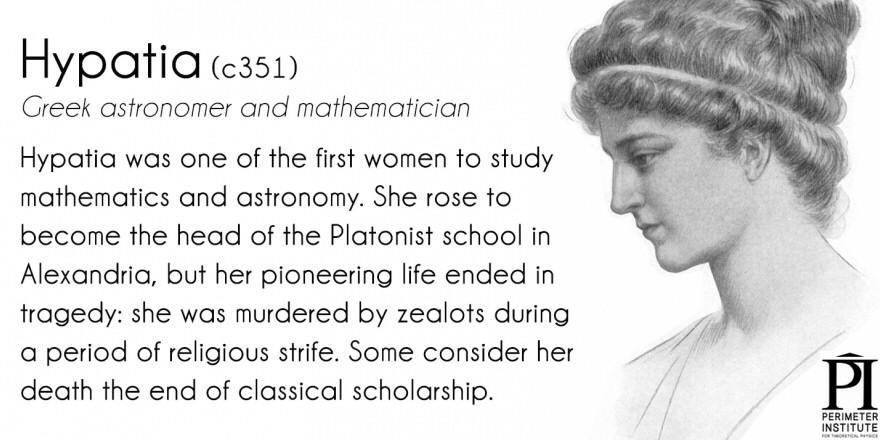
Even though the Romans destroyed everything Greek including the magnificent library of Alexandria (look up more on this history) and forgotten the rigor of Greek mathematics, it did survive through another route via the birth of Islamic civilization in modern Arabia. The Arabs had been known of translating many mathematical works of ancient India and Greece (including Euclid’s Elements) and had kept it alive and kept the spirit of mathematics going.
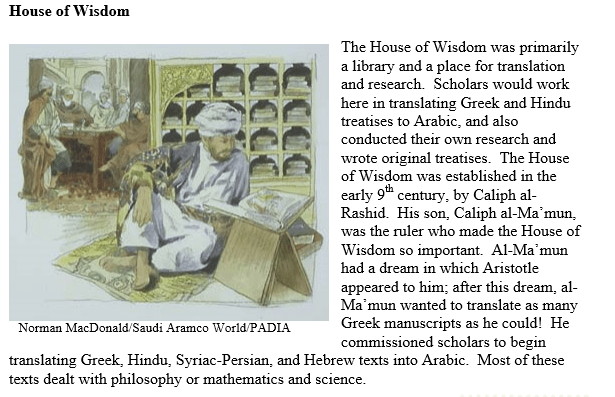
Thus, Elements returned to the European world with the birth of the Renaissance in 12th century CE from Arabia. For more on Romans and Islamic mathematics, click here below.
https://www.irishtimes.com/news/science/what-did-the-romans-ever-do-for-maths-very-little-1.3940438
http://www.csames.illinois.edu/documents/outreach/Islamic_Mathematics.pdf
There were many attempts to prove the parallel postulate, from as early as 5th century CE.
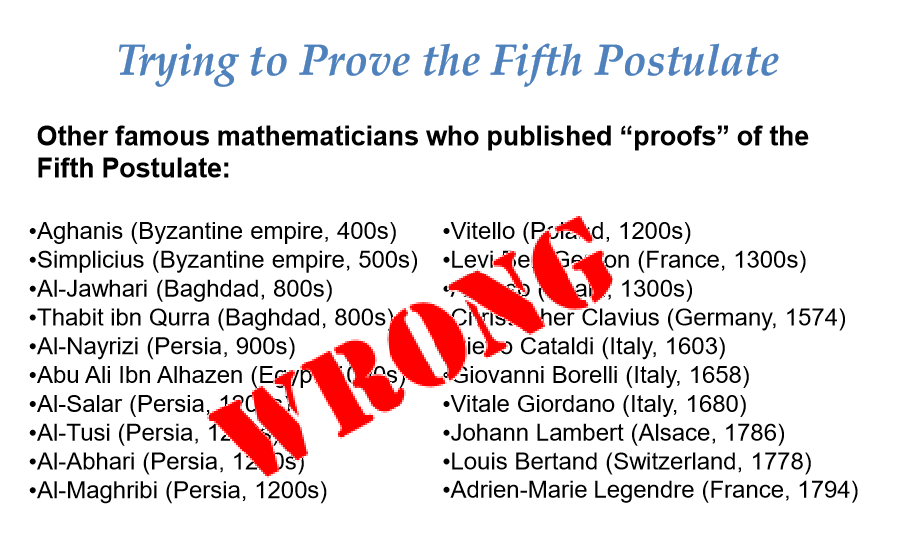
But a careful examination of their proofs revealed that they had used some assumption that was not justifiable from the first four postulates and in most cases, that adhoc assumption used (even though it was more obvious than the fifth postulate) was then proved to be equivalent to the parallel postulate itself. We will present some of those equivalent statements below because in a geometry where Euclid’s fifth postulate is not valid, these statements would not be valid either!!
Attempt 1: Ptolemy (5th century CE)
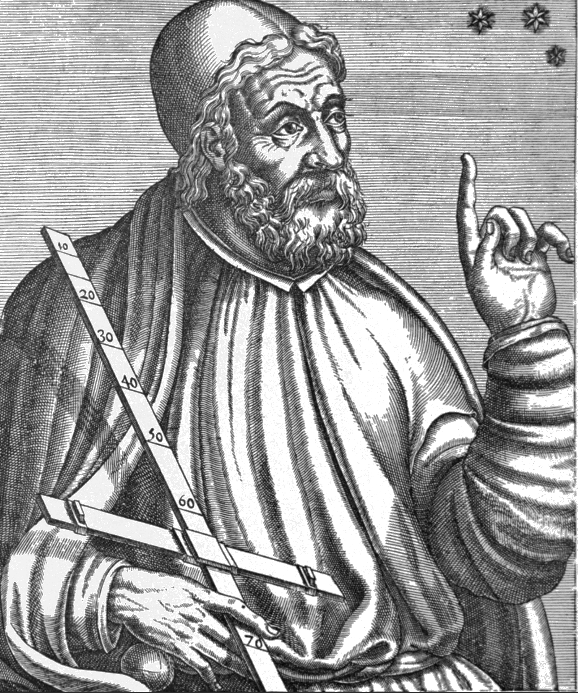
He only established the equivalence between the original statement of fifth postulate of Euclid with the one I actually presented it to you (called also as Playfair’s axiom)
“Given a line l and a point P not on the line l, there exists a unique line passing through P, which is also parallel to l”
Playfair’s axiom (Ptolemy)
Attempt 2: Proclus (5th century CE)
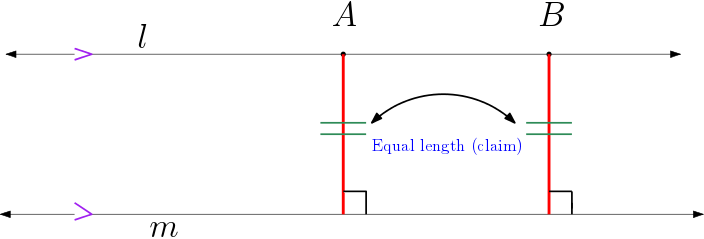
Having proved that the fifth postulate was equivalent to the above statement, Proclus claimed that he had proved this equivalent version (Playfair’s axiom) but had supposedly used an assumption below that was equivalent to the fifth postulate itself. The assumption was:
Parallel lines are equidistant everywhere.
i.e. If l,m are two parallel lines, then every point in ‘l’ is equidistant from ‘m’ as every other point and vice versa.
Definition: Distance between a point and a line is defined as the perpendicular distance (which can be proved to exist and is the shortest distance between that point and any other point in the line!)
Proclus (5th century CE)
Attempt 3: Abu’ Ali Ibn al-Haytham (1000 CE)
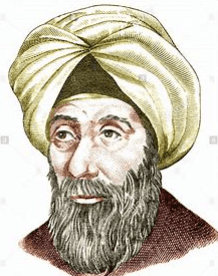
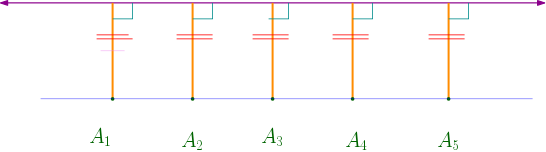
Thabit of Baghdad and Ali Ibn al-Haytham tried to prove the equidistance of parallel lines (above) which would establish eventually the fifth postulate. But they also had an in-built assumption that worked as follows:
The curve traced out by the set of points equidistant and perpendicular to a given line , is a straight line! That is, if we translate every point in a straight line in the direction perpendicular to it and by same amount, and collect the set of such points, it is also a straight line!
– Abu’ Ali Ibn al-Haytham
Attempt 4: John Wallis (1663)
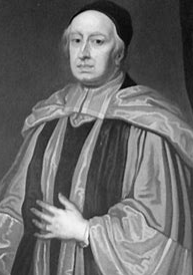
Wallis was a contemporary of Newton and one of the greatest mathematicians of the Renaissance Era. Unlike his predecessors, Wallis did not subconsciously assume something and claimed to have proved a parallel postulate but he claimed that he had replaced the parallel postulate with another postulate which was equivalent to it. But this form of the parallel postulate was so very obvious that mathematicians of the era were really stunned by it. His equivalent statement goes as follows:
Given a triangle and any positive number
– John Walliswhere
, there exists another triangle whose angles are exactly same as the given triangle but whose sides are proportional to the sides of the given triangle with the ratio
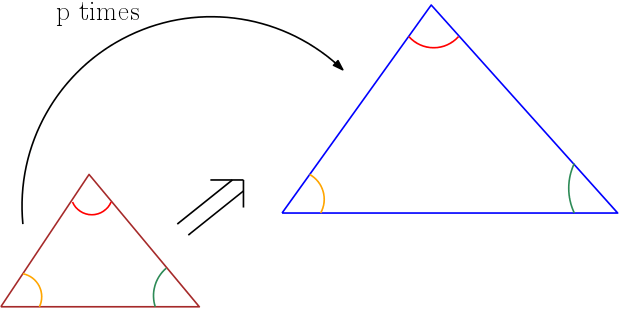
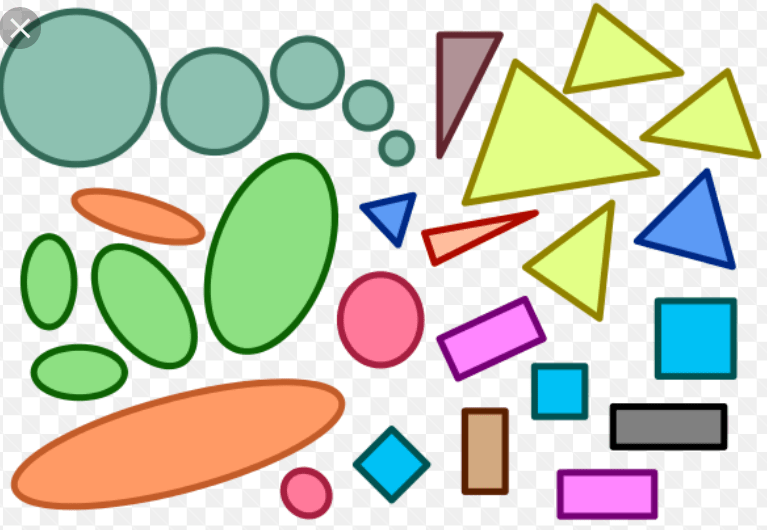
Notice the significance of this statement. It states that given a triangle, there exists a larger or smaller triangle, by any proportion we desire, that has same angles of the original triangle but sides of proportional length of the original triangle. This is very significant that it allows us to magnify or shrink geometric objects so that the distances even though scaled, the shape is completely maintained as angles are maintained. (any object can be approximated as a lattice of triangles).
So, in a geometry where fifth postulate does not hold, it means that there are no similar triangles. It will be a crazy geometry. When you are constructing a new house and the civil engineer shows you the plan, you hope that the original house is of the same shape upto the fact that all distances are magnified by the same amount. In a geometry where fifth postulate does not hold, we can no longer do this and hence the concept of shrinking would lose its meaning. There is no way to enlarge or shrink objects in such a space without distorting the shape. When you shop for shoes on Amazon, you can no longer believe that the delivered shoe is proportional to the real shoe with same shape. (So next time you face such an issue with Amazon, think of the possibility that the shoe was designed in a space where fifth postulate does not hold. So the concept of scaling would not make any sense in a geometry that is devoid of fifth postulate!
Attempt 5: Adrien Marie Legendre (1752-1833)
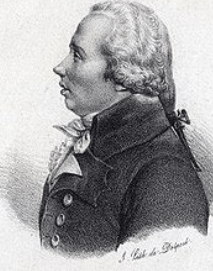
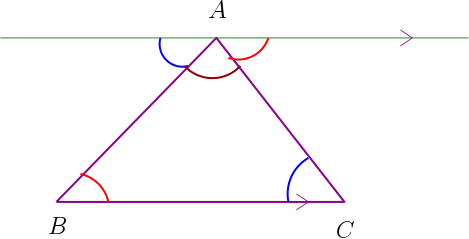
Legendre established the equivalence of the parallel postulate with the statement that the sum of the three interior angles of a triangle is 
The sum of the three interior angles of a triangle equals two right angles
Adrien Marie Legendre
Attempt 6: Giovanni Girolamo Saccheri (1667-1733)
There are some people who come close to making a history and climbing the peak unimagined but who give up when they are almost there. Such a man as Saccheri. Saccheri established that the parallel postulate was equivalent to the below statement. Before that, we define his construction, Saccheri quadrilateral:
A Scaccheri quadrilateral is a quadrilateral with opposite sides equal and one pair of adjacent angles as right angles. Then we have that the other two angles in the quadrilateral are equal. Saccheri proved that the parallel postulate is equivalent to the below statement
The other pair of adjacent angles of a Saccheri quadrilateral are right angles (In other words, there exist rectangles!!!)
– Saccheri
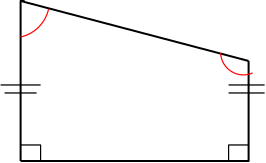
Saccheri hence sought to prove the parallel postulate as follows: If the Saccheri angles could not be right, then they could be acute or obtuse angles. If Saccheri could derive a contradiction based on these assumptions, then he could establish the fifth postulate. Saccheri could derive a contradiction for the case when he assumed that the angle pairs are obtuse. So, indeed we cannot have a Saccheri quadrilateral with obtuse adjacent angles. Now he wanted to contradict the acute angle case. Here is where he started a revolution but almost failed. He derived many remarkable results assuming that the Saccheri angles are acute. Although it did not lead to a contradiction, he proposed that they ought to be contradictions as they were highly counter intuitive. Some of those results he derived include:
1. The sum of interior angles of all triangles is less than
2. There is an upper limit to the area of a triangle. (It is impossible to have triangles of arbitrarily large area!)
3. Given a point P and a line L not containing P, there exists more than one line passing through P and parallel to the line L!
4. There is an absolute unit of length. We cannot shrink or expand objects without distorting their shapes. More technically, all similar triangles are congruent
5. The set of points equidistant from a straight line is not a straight line.
Instead of viewing these results as a discovery of a brand new world, that need not really exist but had a non Euclidean consistent geometry, Saccheri dismissed it as “contradictions” considering that they were counter intuitive. He couldn’t accept the fact that there could be other consistent geometries that need not exist in the real world. Had Saccheri thought otherwise, the discovery of non-Euclidean geometry would have been preponed by a 100 years. Saccheri published his findings in a book titled “Euclid Freed of Every Flaw“. But unfortunately, his work did not get even any critical attention until it was rediscovered later in the era of Voldemort!!
The era of Voldemort:

When a present era mathematician tries to prove something for 20 years and he fails, he would think that maybe the statement he is trying to prove is false. But not with the fifth postulate. When people did not succeed to prove it even after 2000 years, people only had faith on it more. Anyone lacking in the belief of the truth of the fifth postulate would be branded as a heretic. People who were working on non Euclidean geometry would have to fear the wrath of fellow mathematicians also apart from the church. So we saw a lot of secretive unpublished works in this geometry. But the thing I feel the most baffling is that there was already a non Euclidean geometry that was right under everybody’s nose studied from ancient Greeks and explained the world more accurately.
Once I was playing map quiz games in my childhood. One person names a place and another has to find it in the map. The usual norm is that the person who challenges will give a name that is so insignificantly lost among many main cities and too small and that which required deep focus. But I also discovered that the things that miss the attention of most people was the places that would be right under the eye. Some name like Russia that is all over everywhere but too spread and too obvious to capture the eyes of people. And I found people struggled to find such places.
The geometry that was different from Euclidean one yet consistent and explained the world is contained in the word geometry itself. Geo means earth and the surface of the earth which is our world is nothing but the surface of a sphere. In the surface of a sphere, geometry as we know from Euclid fails. This branch of geometry called “spherical trigonometry” was important in astronomy, navigation and time keeping for centuries before the invention of things like GPS. But what do you think is the geometry of the surface of the sphere? Think about it. Spherical trigonometry is the subject of the next post. Now let us continue the main story.
People wanted a geometry that was having four postulates of Euclid yet containing a negation of the fifth postulate so that it would establish the independence of it from other 4 postulates.
The following is an excerpt from the book “Euclid’s window” by Leonard Mlodinow” on one of the first men to discover this new geometry – genius Carl Fredrich Gauss.
“Between 1813 and 1816, as a professor teaching mathematical astronomy at Gottingen, Gauss finally made the definitive breakthroughs that had been waiting since Euclid: he worked out equations relating the parts of a triangle in a new,non-Euclidean space whose structure we today call hyperbolic geometry. By 1824, Gauss had apparently worked out an entire theory. On November 6 of that year, Gauss wrote to F. A. Taurinus, a lawyer who dabbled quite intelligently in mathematics, “The assumption that the sum of the three angles [of a triangle] is less than 180 leads to a special geometry, quite different from ours [ie., Euclidean], which is absolutely consistent, and which I have developed quite satisfactorily for myself. . ..” Gauss never published this, and insisted to Taurinus and others that they not make his discov-
eries public. Why? It wasn’t the church Gauss feared, it was its remnant, the secular philosophers.
In Gauss’s day, science and philosophy hadn’t completely separated. Physics wasn’t yet known as “physics” but “natural philosophy.” Scientific reasoning was no longer punishable by death, yet ideas arising from faith or simply intuition were often considered equally valid”
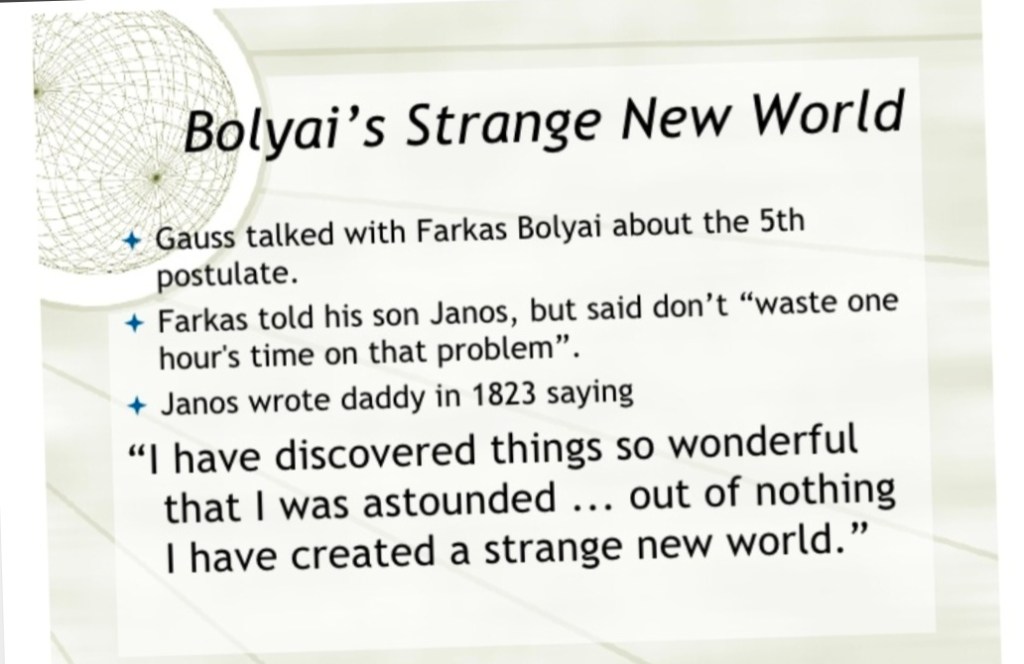
On November 23, 1823, Johann (Janos) Bolyai, son of Gauss’s longtime friend Wolfgang Bolyai, wrote a letter to his father saying that he had discovered another world (non euclidean geometry). In the same year in Russia, another mathematician Nikolay Ivanovich Lobachevsky explored conseuquences of negation of parallel postulate and wrote it in an unpublished journal.
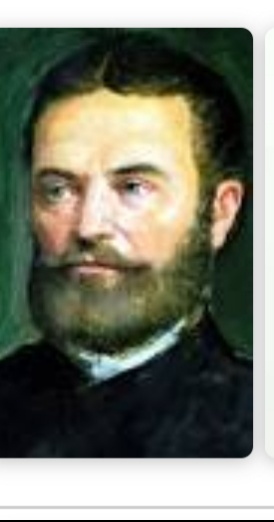
Some fourteen years later, Gauss stumbled upon Lobachevsky’s article, and Wolfgang wrote him about his son’s work, but Gauss wasn’t about to publicize either of them and risk putting himself at the center of controversy. He wrote Bolyai a nice congratulatory letter(mentioning that he himself had already discovered similar results), and graciously proposed Lobachevsky a corresponding member of the Royal Society of Sciences in Gottingen (he was immediately elected in 1842).
Janos Bolyai never published another work of mathematics. Lobachevsky became a successful administrator and eventually president of the University of Kazan. Bolyai and Lobachevsky might have both faded into the distant unknown if not for Gauss.
In summary, these fifty years were years of a secret revolution. Gradually, in several countries, new kinds of space were discovered, but they were either not revealed or not noticed by the community of mathematicians. Not until scholars studied the papers of a recently deceased old man Gauss, in Gottingen, Germany, in the middle of the nineteenth century did the secrets
on non-Euclidean space become known. By then, most of
those who had discovered them, like him, were dead.
But what was this new non Euclidean Space? How does it look like to draw figures in it? How does it feel like to live there? Could the real world be non Euclidean? What about the the geometry of the sphere and this new geometry? What are their new features? We shall dwell into the technicalities next post. But all we do know now is that in such spaces, parallel lines won’t be equidistant, it is impossible to scale figured without distortion and sum of angles of a triangle don’t add to 180 and many theorems like that of Pythagoras don’t hold.
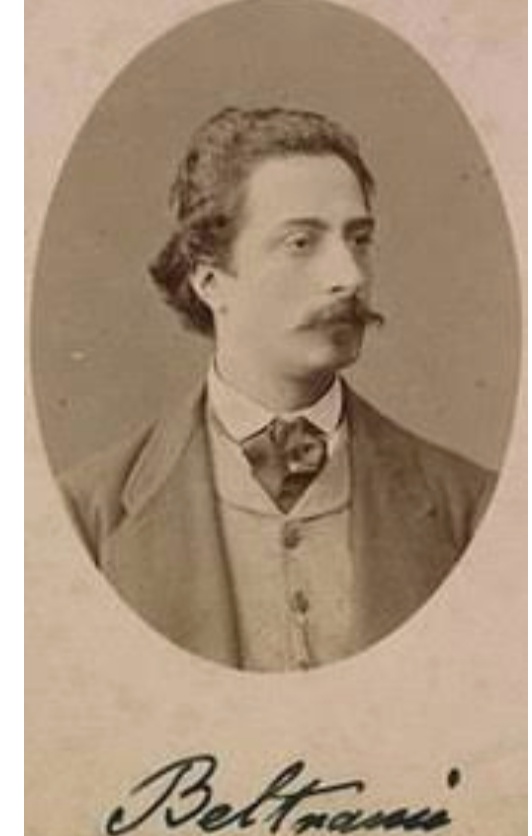
Finally in 1868, the Italian mathematician Eugenio Beltrami laid to rest once for all the issue of proving the parallel postulate: he proved that if Euclidean geometry forms a consistent mathematical structure, then so must the recently discovered non-Euclidean geometries! So Beltrami can be said to have boldly subjugated the Voldemort of non Euclidean geometry. .
 Understanding Einstein in 52 Weeks!!