In 1637, a silent revolution happened in France. No, I am not talking about the political French Revolution which came much later in 1789. This was a revolution without swords. But neverthless like all great revolutions in histrory, it was to topple the very basic structure of the mind sets of the people of not only France but all of the world who did mathematics. But it would find no place in any history textbook and it would not be emphasized in many mathematics texts as a big shot but rather to be taken for granted as the standard state of affairs by the people of the present times. The man of this revolution would be Rene Descartes, a young French man who would surpass Euclid and drastically change the structure of his geometric plane. It would be fair to say that without this revolution, we would not have had any basic technology or industrial revolution or scientific progress. You will realize soon why. Let us unravel what Descartes did step by step.
We saw that Euclid’s Elements served as the standard model of the geometry of the plane. It was unsurpassed in its glory and continued to dominate the viewpoint of planar geometry for over 2000 years from the time it was written. It contained as basic vocabulary, words like point, line, line segment, plane and parallel lines and had five axioms (along with 5 other axioms on numbers called as common notions) as the assumptions about such objects in the plane. Recalling them,
1. Given a line segment, it can be extended uniquely to an infinite line segment that contains the original line segment
2. Given two distinct points, there exists a unique line segment (and hence by postulate 1, a unique line) that contains the given two points
3. All right angles are equal. They can be obtained by translation and rotation of any given right angle.
4. Given any point in the plane and given any positive number radius , there exists a circle whose centre is and radius
5. Parallel Postulate: Given a line and a point not lying on the line, there exists a unique line passing through and parallel to .
So, this continued to be the only face of planar geometry till 1637 until our friend Rene Descartes arrives on the scene. He saw that any line can be put in one-to-one correspondence with real numbers (famously called the “number line” in primary school). So once we put a number system on the line, we essentially can forget about the points in the line and replace them by their respective numbers as every number gets a unique point and every point corresponds to a unique number. So far so good. Once we decide which point to assign the number 0 and which other point to assign 1, then everything would be done.
What Rene Descartes thought of was could we also do the same thing to Euclid’s plane? Can we replace tbe abstract points in the plane by concrete numbers? This is where Rene Descartes toppled the face of geometry by merging it with the algebra of numbers. Descarte proved using Euclid’s postulates that every point in the plane can be put in one-to-one correspondence with two sets of real numbers (instead of one for the line). The way it is done is now seen as obvious by high school students at present but I severely doubt that any child for whom this information had not been dumped early, whether he/she would come up with this idea himself or herself.
Before that we need two lemmas and theorems from Euclidean geometry that are proved below:
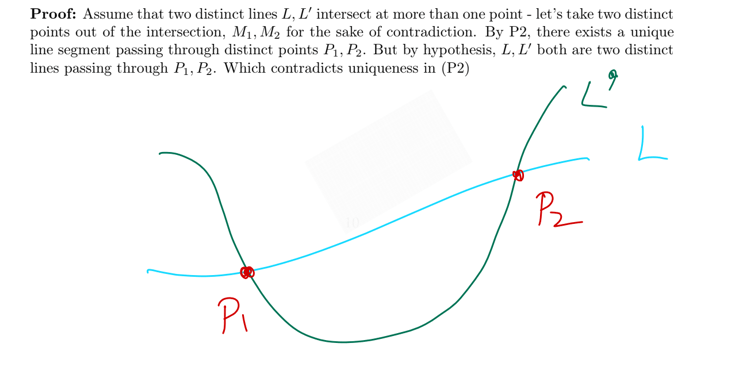
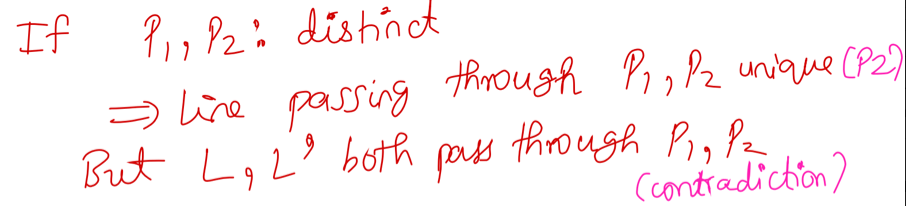
Lemma: Two distinct lines can intersect at utmost one point
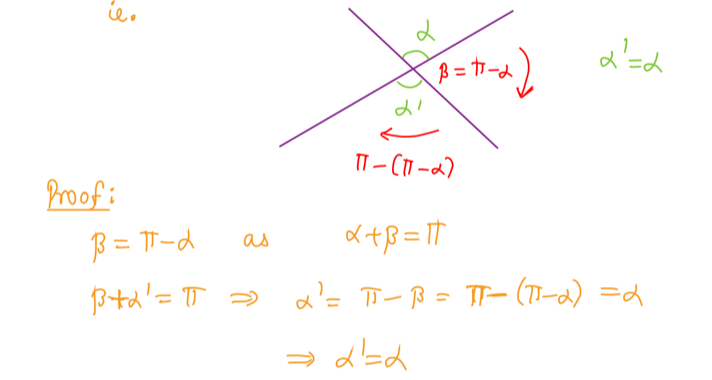
Lemma: Vertically opposite angles are equal
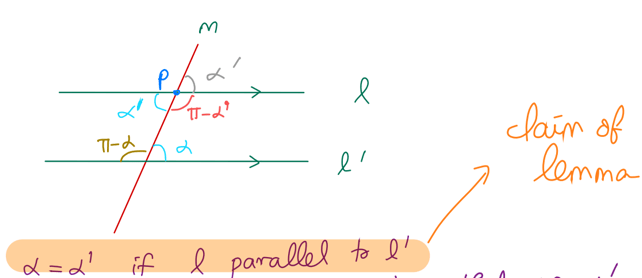
Lemma: Parallel lines make same angle with a given line
For proof of this lemma, see the PDF attached at the bottom of this post.
Lemma:
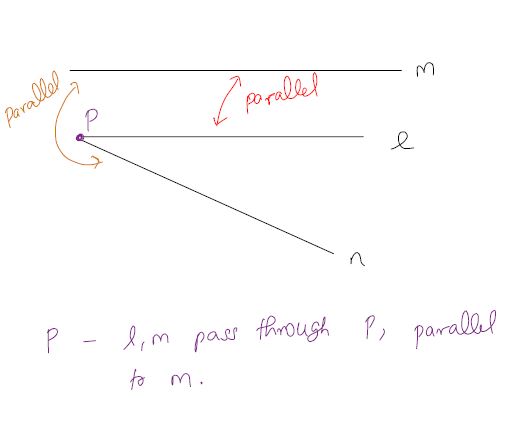
If a line is parallel to , and line is parallel to line , then is parallel to (Assume , , are distinct).
Proof: Let us assume not for the sake of contradiction. Let and be not parallel. By definition of parallelism, they meet at a point . Now both and pass through the point and are parallel to . But by parallel postulate since is not in , there can only be one unique line parallel to and passing through which is contradicting the fact that both distinct lines and pass through and being parallel to .
The next theorem by Pythagoras is notoriously famous!
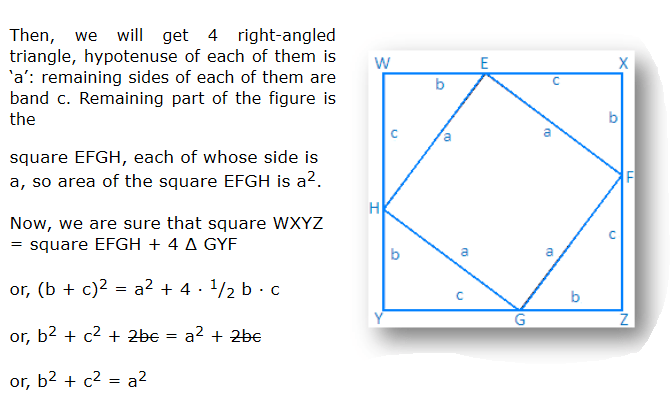
Theorem (Pythagoras)
In a right angled triangle, the square of the length of the hypotenuse (the side opposite to the right angle) is equal to the sum of the squares of length of other two sides.
Proof: (using areas of triangles and squares – my favourite and simplest proof)
Coming back to Descartes as to how he reasoned. Descartes reasoned as follows:
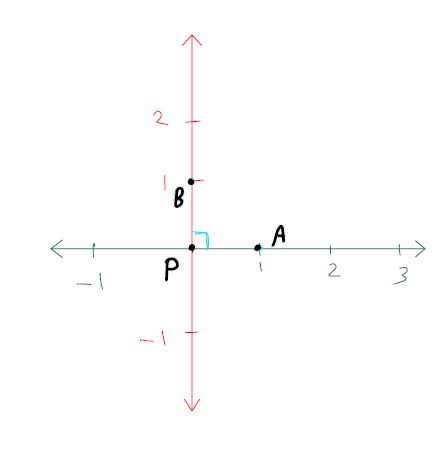
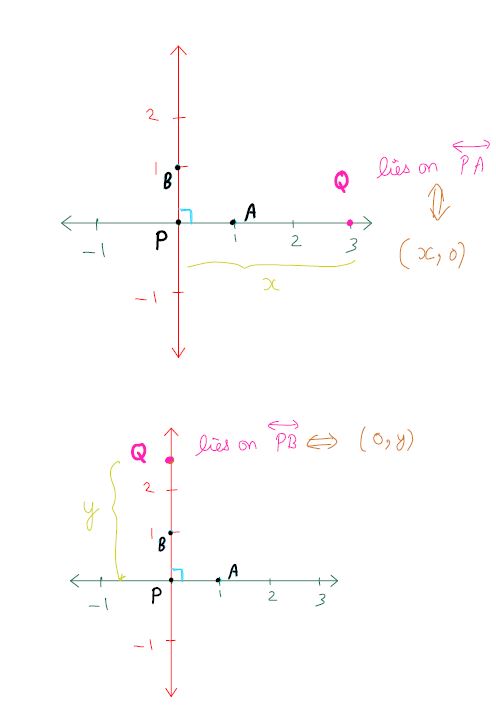
Take a point in the plane. Draw a line segment such that length of is unity and extend it to a line.(Unique extension is possible by Euclid’s P1) Make that line into a number line by taking as zero and as 1. Draw another line perpendicular to such that is of unit length and extend it to a line. Make that also into a number line by marking as 0 and as 1. So now we have two perpendicular lines meeting at , with numbers in each of the two.
Take an arbitrary point in the plane now with the perpendicular lines drawn and extended. Now I am going to tell you how to assign two numbers associated with the point . Now, if is in the line , assign and the number such that it equals the number on the number line .\item If lies on the line , then assign , as the number on the number line .
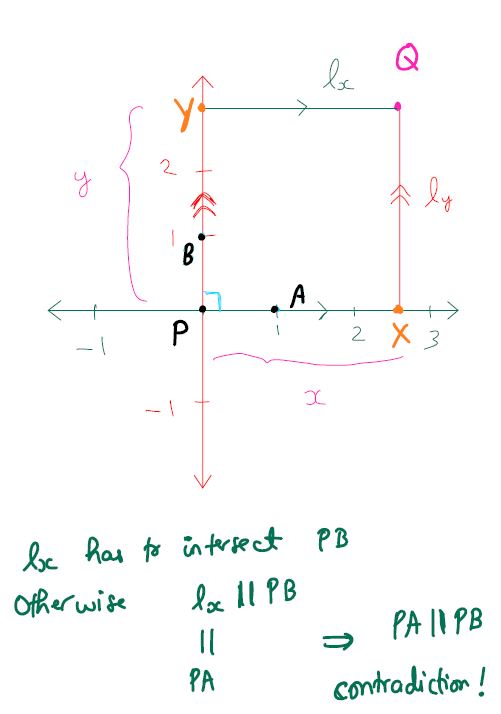
Now if does not lie on either of the lines and , by Euclid’s parallel postulate, there exists unique lines , $l_y$ passing through that are parallel to , respectively. Now, has to intersect the line at a point. (if does not intersect , then by definition of parallelism, parallel to , and we already have parallel to by construction of , and by Lemma 1, would be parallel to which is a contradicton as are perpendicular). Hence has to cut at a unique point. (Lemma). Now let be the intersection of with . Assign the number to as the number associated with the point on the number line . Now similarly, let be the unique line passing through and parallel to . By same reasoning above, has to intersect . Let be that point of intersection. Assign the value as the number associated to the point on the number line .
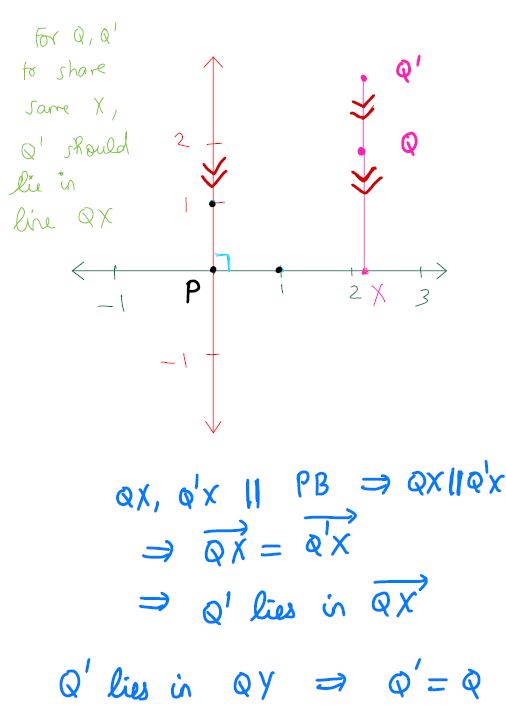
Now we have associated a unique pair of two numbers to every point on the plane. We will first show that no two points get the same pair of numbers. Let two points share same . Then, they share the same points in respectively. By construction, and meet at and are both parallel to . Since both are parallel to and meet, the only option is that the lines coincide. Hence, lies in . Now applying the same logic for , lies in the line . But two distinct lines intersect at a unique point. already meet at by construction and hence if lies in both , it has to be . So, . So, if both the coordinates of two points are same, then the points themselves have to be the same. Hence, no two distinct points share the same coordinate pair.
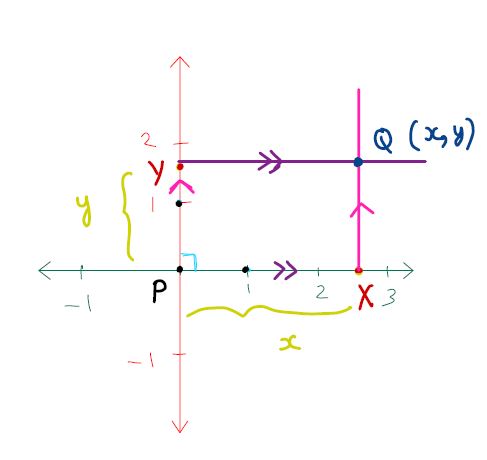
Now we show that corresponding to any pair , there exists a point having the coordinates . Given , locate the point in having the number and the point in having number . Now, draw a line passing through parallel to line . And draw another line passing through parallel to . They both will intersect (if they dont, then they are parallel, which as usual means are parallel which is a contradiction). Let the point they intersect be . By construction, the coordinate of is (x,y) (reverse this construction process)
Thus, we have achieved a remarkable feat!! We have put the plane that obeys Euclidean Geometry in one-to-one correspondence with a pair of real numbers . One-to-one correspondence means that every point has a unique pair of coordinates and every pair of coordinates corresponds to a unique point.
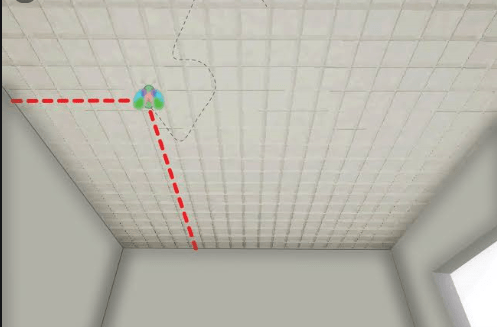
Descartes is said to have thought of this while he was laying in his bed, watching an insect moving in his ceiling and thinking ‘How can I describe the position of the insect using the numbers assigned to the corner of the walls?”.
Unfortunately, in this present day schooling, this is not allowed to be self discovered by students but rather the suspense is spoilt and the teachers give us a haywire explanation of this correspondence without proof also from Euclid’s axioms. But this is very important juncture. Suddenly, we can forget about the plane and look at the set as we have put a one-to-one correspondence of the plane with this set. Even for mensuration (measurement of distances and angles), we can forget about the plane and use the below formula to compute distances:
Theorem (Distance Formula:)
The distance between points , with coordinates and respectively is given by , independent of the choice of the origin and x-axis of coordinates.
Proof: First, let us prove it for the case when one of the point is the origin itself. Consider the construction as usual for determining the coordinates. In this case, consider the quadrilateral . Now, by construction, opposite sides of the quadrilateral are parallel ( parallel to and parallel to ). So, the quadrilateral is a parallelogram (opposite sides parallel). Now in that parallelogram, one of the angles is right angled (the angle ). So, all the angles are right angled. (By properties of angles cut by two parallel lines on the same line being equal). So, the quadrilateral is actually a rectangle. (a rectangle is a quadrilateral where all angles are right angled). Now use the following lemma below:
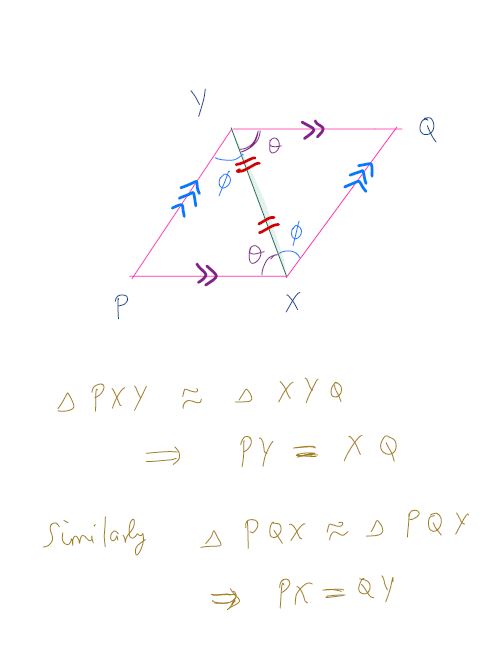
Lemma: Opposite sides of a parallelogram are equal
Proof: Consider a parallelogram . Join the points to make it the diagonal. Now, consider the triangles and . One of their sides are common and hence of equal length. (). Now, angle =angle (property that alternate interior angles are equal). Similarly, angle = angle (same property). Hence, we have that the two triangles share the same side and the two included angles. If we prove that both the triangles are congruent (called ASA), then as corresponding parts of congruent triangles are equal, we have length of =length of and length of = length of . So as and are opposite sides of the parallelogram, the lemma follows after we prove the ASA congruence.
Lemma (ASA congruence):
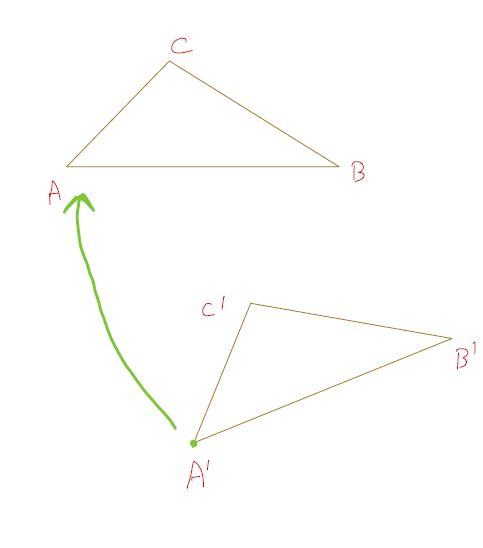
If two triangles share an equal side length (say lengths ) and share the same pair of angles that emante from the sides (i.e. Angle = Angle and Angle =Angle $C’B’A’$, then the two triangles are congruent. i.e. They can be obtained from translating and rotating each other
Step 1: Translate A’ to A
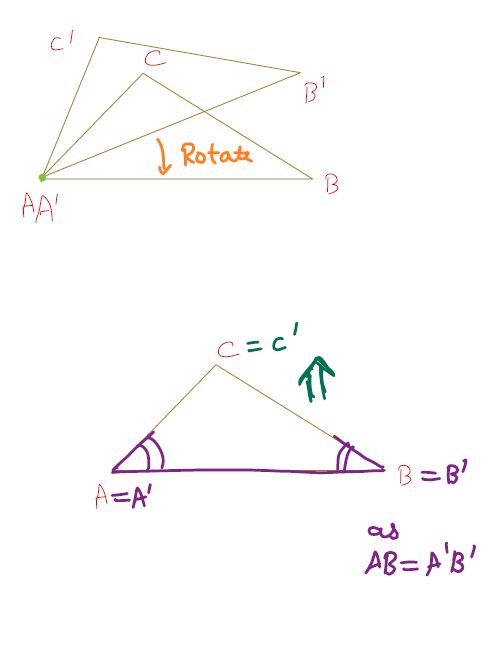
Proof: First, move to by translation. Then, rotate the line segment to coincide with the line . Now since length of is same as and and has same angle, . Now, as well since the angles , $CBA,C’B’A’$ are equal. So, we have that triangle could be translated and rotated to give . Hence the two triangles are congruent.
Step 2
Proof of distance formula: Now coming back to the proof of the distance formula. The quadrilateral is a rectangle and hence as opposite sides are equal in a parallelogram, and . Now as triangle is right angled, by Pythagoras Theorem, and hence, since length of PQ is distance between , we have with , . Now here comes the general case. If is not origin, construct two perpendicular lines from such that the first line is parallel to the given x-axis and the second line is parallel to the given y-axis. Now, complete this proof as an exercise (Trust me you will always feel good after proving something by yourself in mathematics – however trivial it may be!! I will post this complete proof next week).
Having looked back, we have achieved a lot. We have associated a pair of numbers to every point on the plane in a unique manner with the set that is compatible with a notion of distance given by . Suddenly, geometry becomes about numbers. We can compute with points. In fact, a plane is now just a set of possibilities of a pair of real numbers. But notice that the set of pair of real numbers is abstract compared to the concrete notions of points, lines and planes. So, this computational aspect of turning the plane into comes at the cost of an abstraction. We can no longer draw diagrams and talk about lines and angles. We have to argue with numbers instead. But we do this because numbers are easier to manipulate than geometric objects.
So, on one hand we have geometric objects that are concrete, less abstract but that concretness makes it too rigid to manipulate them whereas numbers on the other hand, being abstract (a number is an abstract entity indeed – two bananas are concrete, two elephants are concrete entities but the concept of the number two as you see is indeed very abstract!!). are easier to manipulate (we have lots of manipulations on numbers like arithmetic operations, ordering, etc..)
So, as humans can sacrifice concreteness and visualization for the sake of manipulation, is the stunning example of demonstrating this fact as in fact I bet that most people would be comfortable with the algebraic set rather than the purely geometric plane with its shapes.
Now that we have corresponded the plane with , we now ask. Is there any other geometric object that can be corresponded with ? Or is it only the Euclidean plane that can be one-to-one corresponded with with the distance formula also coming out to be the same?
NOTE: Hereafter when we say , we not only mean the set of all pairs of real numbers as a raw naked collection but also with the distance formula given by
What turns out is that if you have any geometrical set with a notion of distance and angle, that can be corresponded with in a one-to-one manner, with the distance as above, then the object has to satisfy Euclid’s axioms!!! So with the distance formula completely captures the geometry of the plane!
Before proving this, let us prove another small theorem:
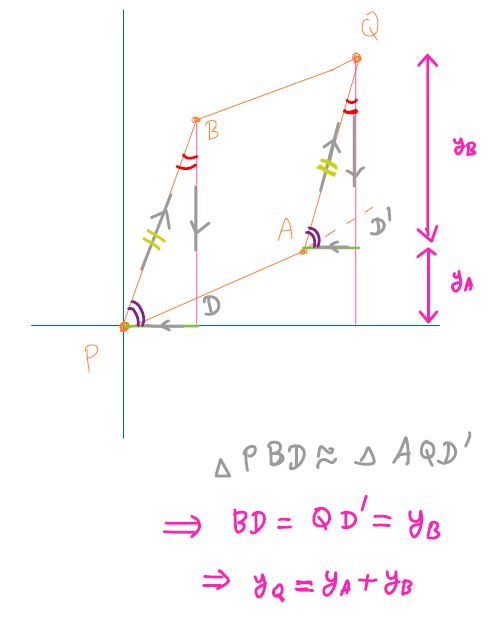
Theorem : (Vector addition in $latex \mathbb{R}^2 – inspiration): Let be the origin of the plane and let be the adjacent sides of a parallelogram with coordinates of being $(x_a,y_a)$ and that of being . Then, the tip of the diagonal of this parallelogram will have coordinates !
Proof: I will draw the necessary diagram and I leave the climax of the proof to you.
Prove by ASA that the two grey traingles are congruent.
is a parallelogram and the constructions are as below:
Similarly, prove for the x-coordinates!!
This is inspired by the parallelogram law of vector addition that says that if two vectors represented by line segments share a common tail and are treated as the adjacent sides of a parallelogram, then the resultant vector sum of the vector is the line segment where is the diagonal of the parallelogram obtained by completing the sides . Note that in terms of components, it is just the addition of components!!
So, now we can define angle between two lines : We refer to a lemma in Euclidean geometry:
Lemma: Cosine Rule
If two adjacent sides of a parallelogram have lengths and have an angle from A to B, then the length of the diagonal is given by . If is not the origin, then in the above formula, the word “coordinate” should be replaced by “coordinate difference with P”
(Look the proof up in any geometry text (like the link below) or try yourself – it is standard)
Now, let be two line segments. Finding the angles as follows:
Let be the segment obtained by extending $PA$ in the opposite side of same length. Then the tips of the diagonals of the parallelograms completing , are respectively, by cosine rule, , respectively. From this we can determine the angle as where , . But lengths of , can be calculated by distance formula from coordinates. And is nothing but the length of the tip of the diagonal of that parallelogram. We know its coordinates if is the origin. Use distance formula again to calculate its length. When is not the origin, the formula should be interpreted as the coordinate difference between the point and . Again, now distance formula.
The Grand Theorem:
Any geometrical set having a one-to-one correspondence with obeying the distance formula, has to satisfy Euclid’s axioms. In other words, Euclid’s plane is the only geometrical set that has this one-to-one correspondence with with the above distance formula!
PROOF:
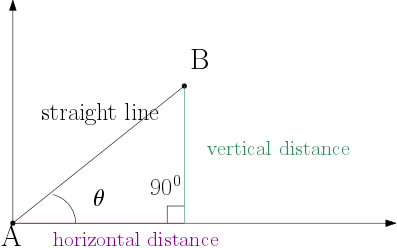
Defining Lines, Line segments and Parallel Lines: First what are the lines in the set? Given any geometric set we need to define what we mean by lines and parallel lines of that set in a way that the postulates of Euclid are obeyed. That is what the theorem claims. For this, we need to come up with the abstract notion of a line in . Then, we can look at the points corresponding to the line in in the geometric object (through the correspondence) and hence define that as the line in that geometric object. In the most intuitive manner, define a line as the set of all numbers satisfying for some such that . Define two lines (a,b,c), (a’,b’,c’) as parallel lines if they satisfy . Notice that two lines are the same if . [The above definitions might look obvious to you as this is what was defined as the equation of a straight line in high school. But the subtle logic here is that in a straight line, the ratio of increments between the two coordinates has to be constant – called the slope – from Euclidean geometry – try drawing and seeing for yourself and proving this that for straight line making angle with a horizontal line and with its perpendicular vertical line, should satisfy that the ratio of increment in vertical distances and horizontal distances between any two points is and hence a constant ]. Translating this fact into coordinates using the correspondence inspires the equation in the definition.
Ratio of vertical to horizontal distances between any two points A and B in a straight line is a constant
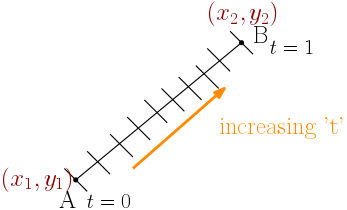
Define the line segment joining two points as the set . Inspiration is below:
Line segment joining two points
Verifying Eulcid’s P1: Now, it is easy to verify Euclid’s postulate 1: Given any line segment as defined above, it is easy to see that all points in it satisfy the equation , which can be rearranged to give an equation of the form . Notice that this is the only line that extends the segment. Let us prove it below:
Let two lines extend the two points . Since both the lines contain both the points, we must have
Now these are nothing but a system of two linear equations in two variables (x, y) with two distinct solutions (x1,y1) and (x2,y2). Hence the first equation must be a scalar multiple of second equation and hence (a, b,c) is proportional to (a’,b’,c’) and hence the two extending lines got to be the same.
Verifying Euclid’s P2: We defined a line segment itself by taking two points as reference. So, define the line segment joining the two points as above and uniqueness is same proving uniqueness of the extended lines which was done above
Verifying Euclid’s P3: First we need to define what is an angle and hence what is a right angle. We can use the vector addition theorem to define angle as we know from it, how to determine angle between two segments. The proof of P3 is quite involved and will become easier when we are equipped with some matrix notation and hence we will return to it when the appropriate time comes.
Verifying Euclid’s P4: By distance formula, define a circle in with centre and radius r>0 as the set and this obviously has a non empty solution set (take x=a, y= for instance) . So this holds.
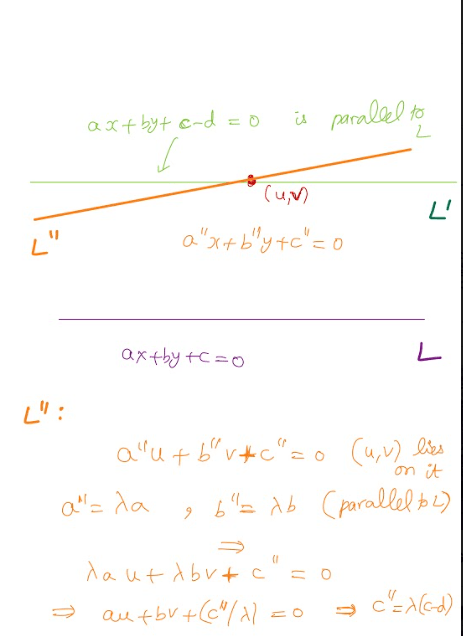
Verifying Euclid’s P5: Now comes the most interesting part. Let a line L be described as . Let a point (u,v) not on that line L be given. Which means . Define the line L’ as . Obviously (u,v) lies on this line L’ as we have au+bv+c=d. L and L’ are parallel as .
Uniqueness proved via picture: Now to prove uniqueness of the parallel line. Let another line L” pass through (u,v) parallel to L. Let it be described by a”x+b”y+c”=0.
So, , , . So, L” is same as L’ as all the coefficients are proportional!!!!
At last, we have achieved a remarkable feat!! Only the geometric object of Euclidean plane , by redefining lines and angles and appropriate notions “can be” put in one-to-one correspondence with , where we first proved the “can be” part and then proved the “only” part. Oh my god – who would have thought there would have been such an intimate monogamous connection between the plane of Euclid and . Suddenly geometry and algebra or numbers become interchangeable and due to this marriage we can now switch back and forth at our will between the geometric plane and the algebraic plane. The representation of a plane by numbers and their freedom of manipulating numbers is what enabled other concepts like calculus to be invented and thus ushered the era of physics!! It was surprising atleast for me when I first saw it. So, by putting numbers in the plane, we are not destroying or losing any geometrical information as long as the distance formula in is not screwed with. If that is screwed with, we shall see that the connection is polygamous. Many exotic geometric objects can then be put in one-to-one correspondence with !! The sacredness of Euclidean axiom is lost then!!
NEXT WEEK: WHAT HAPPENS WHEN THE DISTANCE FORMULA IS INDEED SCREWED WITH? ARE THERE ANY GEOMETRIES THAT ARE NOT EUCLIDEAN? Get excited till then!!





















![dist[(x_1,y_1),(x_2,y_2)]=\sqrt{(x_2-x_)^2+(y_2-y_1)^2}](https://s0.wp.com/latex.php?latex=dist%5B%28x_1%2Cy_1%29%2C%28x_2%2Cy_2%29%5D%3D%5Csqrt%7B%28x_2-x_%29%5E2%2B%28y_2-y_1%29%5E2%7D&bg=FFFFFF&fg=181818&s=0&c=20201002)










 Understanding Einstein in 52 Weeks!!