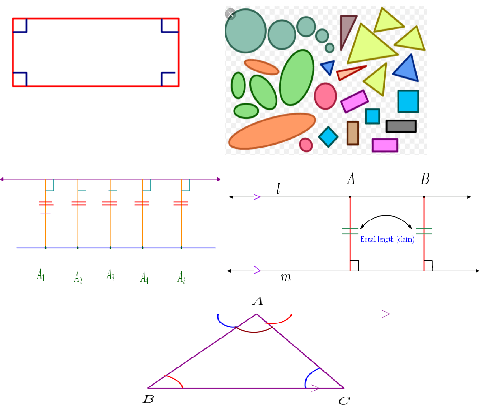
So last time we saw how Euclid’s fifth postulate was deeply influencing many properties of his plane like the ability to scale objects, the equidistance of parallel lines, the sum of interior angles of a triangle being two right angles, the possibility of translating a straight line to another straight line and the existence of rectangles (due to Saccheri). Also the Pythagoras theorem was found to be equivalent to the parallel postulate assuming the remaining four postulates of Euclid.
Let us now get deeper into how we formulated this Euclidean geometry. We had this notion of an “infinite plane” as our building block. We said that we cannot actually visualize it and it is just a figment of our collective imagination. We introduced this just so that we never ran out of space. We imagined this as the building block and the stage of all of our geometric objects and that which is supposed to explain the shapes and geometry of the real world. We imagined that this “infinite plane with Euclidean postulates” was the world that we live in!
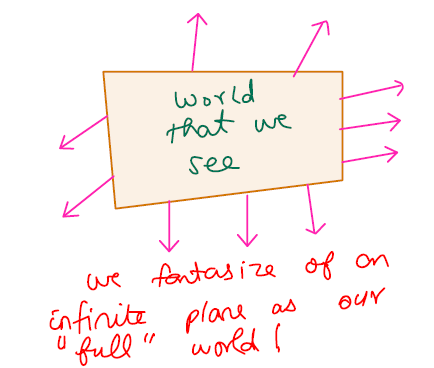
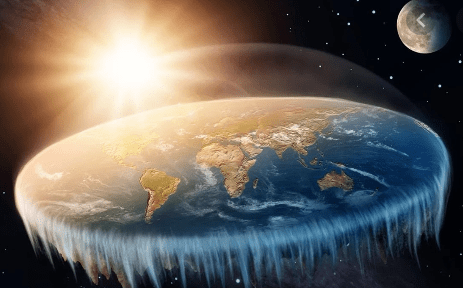
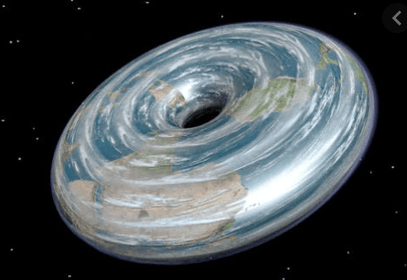
NOTE: When I say “world”, it means the surface of the planet we currently live in. Imagine that you are an ancient Greek who did not have access to any form of flight like spaceships, and all and all that you could do was explore the land. So now we want to know if Euclid’s five postulates hold in the surface of the planet in its entirety although I can at a time access only a small portion of it!
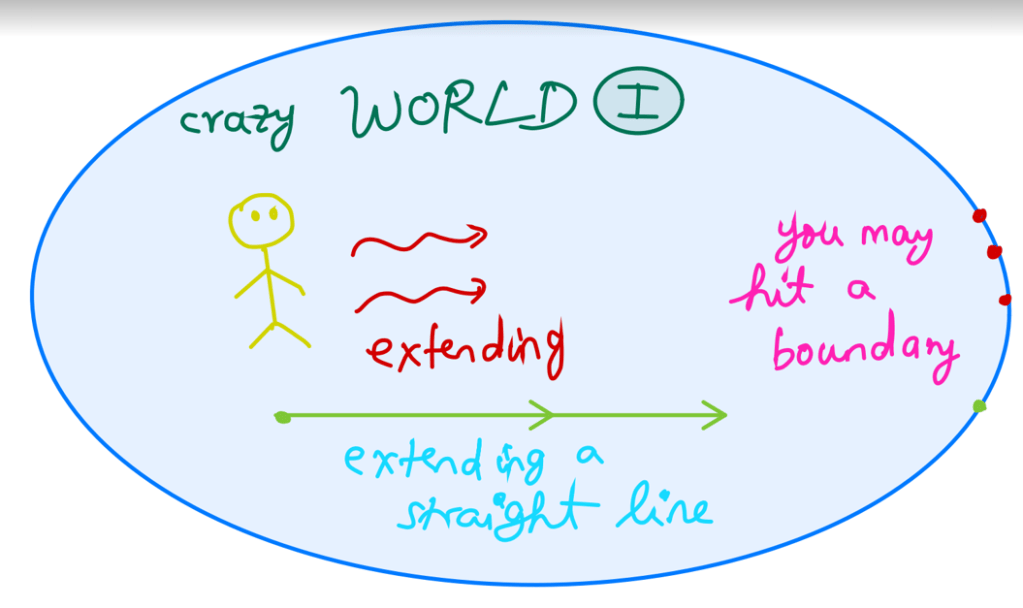
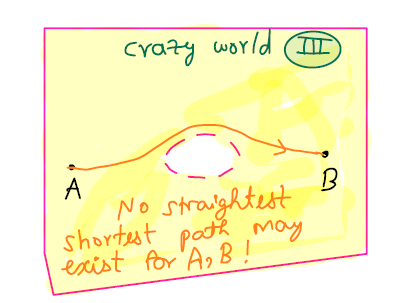
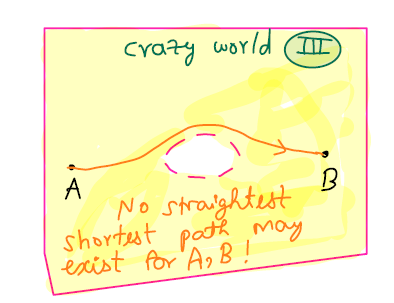
Let us see the second postulate: We believe that it does. We believe that the postulates of Euclid hold good in the real material world. Take two points. We can always draw one and only one straight line between them. Seems legit. But what about the first postulate? A straight line can be extended indefinitely? What makes us think that we can keep on expanding our straight line forever? We know that we can do it in our fantasy world of the infinite plane but the material world can be crazy! What excludes the possibility that if we keep on extending, we may hit a barrier and we cannot go further than that? What makes us think that our fantasizing abstraction of the “infinite plane” is indeed the world we live in when all we know is only a small portion of it?
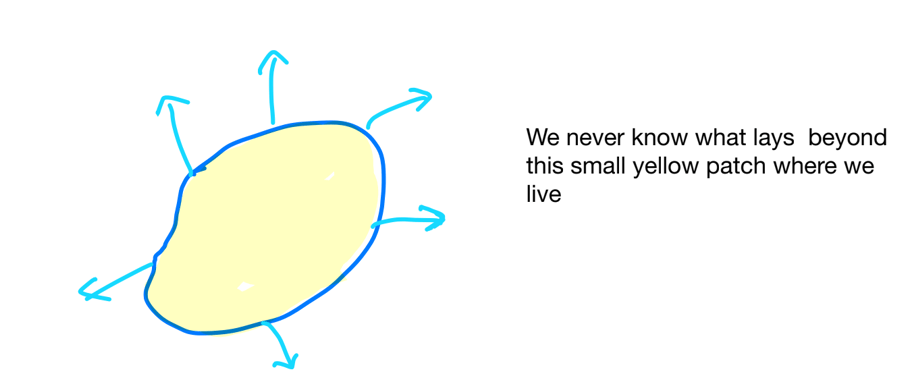
Although the possibility that the real world we live in is such a way that it has a boundary beyond which nothing can be extended sounds unnatural, it is not a logical impossibility!!
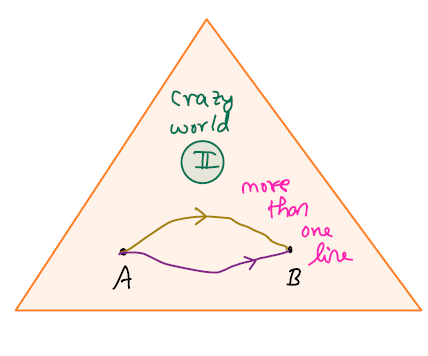
Postulate 2 of Euclid says that given any two distinct points, there exists a unique straight line segment joining them. Sounds legit as we said for the points that we can see. But if the real world were crazy and had exotic points, we can never be sure that this postulate 2 is true for all the points in the world. Keeping my ass in Chennai, and just because I find that given any two points in Chennai, there is a unique line segment joining the two points, it seems so proposterous and ignorant (although very natural) to suppose that it holds for all pairs of points in the entire world.
Next postulate 3: All right angles are equal. This needs a deeper explanation. It is in fact the strongest of all the assumptions that Euclid made although it does not seem so. What did Euclid mean when he said that all right angles are equal?
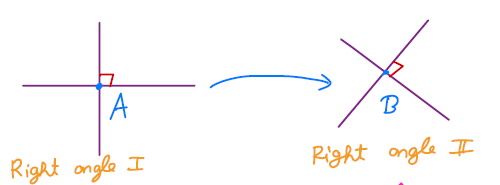
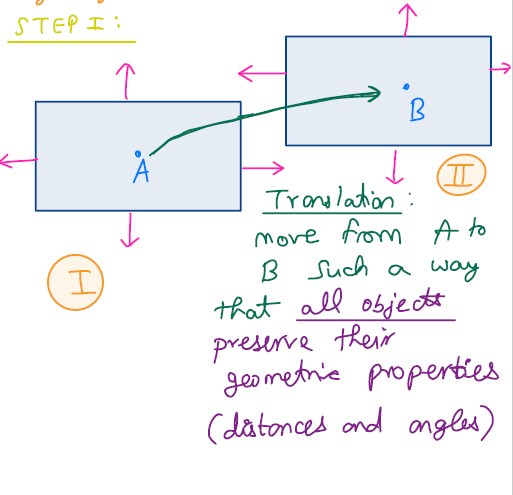
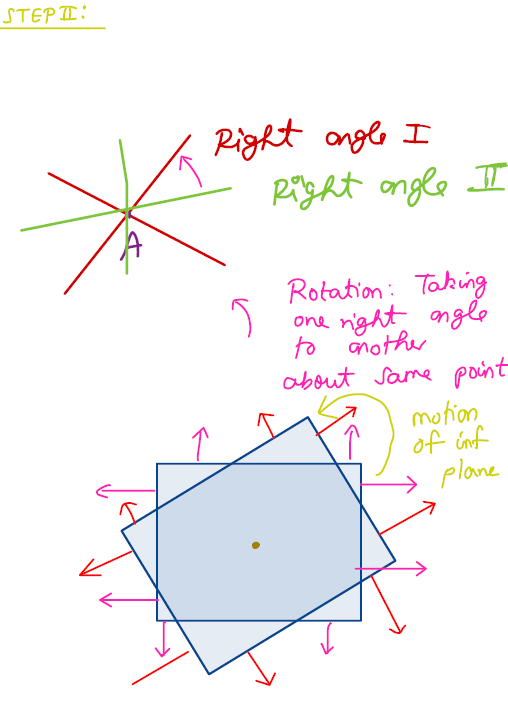
I told in Week 1 that it means the following: Any two right angles anywhere in the plane can be obtained from each other by “translation” and “rotation”. But what is a translation or rotation? We see that on the deepest level, they are correspondences between points in the plane that preserve distances and angles. Such a transformation between points in the world that preserve distances and angles are called technically as “isometries“. So what this postulate says is that given a right angle at point A, and another right angle at point B, there is an isometry taking A to B and that which also takes the right angle from A also to the right angles of B. That part of the isometry that moves between points is called “translation”. And that which takes one right angle to another at the same point is called “rotation”. This actually is very deep. It says that the world is “homogeneous” and “isotropic” on the geometric level at least. That is, the world looks the same around every point looks the same and in every direction. Certainly counterintuitive because it is hot at Chennai and freezing cold at Russia. Also next to my left, I see my genius eccentric friend busily typing in his desk whereas to my front, I see a lifeless piece of wall. The world seems different from point to point and from direction to direction. But what Euclid is trying to say is that it is same geometrically. The notions of hot and cold, living and non living, are not geometric notions. What Euclid is saying is that using measurement of distances and angles, one cannot distinguish between two points. Chennai may be hot and Russia may be cold but I can not see sum of angles of a triangle in Chennai adding to 

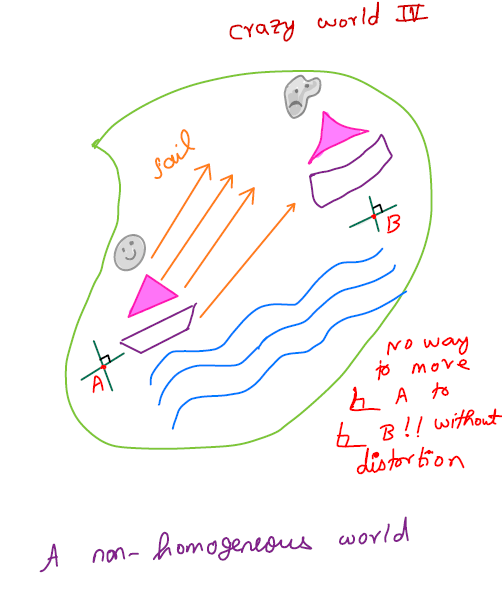
But what if we lived in a world where it were not so? How would it look like if we were given a triangle here, and when we try to move it, it becomes distorted no matter in whatever manner we try to move all its points. i.e. We can never find a distance and angle preserving correspondence between all pairs of points. What if I take a triangle and keep it in my boat and sail all points on the boat in the same direction, only to find that after I reach Russia, the sides and angles of the triangle in the boat is distorted? It sounds like a crazy world to live in but it is a logical possibility if we assume the violation of Euclid’s third postulate!! Of course the sanctity of geometry would be lost but nevertheless we have to accept it as a logical possibility if we rule out the third postulate!
Now comes the fourth postulate: Given any point and any radius, I can draw a circle whose centre is the given point and whose radius is the given radius. In other words, I can keep finding points that are arbitrarily far away from any given point. Again. How? Why in the real world? We will soon see that it is not obviously true given that we live in the Earth which is the surface of a sphere.
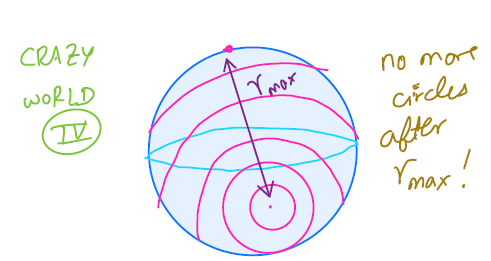
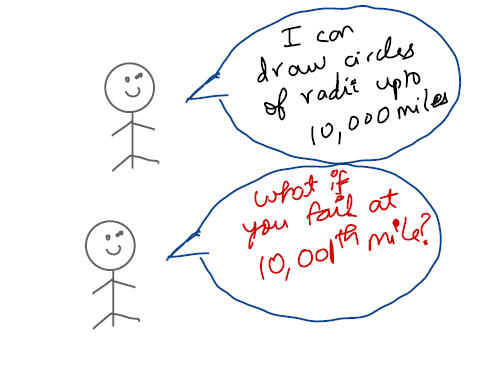
We may think that I can draw a circle of radius 100 miles and 1000 miles about Chennai. But what Euclid claims is more. Given any real number how large, whether million or trillion or a zillion miles or beyond any imaginable limit, we should be able to draw a circle of that corresponding radius. Again we underestimated the power of the statement “given any positive radius” . It is not enough if you check for upto 1000 miles or 10000 miles or 100000 miles. No finite number however large is ever enough. We can never verify this postulate in practice even if it holds as our human memory can do only finite number of steps. So again this is a very non trivial postulate.
Next comes the fifth postulate whom everyone was not having a contention with. Out of all the postulates, somehow for 2000 years, only the fifth postulate seemed unnatural. That too it was not unnatural because Euclid assumed it to be true. It was unnatural as an axiom rather than a theorem. Still people wanted to prove it. They thought only the fifth postulate was least natural whereas as we saw that on a deeper level, all of Euclid’s postulates are very powerful, non-trivial and involve several unjustifiable or even unverifiable assumptions about the world .
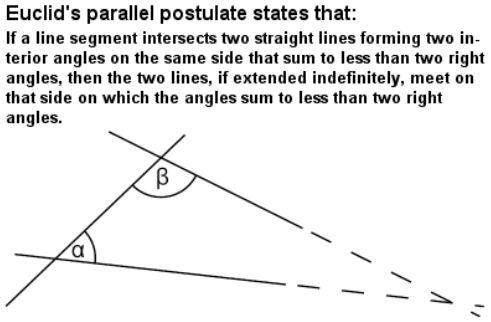
Now, in this course, for the sake of relativity, we would have to abandon all these assumptions as these are all too powerful. But people did not realize that while Euclidean geometry seemed natural, the very world they lived in was a sphere and it did not obey Euclidean geometry. People took that long to realize that while Euclidean geometry reigned supreme, there was a non Euclidean geometry right under their nose and sitting right in front of them.
EARTH IS A SPHERE—-
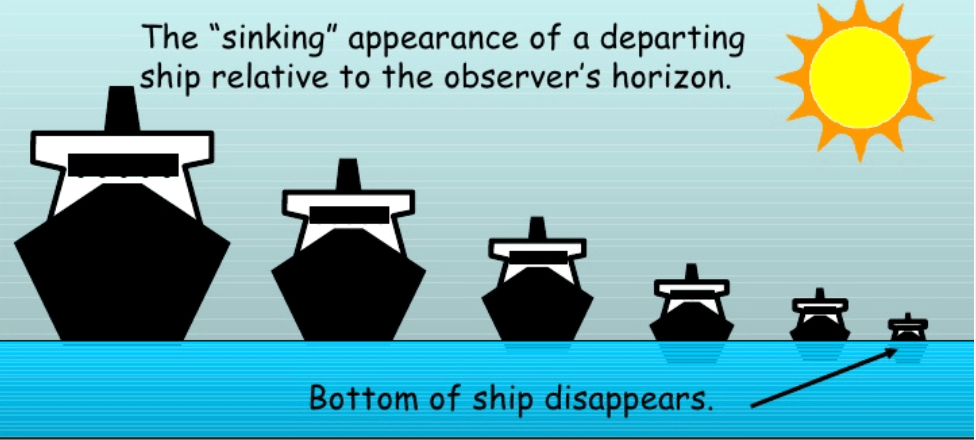
The ancient Greeks realized that the surface of the earth was a sphere rather than a plane. The standard story is that if the Earth were flat, then a ship sailing into the horizon would disappear uniformly but the actual fact is that the mast disappeared in different time than the hull.
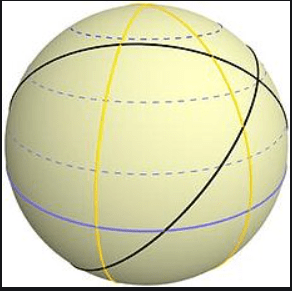
Now that Earth is a sphere, this is our plane now. Certainly not the infinite plane but this sphere shall be the object of our new geometry. Points on the surface of the sphere seems conceivable. But what are lines on spheres? What is a straight line on the sphere?
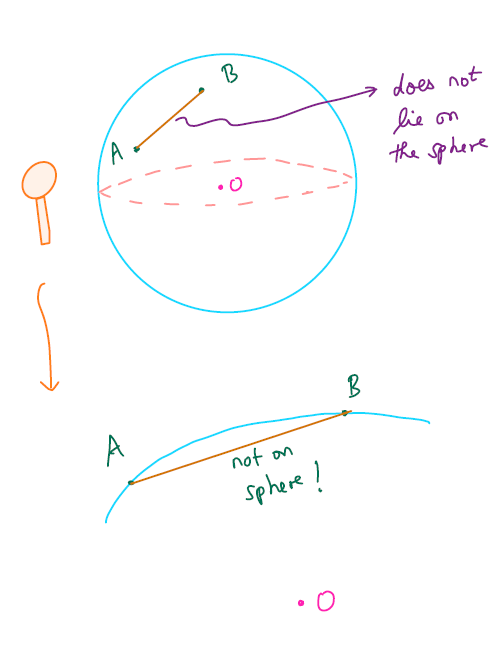
Take two points A and B on the sphere. Forget the sphere. If not for the sphere, the straight line in the space should be the straight line joining A and B. But alas, that straight line in space joining A and B has points that are not on the sphere and hence it cannot be a “straight line on the sphere“. Neverthless we can make that straight line as a guide to forming the straight line on the sphere
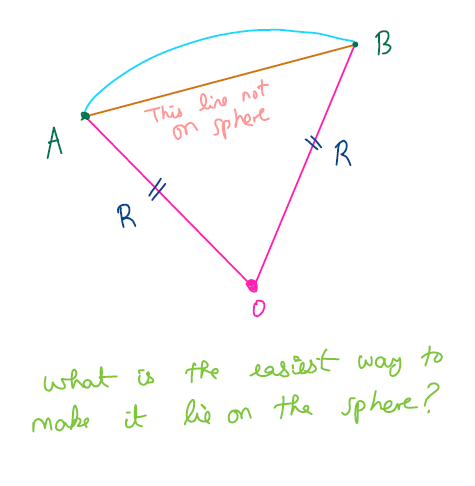
The characteristic feature defining a point on the sphere is that its distance from the centre point should be fixed, say 
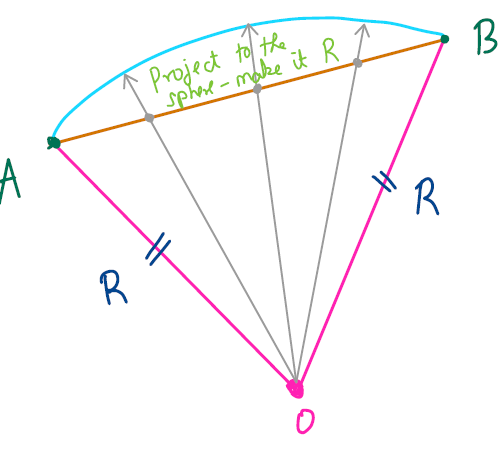
Such a curve is called a GREAT CIRCLE on sphere and should be regarded the straight lines in sphere since that is the closest we could get to a straight line on the sphere!! We also realize that the great circle arises when we intersect the plane passing through OAB with the sphere! So great circles are the intersections of the sphere with planes in space passing through the centre of the sphere.
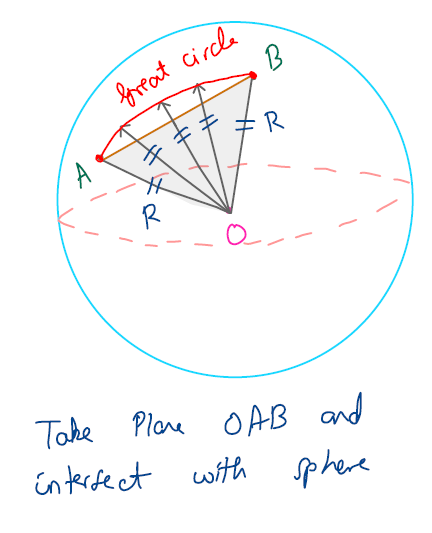
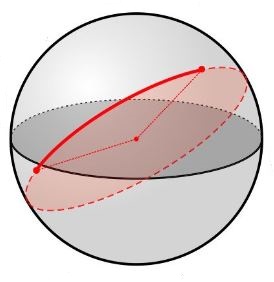
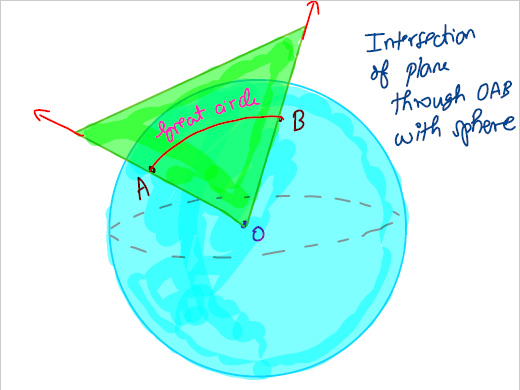
So now do we have Euclid’s first postulate true? Yes. We can keep on extending the great circle to complete the full circle in the OAB plane and keep going. A straight line can be extended uniquely into an indefinite segment no doubt but it is peculiar that after a while, when we extend, we come back to where we started!
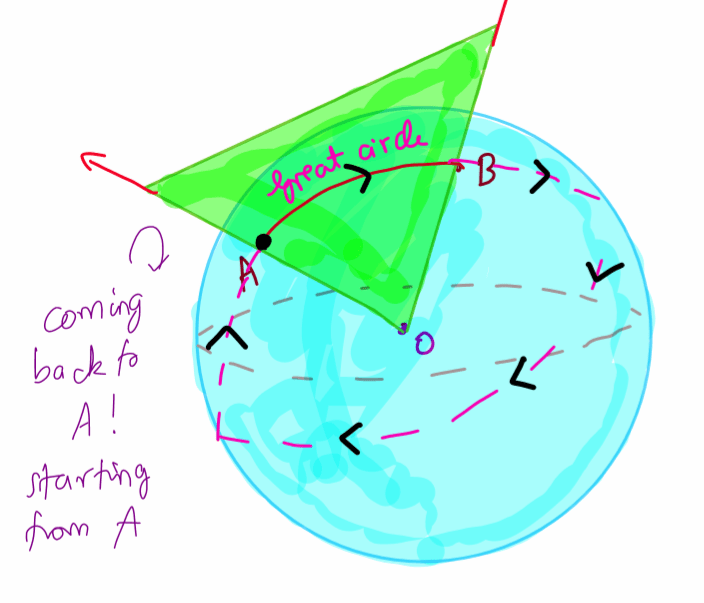
By definition, the extension is unique as there is only one circle lying in the plane OAB that extends the circular arc AB. The arc AB is circular as they are all same distance from O.
Let us try second postulate. Always there exists a straight line between points A and B as there is always a plane that contains OAB and intersects with the sphere. But is the plane containing O,A,B always unique always? Think?
If OAB are collinear, there are many planes (infinitely many) that contain OAB. This happens when A and B on sphere are diametrically opposite. Then we have infinitely many great circles joining A and B as shown below. So certainly in this case it is not unique.
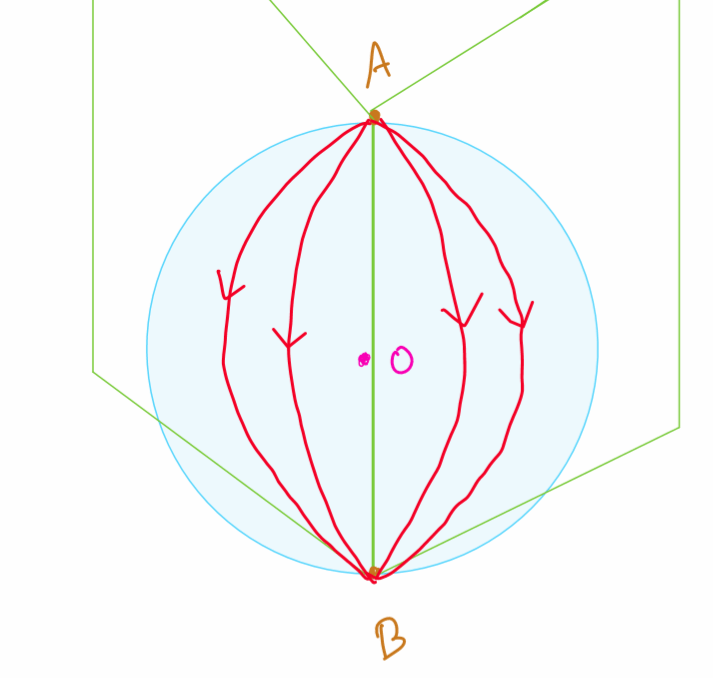
So the second postulate of Euclid already screws up with!
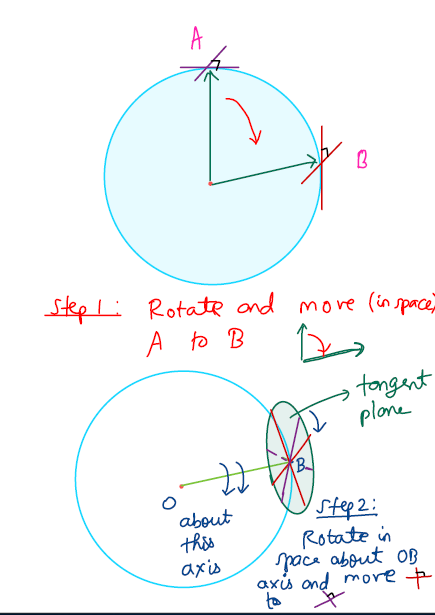
Certainly the third postulate holds as sphere appears to be a symmetric object. Note that when we rotate about any axis passing through the origin in space, points that are on the sphere remain on the sphere.
So translations on sphere = rotations in space about an axis passing through origin
Rotation about the point A on sphere = rotation about the axis OA (as axis is fixed, A is fixed)
As there is rotation taking any line to any other line in the space, (our experience) there is a translation that takes any point to any other point on the sphere. Similarly, as we can rotate from any orientation to any orientation about the same point in the ambient space, we have that we can rotate from any orientation to any other in the sphere also. (Note that angle between lines is defined as the angle between the tangents)
So Euclid’s third postulate definitely holds!!
Now comes the fourth postulate! Given any centre and any radius 


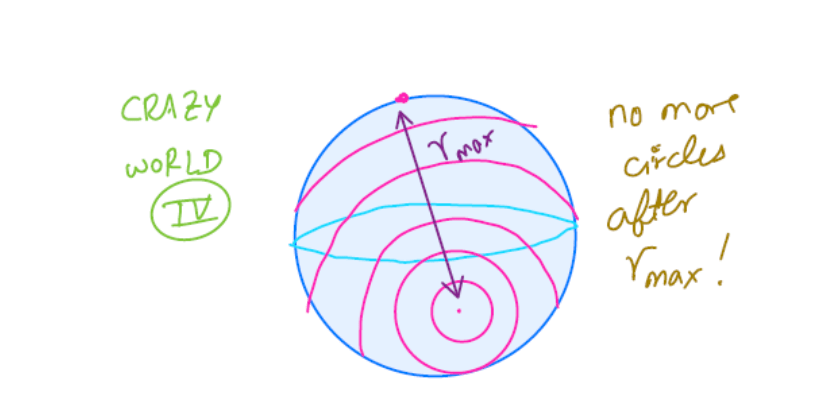
Next obviously fifth postulate does not hold because there do not exists parallel lines at all in this geometry!
If we go by Euclid’s definition that parallel lines are those which do not intersect how much ever extended, here we find that any two great circles intersect at two points!!
Let arc OAB and arc OCD be two great circle segments connecting points A,B and C,D. Then the planes OAB,OCD intersect in a line passing through the origin. Then any line passing through the origin cuts the sphere in two diametrically opposite points. So, we have that there are always two common points on any two of the great circles!!
So given a great circle and a point not on the great circle, vacuously, since there are no parallel lines, there will be no parallel line passing through the point as well. So the fifth postulate is violated as it states that there exists a unique parallel passing through the point:
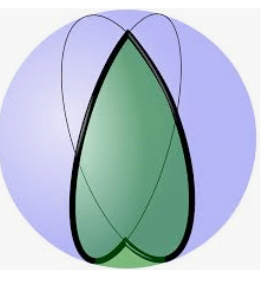
NOTE: We are using Playfair’s version of the fifth postulate. We showed that only under the validity of the first four postulates, is the fifth postulate equivalent to the Playfair’s version. But since here the first four postulates also do not hold, we cannot claim the equivalency of all the versions of the fifth postulate!
So, for example, the original version of Euclid’s fifth postulate will trivially hold as any two lines meet no matter whatever the sum of two angles subtended with another line are. So here the original version of Euclid’s fifth postulate holds but Playfair’s version does not hold.
Having commented about the validity of the postulates let us derive what this peculiar geometry has to offer!!
We can define triangles in the same way as the Euclidean case and triangles are the most fundamental and the most extensively studied objects in Euclidean geometry and any polygon can be decomposed into triangles. One central result in Euclidean geometry is that the sum of three interior angles of a triangle is
First of all we note that the sum of angles of a triangle is not
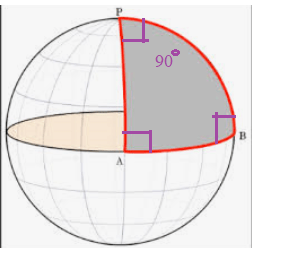
This triangle if you observe has all angles as right angles and hence has angle sum as 270 degrees!! So triangles in a sphere have more angle sum than in Euclidean plane. It turns out that the angle excess over 180 degrees is larger for bigger triangle and it is proportional to the area. There is this remarkable theorem that for a sphere of radius 1, the angle excess of any triangle over 180 degrees is exactly the area of its interior!! So, the angle excess is proportional to the area enclosed by the triangle!
Girard’s Theorem: The angle excess of a spherical triangle in a unit sphere is equal to its area! i.e.

Proof:
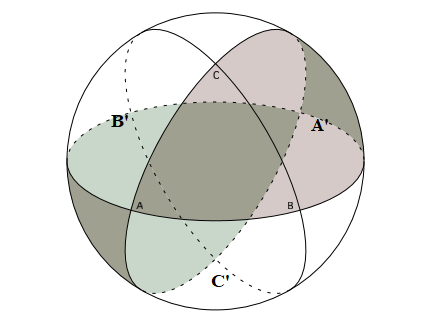
Before that, let us prove an intermediate result that calculates the area of the region between the great circles:
Def: A spherical lune is the region formed by intersection of two great circles. Their angle of intersection is called the lune angle 
Lemma: A lune of angle 

Visual proof of Lemma:
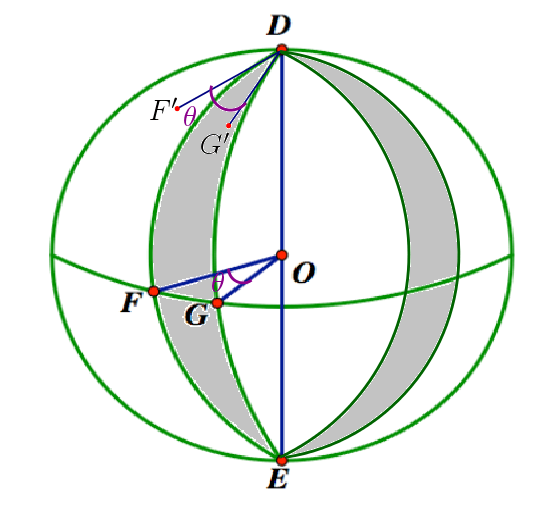
Now, we have that the portion of angle in the sphere subtended by the two lunes together is 
So the fraction of area of the sphere is also the same 


Proof of Girard’s theorem:
Look at the diagram in the theorem statement and carefully observe the lune pairs formed by angles A,B,C respectively. Then if we take all the lune pairs, they cover the sphere but the spherical triangle and its antipode area alone is covered 3 times which is 2 times each more than needed to cover the sphere which is 4 times the area of triangle ABC. So, we have


Therefore,
Now, for a sphere of radius R, you can verify that

So we see that this angle defect is pronounced only when the area of the triangle is large. Which is why we don’t see it for triangles drawn on our city or on the site of our house because such figures occupy a ridiculously small area compared to the square of the earth’s radius.
CONSEQUENCES OF GIRARD’S THEOREM:
1. There is no perfect map of any small region of the earth!!
If a small part of the earth were mapped to the small part of the plane (which is what maps do) exists, then distances and angles are preserved (which maps are supposed to). Then straight lines on sphere (great circles) get mapped to straight lines on the plane (as geometry should be preserved in a perfect map).Then triangles go to triangles. And as the angles are preserved, then the interior angles are same also. But this is a contradiction as sum of interior angles of a triangle is 180 in plane whereas it is more than 180 in a sphere, no matter how small it is. It is 180 only approximately when area is small. So no map is perfect! To illustrate this, consider the map below:
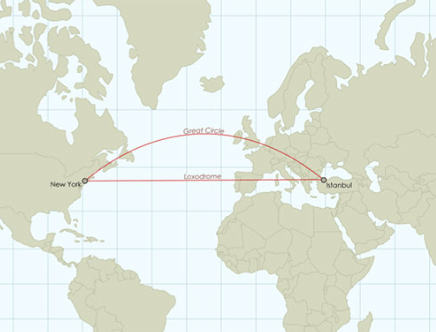
Any map has to distort distance/angle. In normal maps, a Mercator projection is employed that preserves angles but distorts distances. We have to compromise somehow.
No map can be perfect because the geometry of the sphere is intrinsically drastically different from that of the plane and one simply cannot represent it in a plane! So all atlases are bogus. They are only approximate. Only a globe can be trusted!
2. You can never wrap a spherical ball with a sheet without wrinkles!
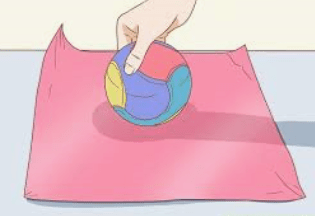
Again, wrapping sheet is a plane and it cannot simply go into a sphere without distortion.

3. You can never flatten an orange peel without tearing it!
Again orange peel section is a sphere whereas flattening it makes it planar. Once cannot do this without distorting the geometry and preserving distances and angles.
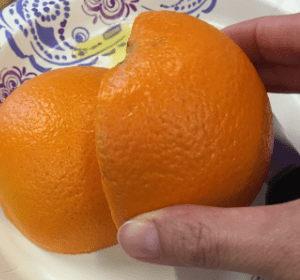
Think of more such examples!!
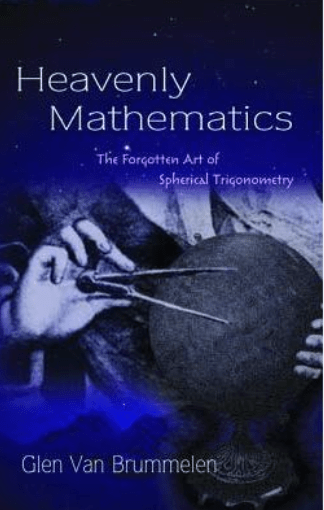
For getting a feel of how other properties of spherical triangles, and get inspired into the glory and tale of this art of spherical trigonometry, do refer to this inspiring book below:
The following is an excerpt from the preface of the book which should inspire you:
Also you should see that as the radius of the sphere tends to infinity, the results of spherical geometry approach that of planar geometry. Euclid’s original 5 postulates are closer and closer to being realized:
P2: There exists a unique straight line joining any two points: The only place where the problem happens is the “antipodal points”. But diametrically opposite points get farther apart and hence the troublesome pair of points to the points in any given region gets farther apart as radius increases
P4: As maximum possible radius of the circle that can be drawn in a sphere is $\pi R$, it increases as
P5: There are now parallel lines in the limit. Given a great circle and a point not on it, we can draw another great circle such that it is perpendicular to the perpendicular of the point to the given great circle. This can meet the given great circle only at the antipodal opposite image which drifts farther apart as
So in the limit of 
Some of properties of spherical triangles below:
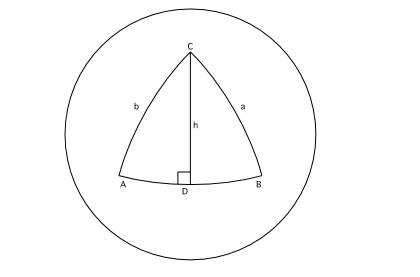

Now when sides are very small, 


Simplifying, we get the celebrated cosine rules for normal triangles in the plane,

Thus we see that why our Euclidean fantasy worked nicely in our house or the city as we dealt with small objects.
I would urge the reader to look up the book I recommended above and take up spherical trigonometry rigorously. Atleast let us learn that with proper motivation and intuition and rigor unlike how we learnt plane trigonometry in school by blind manipulations and formulae. We will also end up learning plane trigonometry as when radius tends to infinity, sphere approaches the plane!
Happy Reading! See you next week!
And mind you, all of these play an important role in relativity. See you next time with another kind of geometry that is opposite to this geometry. Where given a line and a point not on the line, instead of NO parallels, we will have many parallels!!! Let us discover that brand new word which Bolyai said he had discovered. And some more insights on some aspects on geometry: from local to global!!
GAUSS and SPHERICAL GEOMETRY – HISTORICAL NOTE:
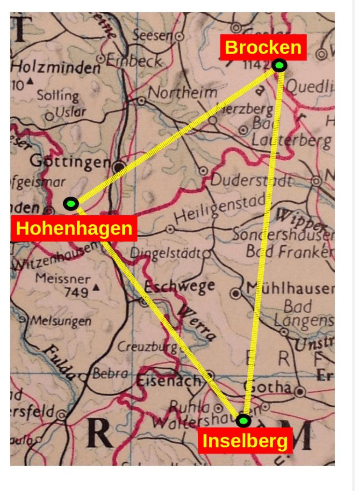
In the 1820s Carl Friedrich Gauss carried out a surveying experiment to measure the sum of the three angles of a large triangle. Euclidean geometry tells us that this sum is always 180º or two right angles. But Gauss himself had discovered other geometries, which he called non-Euclidean. In these, the three angles of a triangle may add up to more than two right angles, or to less. Using his new invention, a surveying instrument called a heliotrope, Gauss took measurements from three mountains in Germany, Hohenhagen, near Göttingen, Brocken in the Harz Mountains and Inselberg in the Thüringer Wald to the south. In his survey of Hannover, Gauss had used these three peaks as “trig points”. The three lines joining them form a great triangle with sides of length 69km, 85km and 107km. The angle at Hohenhagen is close to a right angle, so the area of the triangle as close to half the product of the two short sides, or about 3000km². Gauss assumed that light travels in a straight line. His sightings were along three lines in space.
 Understanding Einstein in 52 Weeks!!